

The Largest Religious Groups in Southeast Asian Countries
Buddhism is the most common religion in Southeast Asia.

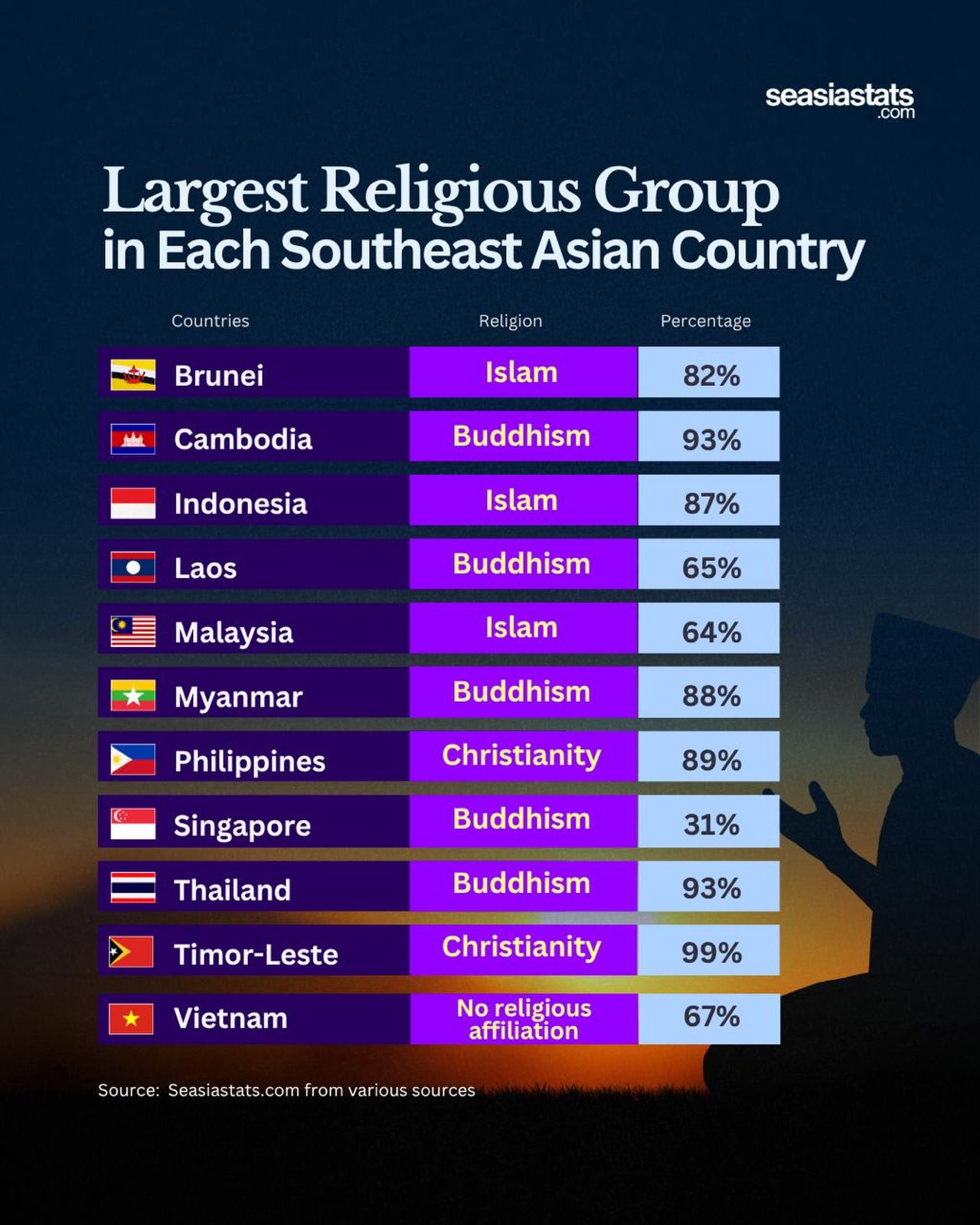
Southeast Asia is a culturally diverse region where religion plays an important role in shaping people's beliefs, traditions, lifestyles, and national identities. Each country has its own religious landscape, influenced by historical events, cultural exchanges, and social developments.
Although the region is home to many religions, certain religious groups form the majority or the largest portion of the population in each country.
In Brunei, Islam is the dominant religion, representing approximately 82% of the population. It strongly influences the country's laws, culture, public celebrations, and daily life.
Cambodia, on the other hand, is predominantly Buddhist, with around 93% of its population following Buddhism. Buddhist temples and monks are important parts of Cambodian society, and Buddhist teachings influence traditional ceremonies and community values.
Indonesia, the largest country in Southeast Asia by population, has approximately 87% of its people practicing Islam. Islam has a significant influence on Indonesian culture, although the country is also home to Christians, Hindus, Buddhists, and other religious communities.
In Laos, Buddhism is practiced by about 65% of the population. Buddhist traditions are closely connected to Lao culture, particularly through temple activities, religious festivals, and ceremonies.
Malaysia has an estimated 64% Muslim population, making Islam the country's largest religious group. Islam influences Malaysian traditions and national identity, while Christianity, Hinduism, Buddhism, and other beliefs also contribute to its multicultural society.
Meanwhile, Myanmar has approximately 88% Buddhists. Buddhism is deeply rooted in Myanmar's cultural heritage, with monasteries, pagodas, and religious practices playing prominent roles in everyday life.
In the Philippines, Christianity is the largest religious group, representing around 89% of the population. Christian beliefs, particularly Roman Catholicism, influence festivals, family traditions, and public celebrations.
Singapore presents a different religious landscape, with Buddhism being the largest single religious group at approximately 31%. Its diverse population also includes Christians, Muslims, Hindus, Taoists, and people without religious affiliation.
Thailand is another predominantly Buddhist country, with approximately 93% of its population practicing Buddhism. Buddhist temples and religious festivals are central to Thai cultural traditions. In Timor-Leste, Christianity represents about 99% of the population, with Roman Catholicism being especially prominent in national identity and community life.
Finally, Vietnam differs from many of its neighbors because approximately 67% of its population is reported to have no religious affiliation. Nevertheless, ancestor worship, traditional spiritual practices, Buddhism, and other beliefs remain influential in Vietnamese culture.
Overall, Southeast Asia demonstrates remarkable religious diversity, reflecting the region's rich history and cultural heritage.