

The Latest US Tariffs on 7 ASEAN Countries
The United States just imposed new tariffs on seven Southeast Asian countries.

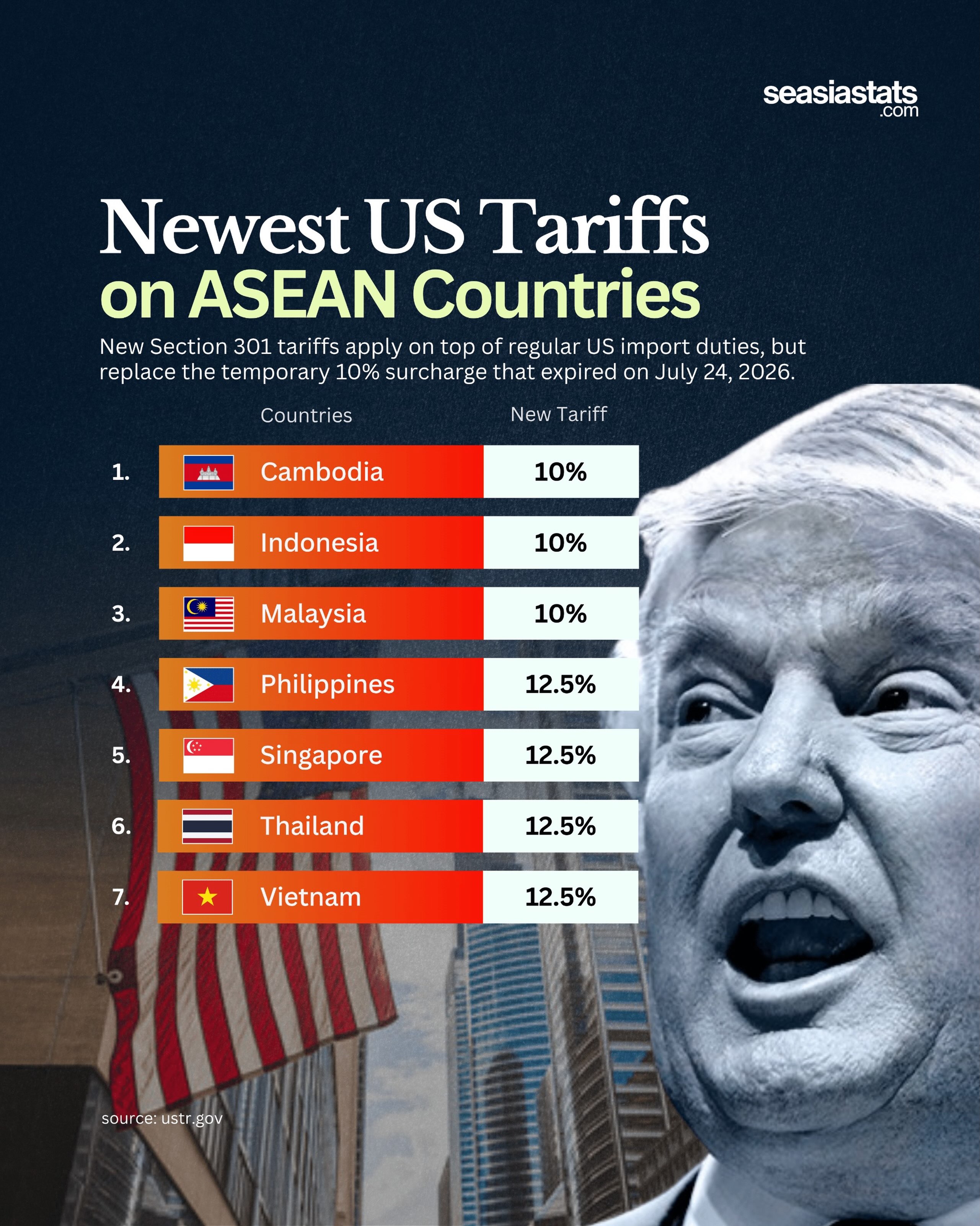
The United States has introduced a new tariff framework for imports from dozens of trading partners, replacing the temporary 10% global levy that expired on 24 July 2026.
Under the revised policy, seven Southeast Asian countries are now subject to country-specific tariffs, with Cambodia, Indonesia, and Malaysia facing a 10% tariff, while the Philippines, Singapore, Thailand, and Vietnam are subject to a higher 12.5% rate.
The measures are part of a broader U.S. trade initiative targeting 60 economies over concerns related to the enforcement of forced labor regulations in global supply chains.
The new tariff structure reflects Washington's effort to differentiate trading partners based on its assessment of their labor enforcement policies.
Countries assigned the 10% rate are viewed as having taken comparatively stronger steps or maintained frameworks that align more closely with U.S. expectations, while those receiving the 12.5% tariff are considered to require further progress.
Although the difference between the two rates is relatively modest, it may still influence sourcing decisions, export competitiveness, and investment flows across Southeast Asia. For exporters, the policy introduces a new layer of cost when selling goods to the U.S. market.
Industries such as electronics, textiles, furniture, footwear, and manufactured products—key export sectors for many Southeast Asian economies—could experience varying degrees of impact depending on product exemptions and the ability of businesses to absorb or pass on the additional costs.
Some strategic products, including selected technology goods and other exempted categories, are expected to remain outside the scope of the new tariffs.
Regional governments have responded cautiously, emphasizing continued engagement with Washington while seeking to preserve trade competitiveness. Malaysian officials welcomed the relatively lower tariff rate compared with the 12.5% level imposed on several neighboring countries but indicated that negotiations with the U.S. would continue.
Other affected governments have reiterated their commitment to labor standards and expressed hopes of strengthening bilateral trade ties.
While the tariff adjustments are less severe than some earlier proposals, analysts believe they could reshape supply chains by encouraging companies to reassess manufacturing locations and sourcing strategies.
Businesses operating across ASEAN may increasingly evaluate tariff differentials when making future investment decisions. As negotiations continue and countries seek to demonstrate stronger compliance with labor standards, the new tariff regime is likely to remain an important factor influencing U.S.–Southeast Asia trade relations in the months ahead.