

The Military Drill Command "Attention" Across Asia
How do Asians say "attention" for military drills?

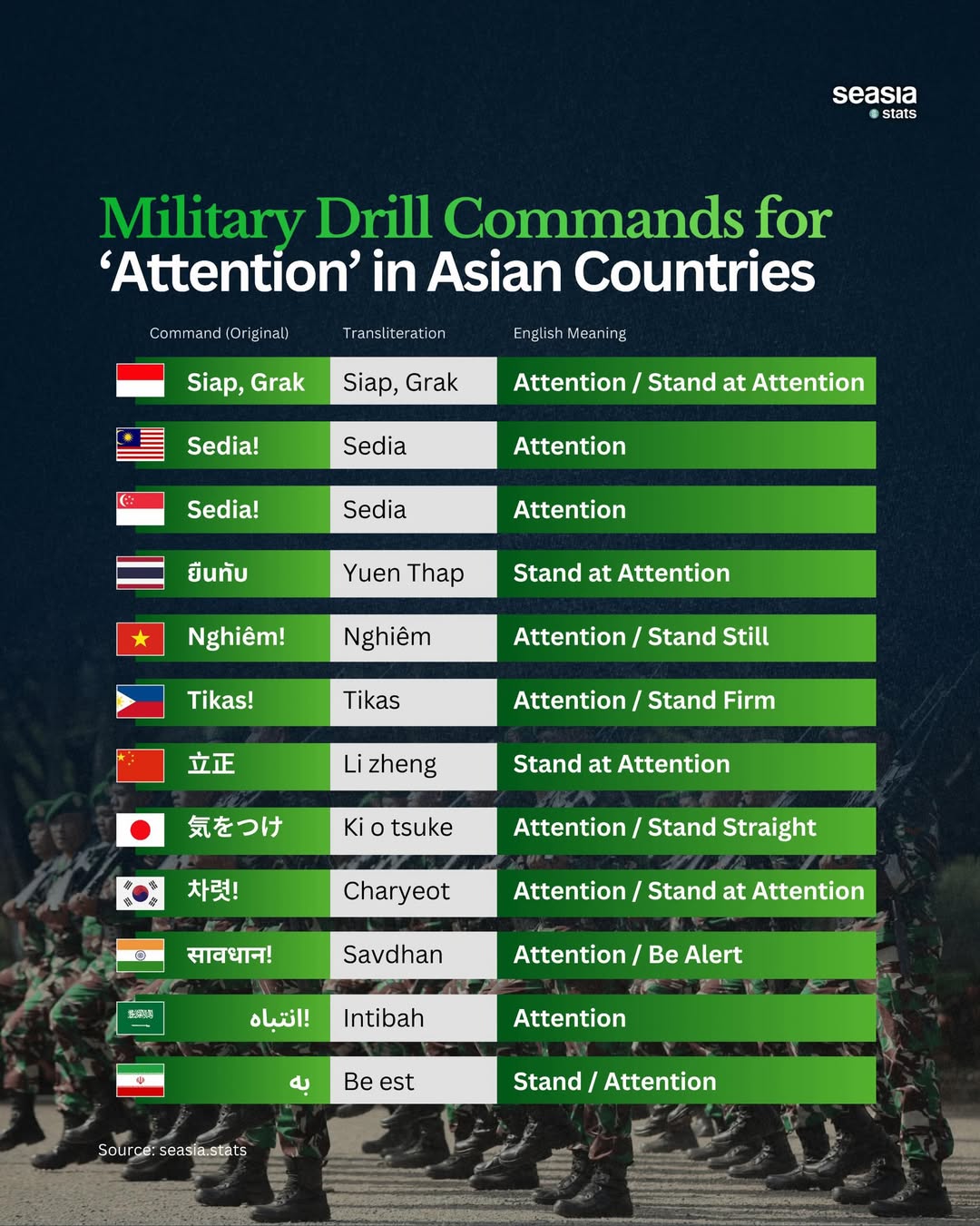
Military drill commands are an essential part of armed forces training and ceremonial traditions worldwide. One of the most fundamental commands is “attention,” which requires personnel to stand upright, remain silent, and focus completely on the commanding officer.
Although the purpose of the command is universal, the wording differs across Asia, reflecting the region’s rich linguistic and cultural diversity.
In Indonesia, the command for attention is “Siap, grak!” Soldiers immediately assume a rigid standing posture with their eyes forward and hands positioned alongside their bodies. The command is widely used not only by the military but also by police, cadet organizations, and schools during flag ceremonies.
Malaysia and Singapore use the Malay command “Sedia!” Both countries inherited many military traditions from the British era while adapting them to local languages. The command remains a cornerstone of military drills, parades, and ceremonial events.
Thailand uses the command “Yuen thap,” while Vietnam employs “Nghiem.” These commands serve the same purpose of bringing troops into a state of readiness and discipline. They are commonly heard during military training, inspections, and national ceremonies.
In the Philippines, the command “Tikas” is used to call soldiers to attention. Derived from local military traditions, it remains an important element of drill and ceremony within the Armed Forces of the Philippines.
China’s military uses “Li zheng”, a command that literally means “stand upright.” It is one of the most recognizable commands in the People’s Liberation Army and reflects the emphasis on precision and discipline in Chinese military culture.
Japan’s Self-Defense Forces use “Kiotsuke,” a term familiar to many Japanese citizens through school activities and martial arts training. Similarly, South Korea uses “Charyeot,” a command also commonly heard in taekwondo dojangs and educational settings.
In South Asia, India’s armed forces use the Hindi command “Savdhan,” meaning “attention” or “be alert.” The command was adopted after independence as part of efforts to replace many English-language drill commands with Indian terminology.
In the Middle East, Saudi Arabia uses the Arabic command “Intibah,” while Iran employs “Be est.” Both commands direct troops to assume the formal position of attention during military drills and ceremonial occasions.
Despite differences in language and pronunciation, these commands share a common purpose: instilling discipline, unity, and readiness. Across Asia, the command for attention remains a powerful symbol of military professionalism and collective identity, demonstrating how diverse traditions can serve the same fundamental objective.