

The Most and Least Well-Rested Countries in the World
The people of Vietnam claim to be the most well-rested, while the people of Ukraine claim the opposite.

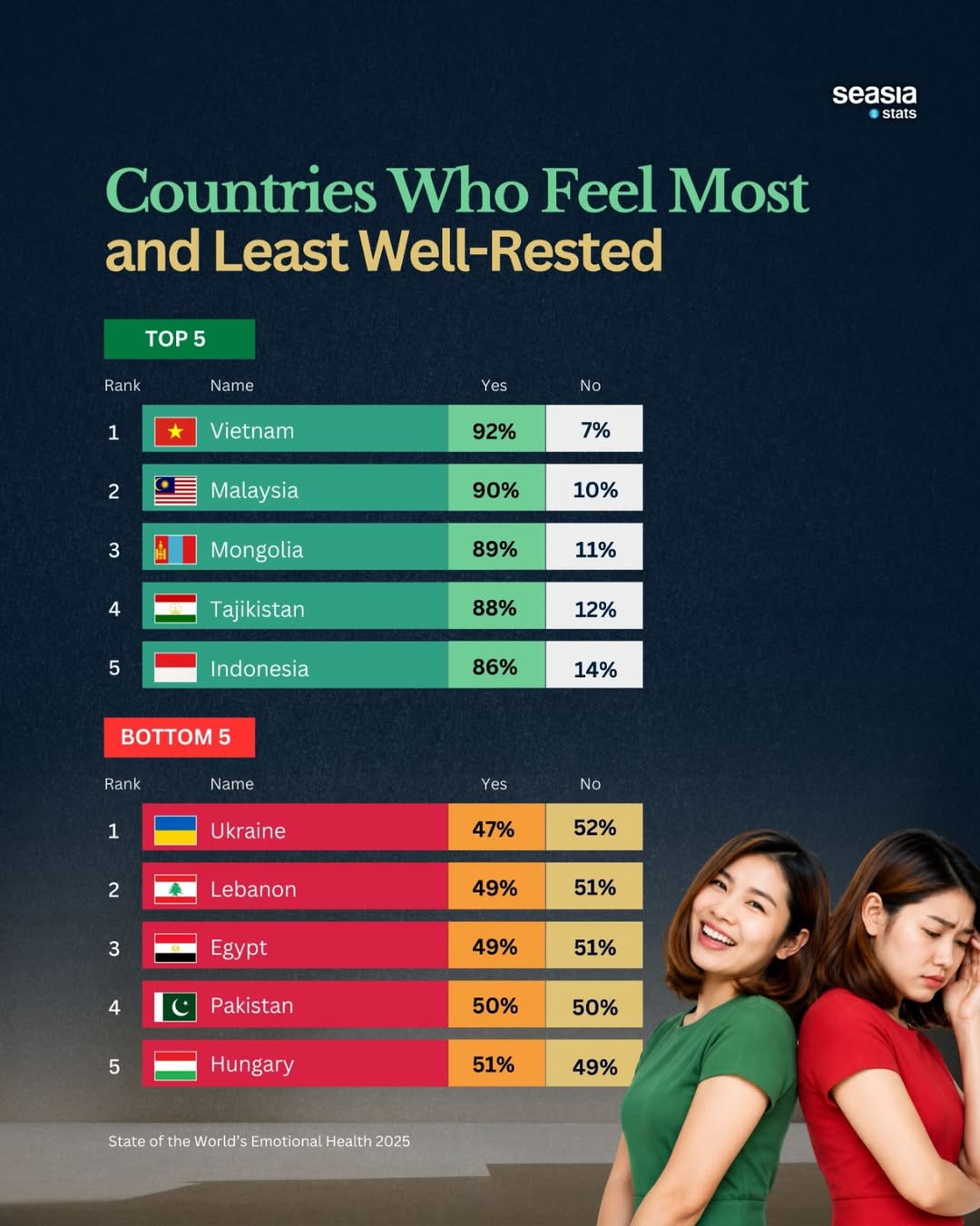
Getting enough rest is one of the most important factors for maintaining physical health, mental well-being, and overall quality of life. The State of the World’s Emotional Health 2025 report sheds light on how people around the globe perceive their level of rest by asking whether they felt well-rested the previous day.
The findings reveal significant differences between countries, highlighting how lifestyle, work culture, economic conditions, and social stability can influence sleep and recovery.
Among the world’s most well-rested nations, Vietnam ranks first, with an impressive 92% of respondents saying they felt well-rested. The country’s strong performance may reflect a combination of cultural habits, community-oriented lifestyles, and increasing awareness of health and well-being.
Close behind is Malaysia, where 90% of people reported feeling well-rested. Mongolia follows with 89%, while Tajikistan recorded 88%. Rounding out the top five is Indonesia, where 86% of respondents said they felt rested. These results suggest that many countries in Asia are achieving high levels of perceived rest despite rapid economic development and urbanization.
In contrast, the report identifies several countries where people are significantly less likely to feel well-rested. At the bottom of the ranking is Ukraine, with only 47% of respondents reporting that they felt rested. Ongoing challenges and uncertainty may contribute to elevated stress levels and reduced sleep quality.
Lebanon and Egypt both recorded 49%, meaning fewer than half of respondents in these countries felt well-rested. Economic pressures, social concerns, and daily stressors can have a profound impact on sleep patterns and emotional health.
Pakistan follows closely with 50%, while Hungary rounds out the five least well-rested countries at 51%. Although these nations differ greatly in geography, culture, and economic circumstances, the findings suggest that a substantial portion of their populations may struggle to achieve adequate rest on a regular basis.
The gap between the highest-ranked and lowest-ranked countries is striking. While more than nine out of ten people in Vietnam reported feeling rested, fewer than half did so in Ukraine. Such differences highlight the close connection between emotional well-being and everyday experiences.
Ultimately, the State of the World’s Emotional Health 2025 report demonstrates that rest is more than a personal habit—it is also shaped by broader social and economic conditions. Understanding these patterns can help policymakers, employers, and health professionals promote healthier lifestyles and improve well-being across populations.