

The Most Competitive Countries in 2026
Singapore is officially the most competitive country in the world.

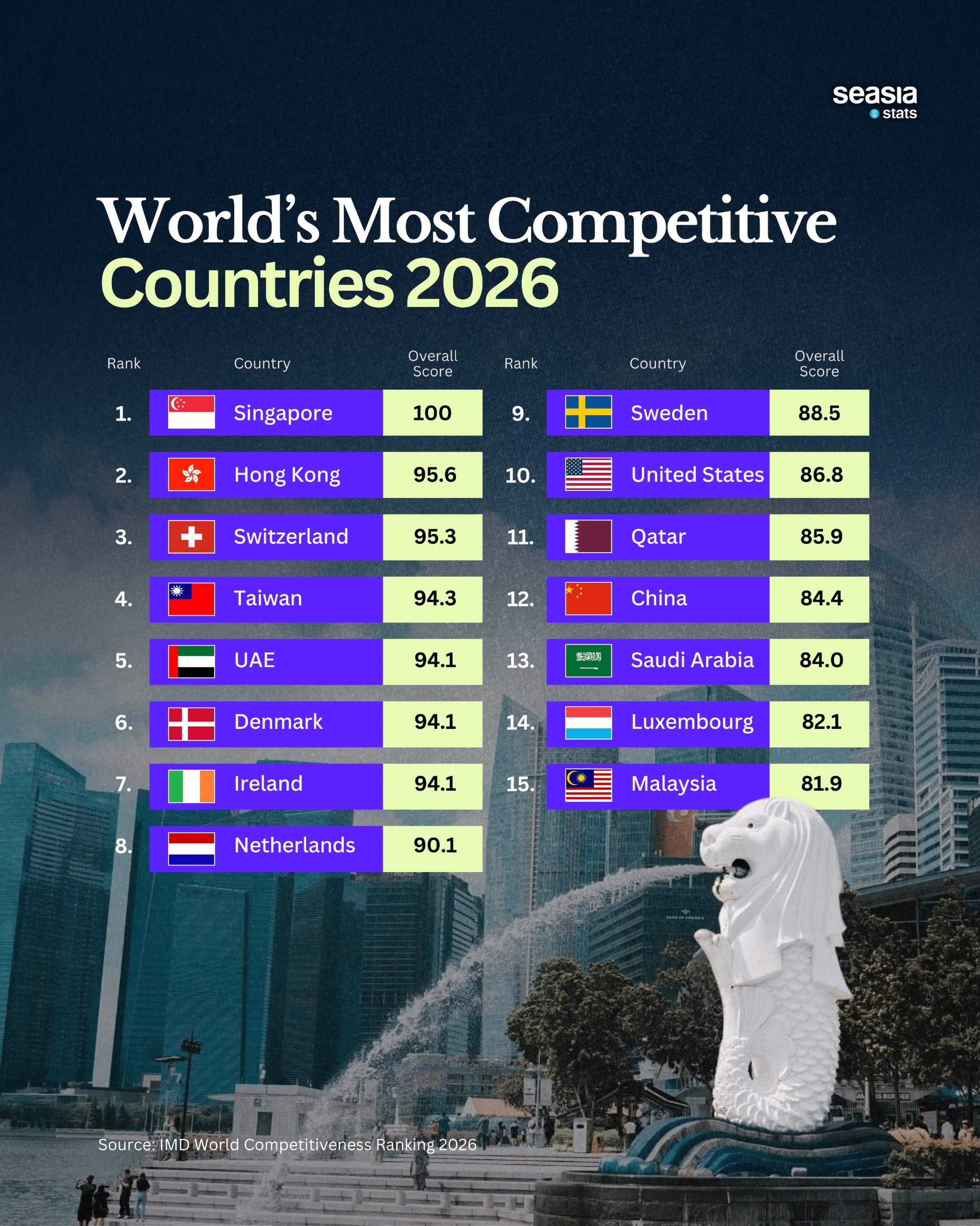
The IMD World Competitiveness Ranking 2026 highlights the economies that have demonstrated exceptional performance in creating environments that foster business growth, innovation, productivity, and long-term prosperity.
The ranking evaluates countries based on economic performance, government efficiency, business efficiency, and infrastructure, providing a comprehensive measure of national competitiveness.
Singapore leads the global ranking with a perfect overall score of 100, reaffirming its position as the world's most competitive economy. The city-state continues to excel through its strong governance, world-class infrastructure, business-friendly regulations, and commitment to innovation.
Hong Kong follows in second place with a score of 95.6, while Switzerland ranks third with 95.3, reflecting their resilient financial sectors, efficient institutions, and highly developed economies. Taiwan secures fourth place with 94.3, supported by its leadership in advanced manufacturing and technology.
The United Arab Emirates, Denmark, and Ireland share the next positions with identical scores of 94.1, highlighting their strong economic policies, competitive business environments, and high-quality public services.
The Netherlands ranks eighth with a score of 90.1, benefiting from its strategic location, advanced logistics network, and innovation-driven economy.
Sweden follows in ninth place with 88.5, recognized for its technological advancement, sustainability initiatives, and skilled workforce. The United States completes the top ten with 86.8, maintaining its global influence through innovation, entrepreneurship, and the world's largest economy.
Outside the top ten, Qatar ranks eleventh with 85.9, reflecting its continued efforts to diversify its economy beyond energy. China follows with 84.4, driven by its manufacturing strength, technological development, and expanding domestic market.
Saudi Arabia secures thirteenth place with 84.0, supported by ongoing economic reforms and investment under its Vision 2030 agenda.
Luxembourg ranks fourteenth with 82.1, maintaining its competitiveness through financial services and political stability. Malaysia rounds out the top fifteen with 81.9, demonstrating sustained progress in infrastructure, manufacturing, digital transformation, and investment attractiveness within Southeast Asia.
The 2026 rankings underscore that competitiveness extends beyond economic size. Countries that prioritize effective governance, innovation, digital transformation, infrastructure, and business efficiency continue to outperform their peers.
As global economic conditions evolve, these leading economies provide valuable examples of how strategic policymaking and investment can strengthen resilience, attract investment, and support sustainable long-term growth.