

The Most Dangerous Countries to Drive in
According to WHO, these countries are the most dangerous for drivers.

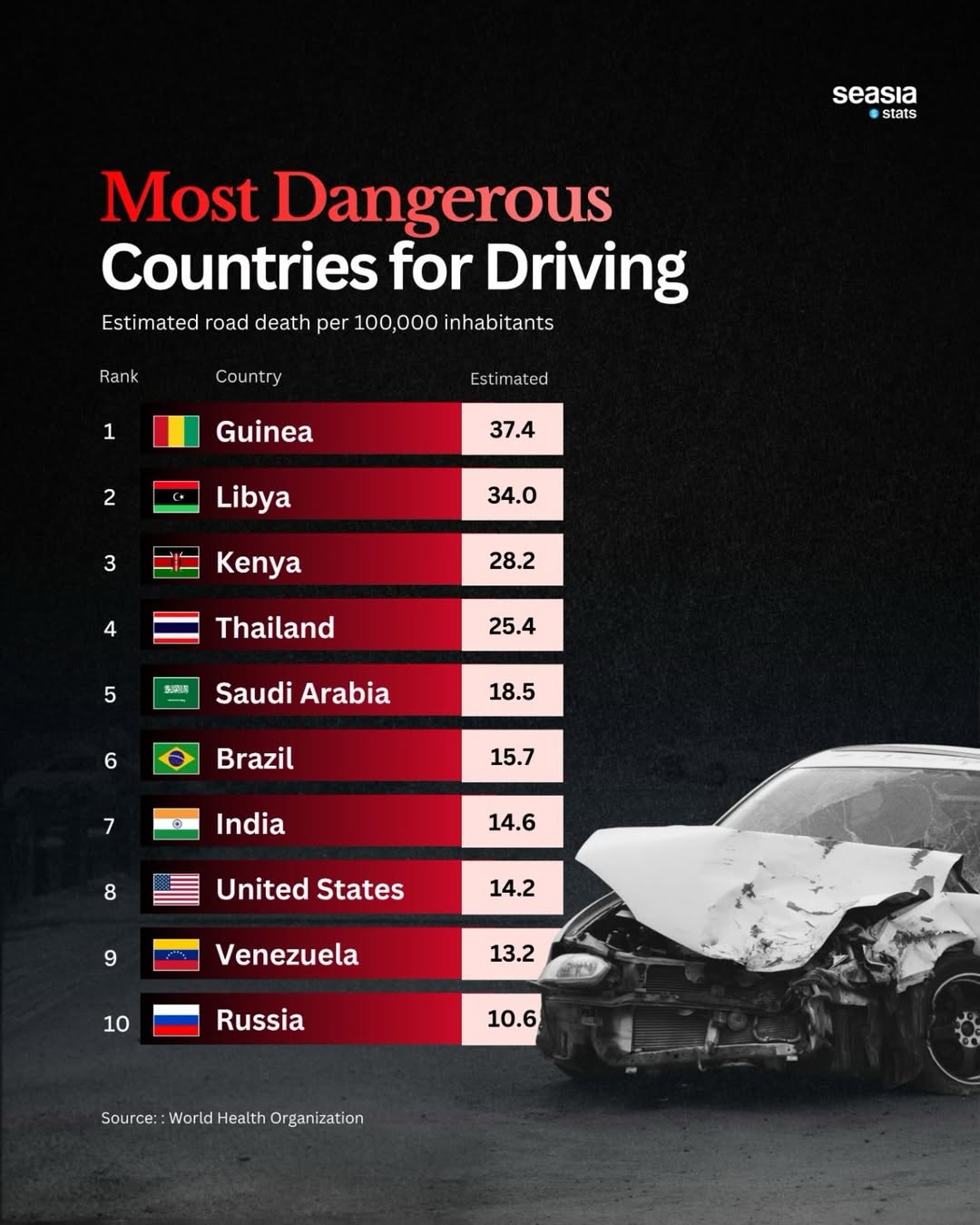
Road safety remains a major global challenge, with road traffic accidents claiming more than a million lives every year.
According to data from the World Health Organization (WHO), some countries experience significantly higher road traffic death rates than others, reflecting differences in infrastructure, law enforcement, vehicle safety standards, and driving behavior.
The following countries rank among the most dangerous places to drive based on estimated road traffic death rates per 100,000 inhabitants.
At the top of the list is Guinea, with a road traffic death rate of 37.4 per 100,000 people. Poor road conditions, limited traffic enforcement, and inadequate emergency response systems contribute to the country's high fatality rate.
Following closely is Libya, where the rate stands at 34.0. Years of political instability and damaged infrastructure have created hazardous driving conditions across much of the country.
Kenya ranks third with 28.2 deaths per 100,000 people, highlighting ongoing challenges related to road safety, speeding, and enforcement of traffic regulations. Thailand follows with a rate of 25.4, a figure often linked to the country's high number of motorcycle users and frequent road accidents involving two-wheeled vehicles.
In the Middle East, Saudi Arabia records 18.5 road traffic deaths per 100,000 inhabitants. Although improvements have been made in recent years, speeding and long-distance highway travel remain significant risk factors.
Brazil reports a rate of 15.7, while India records 14.6. Both countries face challenges associated with large populations, heavy traffic volumes, and varying levels of road infrastructure.
The United States follows closely with a rate of 14.2 deaths per 100,000 people. Despite advanced vehicle technology and extensive road networks, factors such as speeding, distracted driving, and high vehicle dependency contribute to the country's relatively elevated fatality rate compared to many developed nations.
Next, Venezuela records 13.2 deaths per 100,000 inhabitants, while Russia rounds out the list with 10.6.
These figures demonstrate that road safety is influenced by a complex combination of infrastructure quality, legislation, enforcement, vehicle standards, and driver behavior. Continued investment in safer roads, stronger traffic laws, and public awareness campaigns remains essential for reducing fatalities and making transportation safer worldwide.