

The Most Turbulent Flight Routes in the World
China and South America have the most turbulent flight routes in the world.

Air travel is generally considered one of the safest forms of transportation, but turbulence can make a flight uncomfortable and, in some cases, challenging for passengers and crew.
Turbulence is caused by irregular movements of air and can result from weather systems, mountains, jet streams, and other atmospheric conditions. Some flight routes experience turbulence more frequently than others because of their geographic location and surrounding terrain.
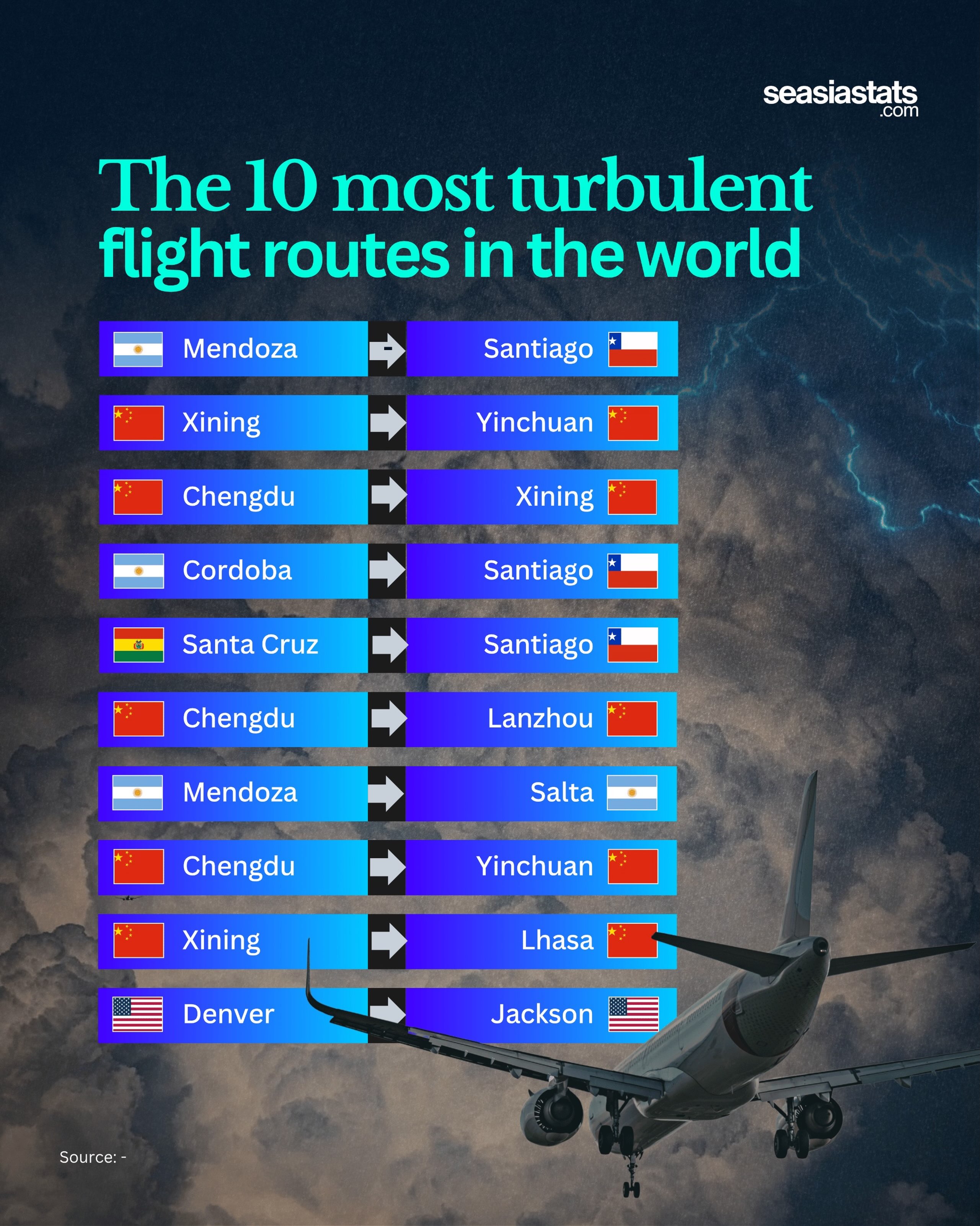
Among the world's most turbulent flight routes is the journey from Mendoza, Argentina, to Santiago, Chile. The route crosses the Andes Mountains, one of the world's major mountain ranges, where strong air movements can create challenging conditions. Its location between Argentina and Chile makes it particularly notable for turbulence.
Several of the routes experiencing significant turbulence are located in China, particularly around the country's mountainous western regions. The Xining–Yinchuan route and Chengdu–Xining route are among those identified as highly turbulent.
Other Chinese routes on the list include Chengdu–Lanzhou, Chengdu–Yinchuan, and Xining–Lhasa. The presence of extensive mountain ranges and complex terrain across western China contributes to atmospheric conditions that can produce turbulence.
South America also features prominently in the ranking. In addition to Mendoza–Santiago, the Córdoba–Santiago and Santa Cruz–Santiago routes can encounter turbulent conditions. The geography surrounding the Andes plays an important role, as air flowing over and around mountains can become disturbed.
Another route in Argentina, Mendoza–Salta, is also included among the world's most turbulent flight paths. Together, these South American routes demonstrate the influence of mountainous terrain on aviation conditions.
The list extends to North America with the Denver–Jackson route in the United States. Denver is located near the Rocky Mountains, while Jackson, Wyoming, is surrounded by mountainous terrain. The region's geography and atmospheric patterns can therefore contribute to turbulence along flights between the two destinations.
It is important to remember that a route being classified as turbulent does not mean that every flight on it will experience severe turbulence. Conditions can change from one day to another depending on weather, altitude, wind patterns, and the specific flight path selected by pilots and air traffic controllers.
Passengers can reduce discomfort by keeping their seat belts fastened whenever seated, following crew instructions, and avoiding unnecessary movement during periods of turbulence. Modern aircraft are designed to withstand turbulence, and pilots receive forecasts and weather information to help them anticipate and avoid the most significant areas when possible.
From the Andes and Rocky Mountains to the high-altitude landscapes of western China, these routes illustrate how geography can influence the flying experience. Turbulence remains a normal part of aviation, and understanding its causes can help passengers feel more prepared when traveling through these regions.