

The Number Languages in Southeast Asia
Southeast Asia is famous for its diversity, including languages with Indonesia leading far ahead.

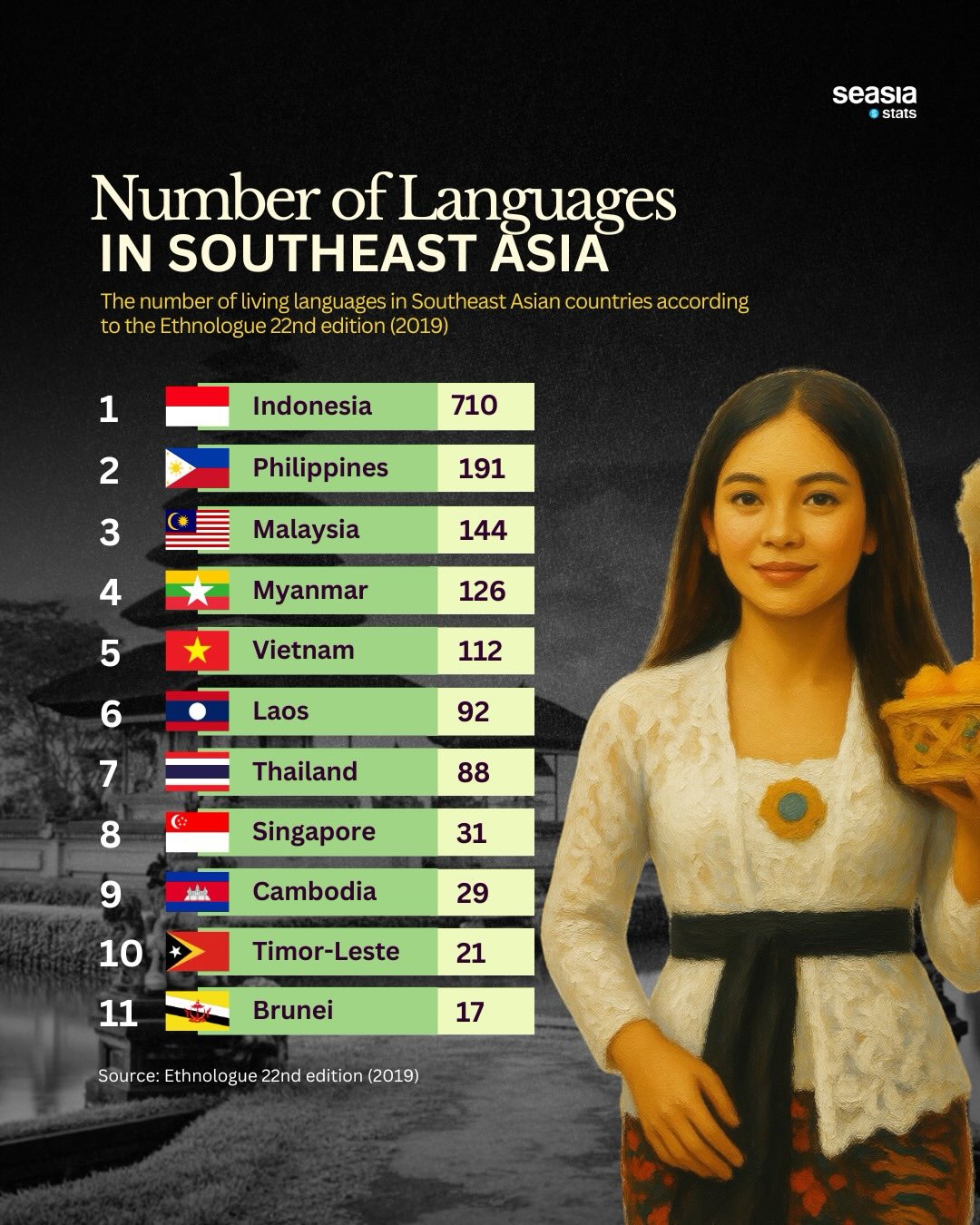
Southeast Asia is one of the most linguistically diverse regions in the world, home to hundreds of languages spoken across thousands of islands, mountains, forests, and urban centers. The region’s remarkable diversity reflects centuries of migration, trade, cultural exchange, and the survival of indigenous communities.
According to Ethnologue 22nd edition, Indonesia has the highest number of languages in Southeast Asia, followed by the Philippines and Malaysia.
Indonesia stands far ahead of its neighbors with 710 languages, making it one of the most linguistically diverse countries on Earth. Spread across more than 17,000 islands, Indonesia is home to hundreds of ethnic groups, each with its own local language or dialect.
While Indonesian serves as the national language and unifying tool, regional languages such as Javanese, Sundanese, and Balinese continue to thrive in daily life.
The Philippines ranks second in Southeast Asia with 191 languages. Its archipelagic geography helped communities develop independently for centuries, leading to the creation of many distinct languages. Filipino and English are the country’s official languages, but regional languages like Cebuano, Ilocano, and Hiligaynon remain widely spoken.
Malaysia follows with 144 languages, reflecting the country’s multicultural population and the presence of numerous indigenous groups in Sabah and Sarawak on the island of Borneo.
Myanmar records 126 languages, while Viet Nam has 112. Both countries are home to many ethnic minorities living in mountainous and rural areas, where traditional languages continue to be preserved. Laos has 92 languages and Thailand 88, demonstrating the continued linguistic richness of mainland Southeast Asia despite modernization and urbanization.
Smaller nations in the region also possess notable diversity. Singapore, despite its compact size, has 31 languages due to its multicultural society shaped by Chinese, Malay, Indian, and international communities.
Cambodia has 29 languages, Timor-Leste 21, and Brunei 17. Although these numbers are lower compared to larger countries, they still represent important cultural traditions and identities.
However, many of Southeast Asia’s languages face challenges in the modern era. Urbanization, globalization, and the dominance of national or international languages can reduce the use of smaller indigenous languages among younger generations. Linguists warn that some languages may disappear if they are no longer passed down within families and communities.
Overall, Southeast Asia’s linguistic diversity remains one of its greatest cultural treasures. The hundreds of languages spoken across the region reflect its deep historical roots and rich cultural heritage, making Southeast Asia a unique mosaic of identities and traditions.