

The Number of Police Officers in Southeast Asia
The number of police officers in Southeast Asian countries varies, with Indonesia having the biggest number.

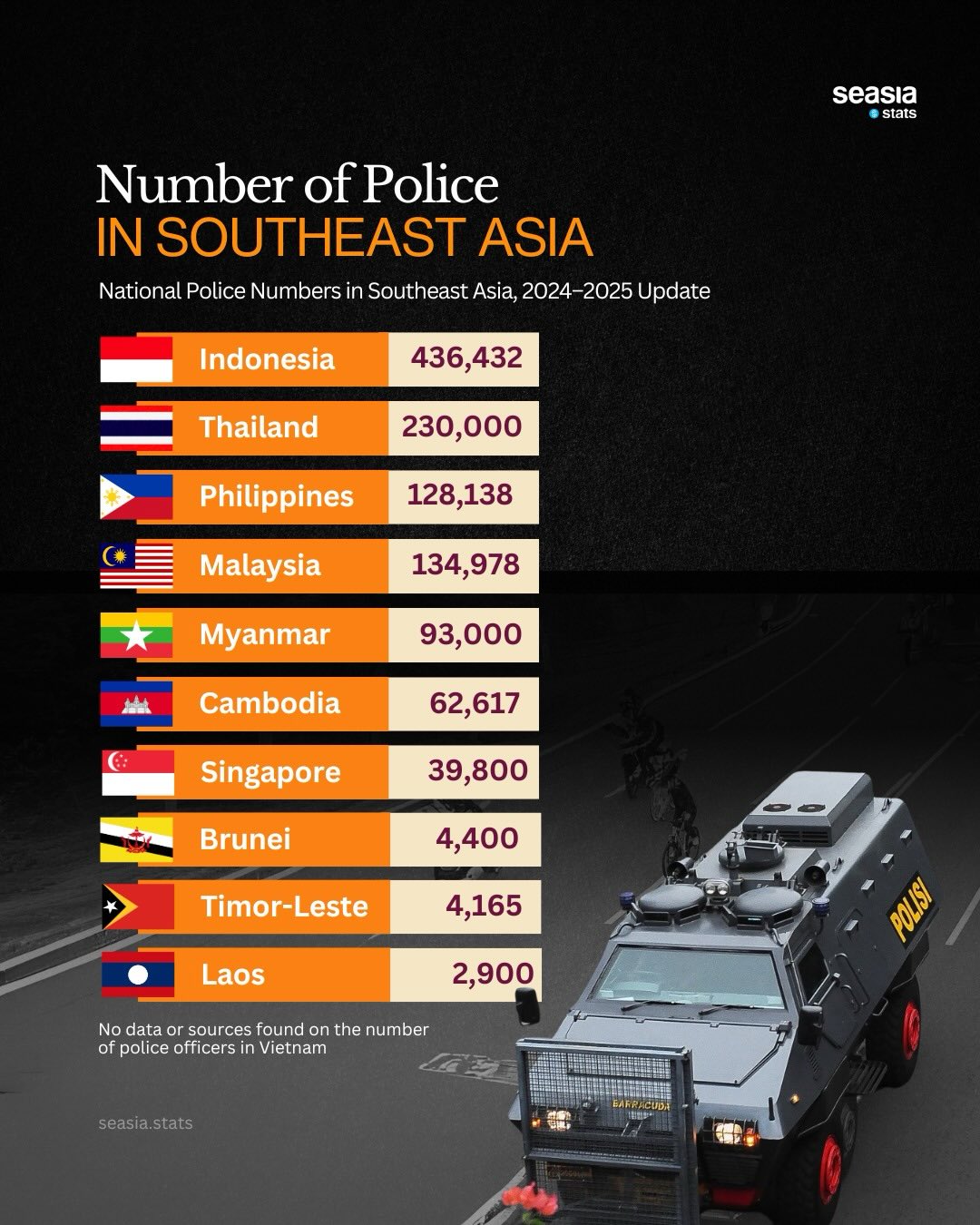
Police forces play an essential role in maintaining public safety, enforcing laws, and supporting national stability. Across Southeast Asia, the size of police organizations varies significantly depending on population size, geography, economic development, and security needs.
Countries with large populations and extensive territories generally require larger police forces, while smaller nations operate with more limited numbers of officers.
Indonesia has the largest police force in Southeast Asia, with approximately 436,432 officers. As the world’s largest archipelagic country, Indonesia faces unique security challenges across thousands of islands and hundreds of ethnic groups.
The Indonesian National Police is responsible for maintaining order, combating terrorism, controlling traffic, and addressing cybercrime and organized crime. Its large size reflects both the country’s vast population and geographic complexity.
Thailand has the region’s second-largest police force, with around 230,000 officers. Thai police are tasked with handling urban security, tourism protection, border enforcement, and anti-drug operations. Given Thailand’s importance as a regional tourism and trade hub, maintaining public security is a major national priority.
Malaysia and the Philippines have similarly large police organizations. Malaysia employs approximately 134,978 police officers, while the Philippines has around 128,138. In Malaysia, police responsibilities include crime prevention, maritime security, and border patrol.
The Philippines, an archipelagic nation like Indonesia, relies heavily on its police force to address criminal activity, insurgency, and disaster response across its many islands.
Myanmar has approximately 93,000 police personnel. The country’s police force has historically been involved in both civil law enforcement and internal security operations. Cambodia follows with around 62,617 officers, reflecting the country’s efforts to improve domestic security and strengthen law enforcement institutions in recent decades.
Singapore stands out despite its relatively small population and territory. The country maintains about 39,800 police personnel and is internationally recognized for its strict law enforcement and low crime rates. Singapore emphasizes advanced surveillance systems, efficient policing strategies, and strong legal enforcement to maintain public order.
Brunei and Timor-Leste operate much smaller police organizations due to their limited populations. Brunei has approximately 4,400 officers, while Timor-Leste has around 4,165. Both countries focus primarily on domestic law enforcement and community safety.
Laos has the smallest police force on this list, with approximately 2,900 officers. Despite the relatively small number, Lao police continue to play an important role in maintaining order and supporting border security in the landlocked nation.
Overall, the number of police officers in Southeast Asian countries reflects each nation’s population size, political environment, economic conditions, and security priorities.
While larger countries require extensive policing systems to manage broad territories and large populations, smaller nations often rely on more compact but specialized police organizations. Together, these forces contribute to regional stability and public safety throughout Southeast Asia.