

The Oldest National Anthems in Asia Still Sung Today
Japan's Kimigayo was adopted in 1880 and has been sung since then, making it the oldest in Asia.

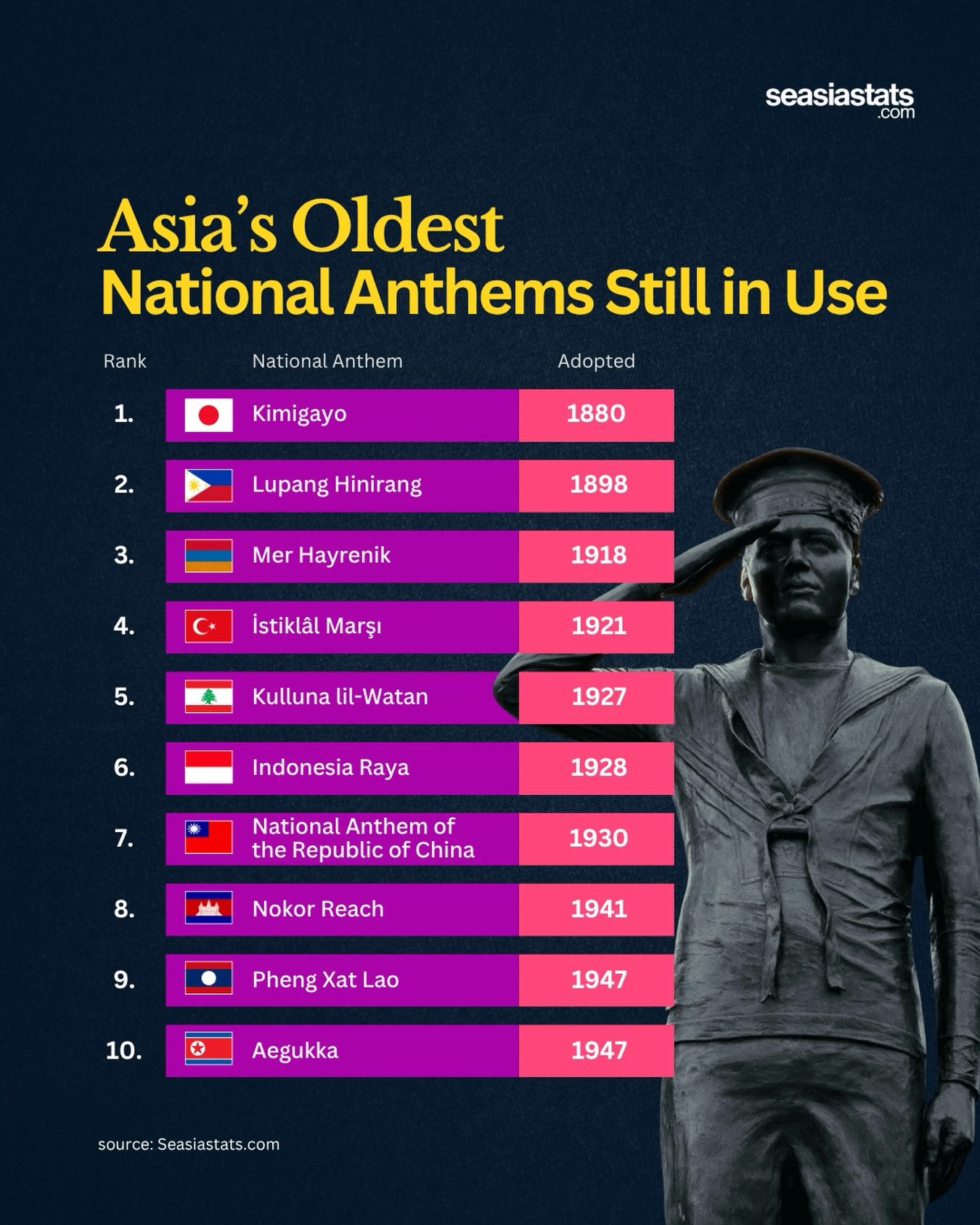
National anthems are among the most recognizable symbols of a country, representing its history, identity, independence, and aspirations. Asia is home to several national anthems with origins stretching back more than a century.
Among the oldest still associated with countries today is Japan’s “Kimigayo,” whose present melody dates from 1880. Its lyrics, however, are far older, originating from a classical Japanese poem recorded in the Kokin Wakashū around the tenth century. The anthem was formally recognized in law in 1999.
The Philippines’ “Lupang Hinirang” follows historically. Its music was composed by Julián Felipe in 1898 and was first performed during the proclamation of Philippine independence on June 12 of that year. The lyrics were originally written in Spanish before the Filipino version became official. Philippine law today requires the anthem to be sung in the national language.
Armenia’s “Mer Hayrenik,” meaning “Our Fatherland,” was adopted in 1918 by the First Republic of Armenia. It was discontinued during the Soviet period but was readopted after Armenia restored its independence in 1991, with slightly modified lyrics. Thus, its history is older than its uninterrupted present-day use.
Turkey’s “İstiklal Marşı,” or “Independence March,” was adopted on March 12, 1921, during the Turkish War of Independence. Written by Mehmet Akif Ersoy, it became the national anthem of the Republic of Turkey and remains in use today.
Lebanon’s “Kulluna lil-Watan” was adopted in 1927, with lyrics by Rachid Nakhle and music by Wadih Sabra.
Indonesia’s “Indonesia Raya” was introduced by Wage Rudolf Supratman in 1928 during the Youth Pledge. It became Indonesia’s national anthem following independence in 1945.
The Republic of China’s National Anthem was adopted in 1930 and remains the anthem used by the Republic of China in Taiwan. Cambodia’s “Nokor Reach” was adopted in 1941, although it was later replaced and restored, most recently in 1993.
Finally, Laos’ “Pheng Xat Lao” traces its national-anthem history to 1947, while North Korea’s “Aegukka” was adopted in 1947 after being composed in the mid-1940s.
Together, these anthems demonstrate how music can survive political change, independence movements, changing governments, and generations, continuing to serve as powerful symbols of national identity across Asia.