

The Oldest Nations in the World
These nations have such incredibly long and rich history compared to most modern countries.

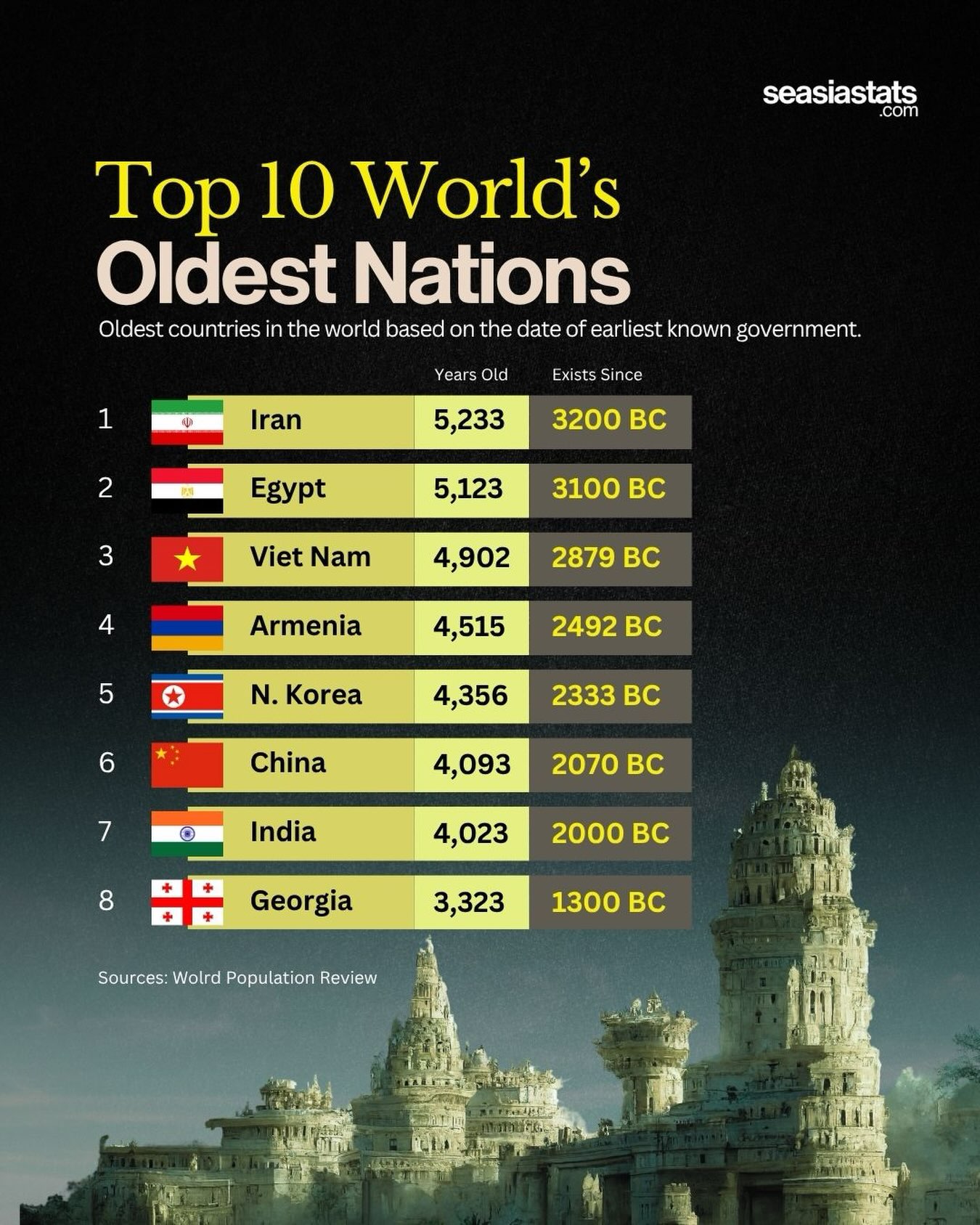
Some countries in the world have histories that stretch back thousands of years, long before the modern concept of nation-states existed. Their ancient civilizations, kingdoms, cultures, and traditions have played an important role in shaping human history.
Iran is often associated with one of the oldest civilizations in the world, with its origins traditionally traced to around 3200 BC. Ancient civilizations such as Elam developed in the region, followed centuries later by the powerful Persian empires. Iran has preserved a remarkable cultural heritage through its languages, architecture, literature, and traditions.
Egypt follows closely, with its ancient civilization traditionally dating to around 3100 BC, when Upper and Lower Egypt were unified. The civilization that flourished along the Nile became famous for its pyramids, temples, hieroglyphic writing, engineering, and powerful pharaohs. Ancient Egypt remains one of the most influential civilizations in human history.
Vietnam has traditionally traced its origins to 2879 BC, associated with the legendary Hùng Kings and the ancient kingdom of Văn Lang. While this date comes from traditional Vietnamese history rather than firmly documented modern statehood, the story remains an important part of the country's cultural identity.
Armenia is often cited as having ancient origins dating to around 2492 BC. Located at the crossroads of Europe and Asia, the region has witnessed the rise and fall of numerous civilizations and kingdoms. Armenia developed a distinctive cultural identity that has survived for thousands of years.
North Korea's traditional historical narrative traces Korean origins to 2333 BC, when Dangun is said to have founded Gojoseon. This legendary date remains significant in Korean history and national tradition.
China's ancient history is commonly traced to around 2070 BC, traditionally marking the beginning of the Xia Dynasty. Over the centuries, successive Chinese dynasties developed influential philosophies, political institutions, technologies, literature, and arts that continue to shape Chinese civilization today.
India's ancient roots extend back to around 2000 BC and earlier, particularly through the civilizations that developed across the Indian subcontinent. The Indus Valley Civilization produced sophisticated cities, trade networks, architecture, and systems of sanitation, leaving an extraordinary archaeological legacy.
Finally, Georgia's ancient roots are often dated to around 1300 BC. Ancient kingdoms such as Colchis and Iberia emerged in the Caucasus, laying foundations for Georgia's distinctive cultural and political heritage.
Although these dates should be understood as traditional or approximate starting points rather than the creation dates of today's modern countries, they demonstrate the extraordinary depth of history connecting these nations to some of the world's earliest civilizations.