

The Rankings of Global Islamic Economy in 2024/2025
These are the rankings of Muslim-majority countries in Global Islamic Economy from 2024 to 2025.

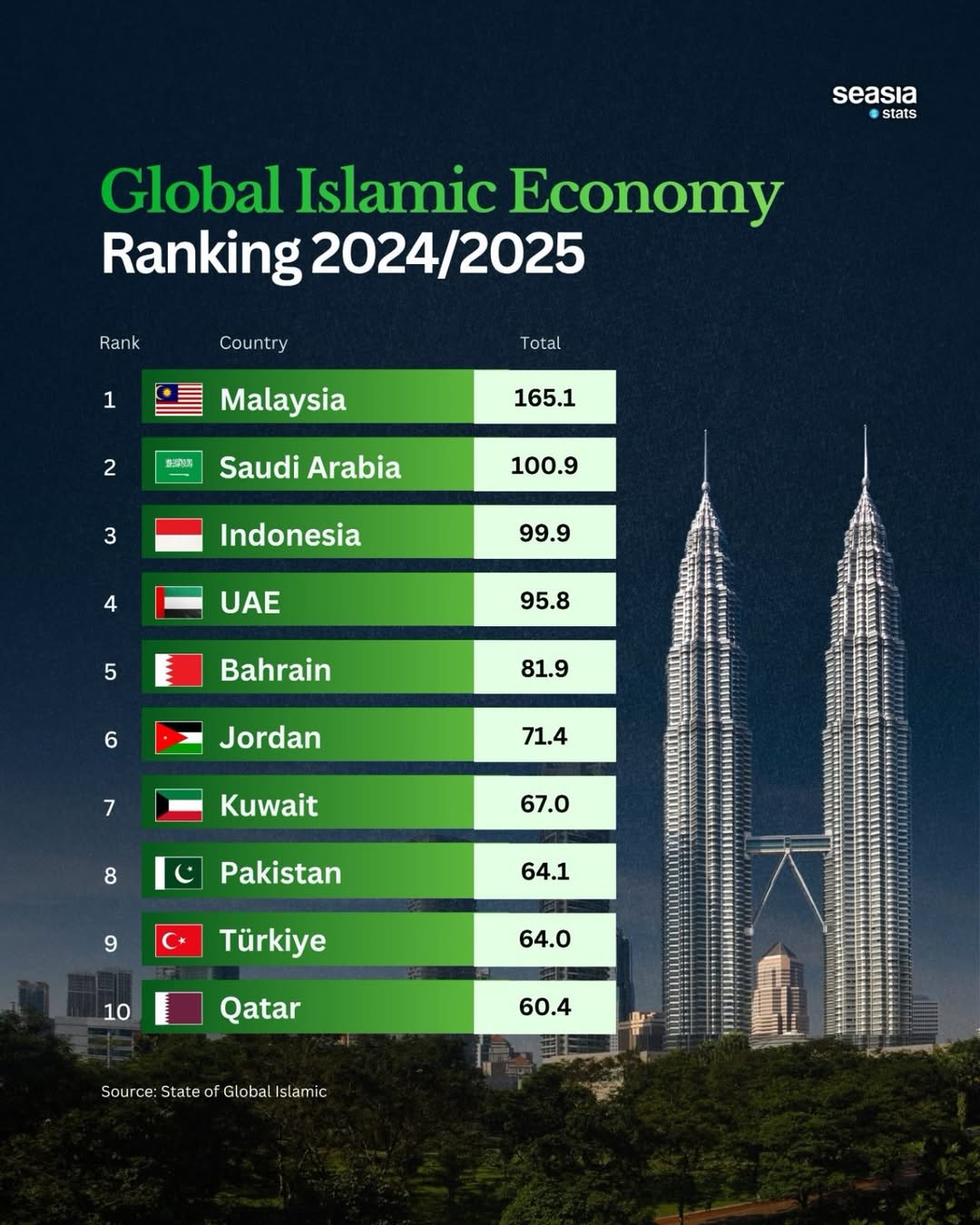
The State of the Global Islamic Economy Report 2024/2025 highlights the continued growth and influence of the Islamic economy worldwide.
Covering sectors such as Islamic finance, halal food, modest fashion, pharmaceuticals, cosmetics, media, recreation, and Muslim-friendly travel, the report ranks countries according to their overall performance and development within the Islamic economy ecosystem.
Malaysia remains the undisputed global leader, achieving a score of 165.1. The country has consistently topped the rankings thanks to its well-developed Islamic finance industry, comprehensive halal certification system, supportive government policies, and strong international reputation as a hub for Islamic economic innovation.
Malaysia's integrated approach has allowed it to maintain a significant lead over all other countries.
In second place is Saudi Arabia with a score of 100.9. As the birthplace of Islam and one of the world's largest economies in the Muslim world, Saudi Arabia continues to strengthen its position through investments in Islamic finance, halal industries, and tourism initiatives linked to its Vision 2030 development strategy.
Indonesia ranks third with 99.9 points, only slightly behind Saudi Arabia. Home to the world's largest Muslim population, Indonesia has made substantial progress in expanding its halal economy, Islamic banking sector, and halal product exports. The country's growing consumer market provides a strong foundation for future development.
The United Arab Emirates occupies fourth place with a score of 95.8. The UAE has emerged as a major global center for Islamic finance, trade, and halal business, benefiting from its strategic location and business-friendly environment.
Bahrain ranks fifth with 81.9 points. Despite its relatively small size, Bahrain has built a strong reputation as a regional leader in Islamic banking and financial services. Its regulatory framework has helped attract significant investment and innovation.
Jordan follows in sixth place with 71.4 points, while Kuwait ranks seventh with 67.0. Both countries have developed important Islamic finance sectors and continue to support growth across various halal industries.
Pakistan secures eighth place with a score of 64.1, narrowly ahead of Turkey at 64.0. Pakistan's large Muslim population and expanding halal market contribute to its strong position, while Turkey benefits from its diversified economy, manufacturing capabilities, and growing halal exports.
Completing the top ten is Qatar with a score of 60.4. The country continues to strengthen its Islamic financial institutions and expand opportunities in halal-related sectors.
The 2024/2025 rankings demonstrate the growing importance of the Islamic economy as a driver of economic development. While Malaysia remains the clear leader, countries across the Middle East and Asia are increasingly investing in halal industries and Islamic finance, creating a dynamic and rapidly expanding global economic ecosystem.