

The Remarkable Growth of Southeast Asian Economies: GDP per Capita in US Dollars from 1990 to 2025
Vietnam has the largest growth of GDP from 1990 to 2025 with more than fifty-fold increase.

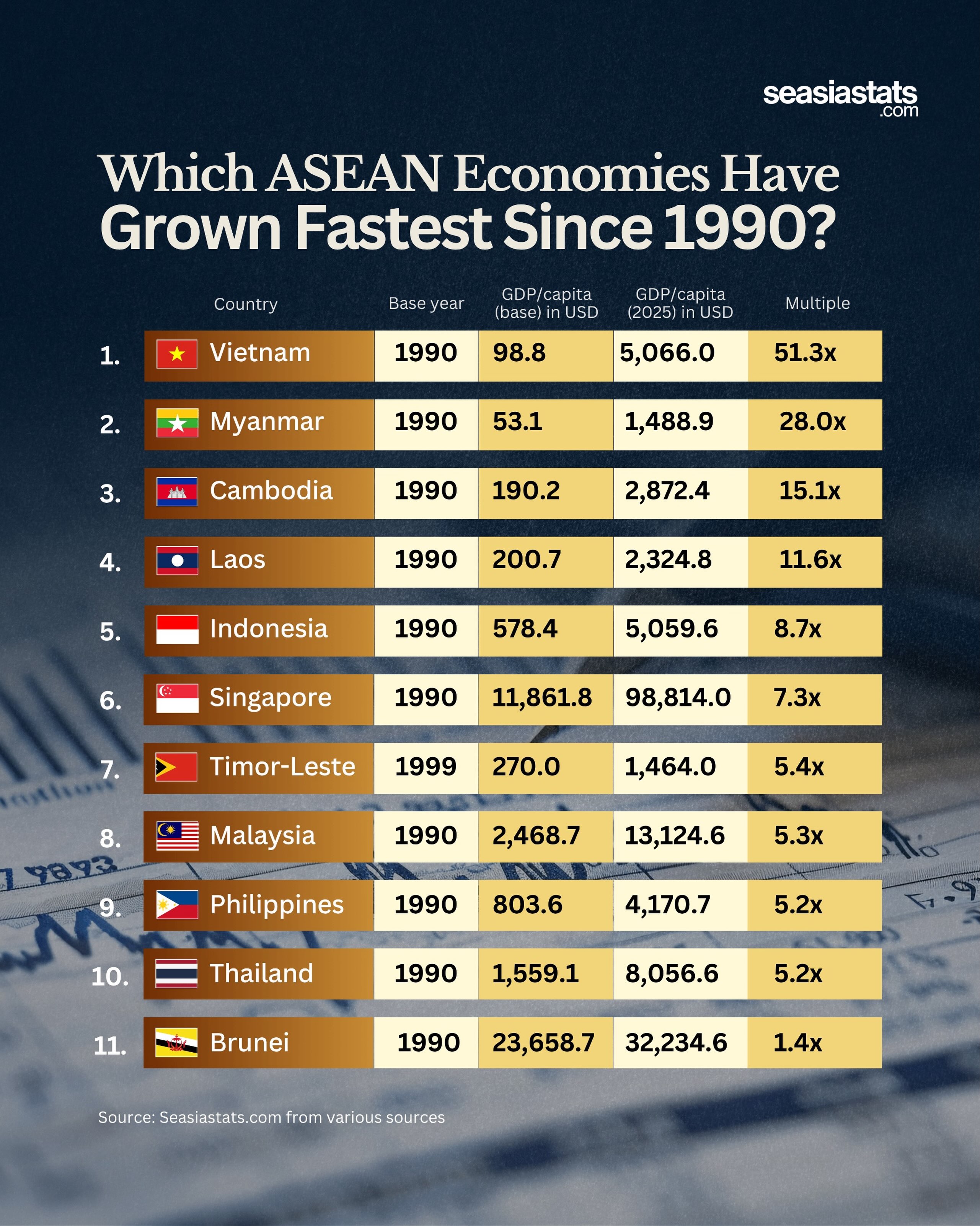
Southeast Asia has undergone a profound economic transformation over the past three and a half decades. Measured in nominal US dollars, GDP per capita figures for the region’s countries illustrate a story of rapid development, rising incomes, and increasing integration into the global economy.
While absolute levels still vary widely, the trajectory from 1990 to 2025 (and from 1999 for Timor-Leste) reveals impressive gains across the board.
Vietnam stands out as one of the most dramatic success stories. Starting from a low base of just $98.8 in 1990, its GDP per capita is projected to reach $5,066.0 by 2025, an increase of more than fifty-fold.
Myanmar, beginning even lower at $53.1, is expected to climb to $1,488.9. Cambodia has advanced from $190.2 to $2,872.4, while Laos has grown from $200.7 to $2,324.8. These figures reflect sustained reforms, foreign investment, and expanding manufacturing and services sectors that have lifted millions out of poverty.
Indonesia, the region’s largest economy by population, has seen its GDP per capita rise from $578.4 to $5,059.6. The Philippines has progressed from $803.6 to $4,170.7, and Thailand from $1,559.1 to $8,056.6. Malaysia has recorded strong growth as well, moving from $2,468.7 to $13,124.6, consolidating its position as an upper-middle-income economy.
At the high end of the spectrum, Singapore has reinforced its status as a global financial and trading hub. Its GDP per capita has soared from $11,861.8 in 1990 to an extraordinary $98,814.0 in 2025.
Brunei, endowed with oil and gas resources, has seen more modest relative growth, from $23,658.7 to $32,234.6, yet remains one of the wealthiest nations in the region on a per-capita basis.
Timor-Leste, independent since 2002 and measured from 1999, has advanced from $270.0 to $1,464.0, reflecting the challenges and opportunities of a young resource-dependent economy.
Collectively, these numbers underscore Southeast Asia’s resilience and dynamism. Despite external shocks, political transitions, and varying natural-resource endowments, the region has delivered substantial improvements in living standards.
Looking ahead, continued investment in human capital, infrastructure, and technological upgrading will be essential to sustain this momentum and narrow remaining development gaps. The period from 1990 to 2025 will be remembered as a defining era of economic ascent for Southeast Asia.