

The Rise of Religious Beliefs in Asia-Pacific
The number of people without any affiliation to any religion keeps growing in Asia-Pacific.

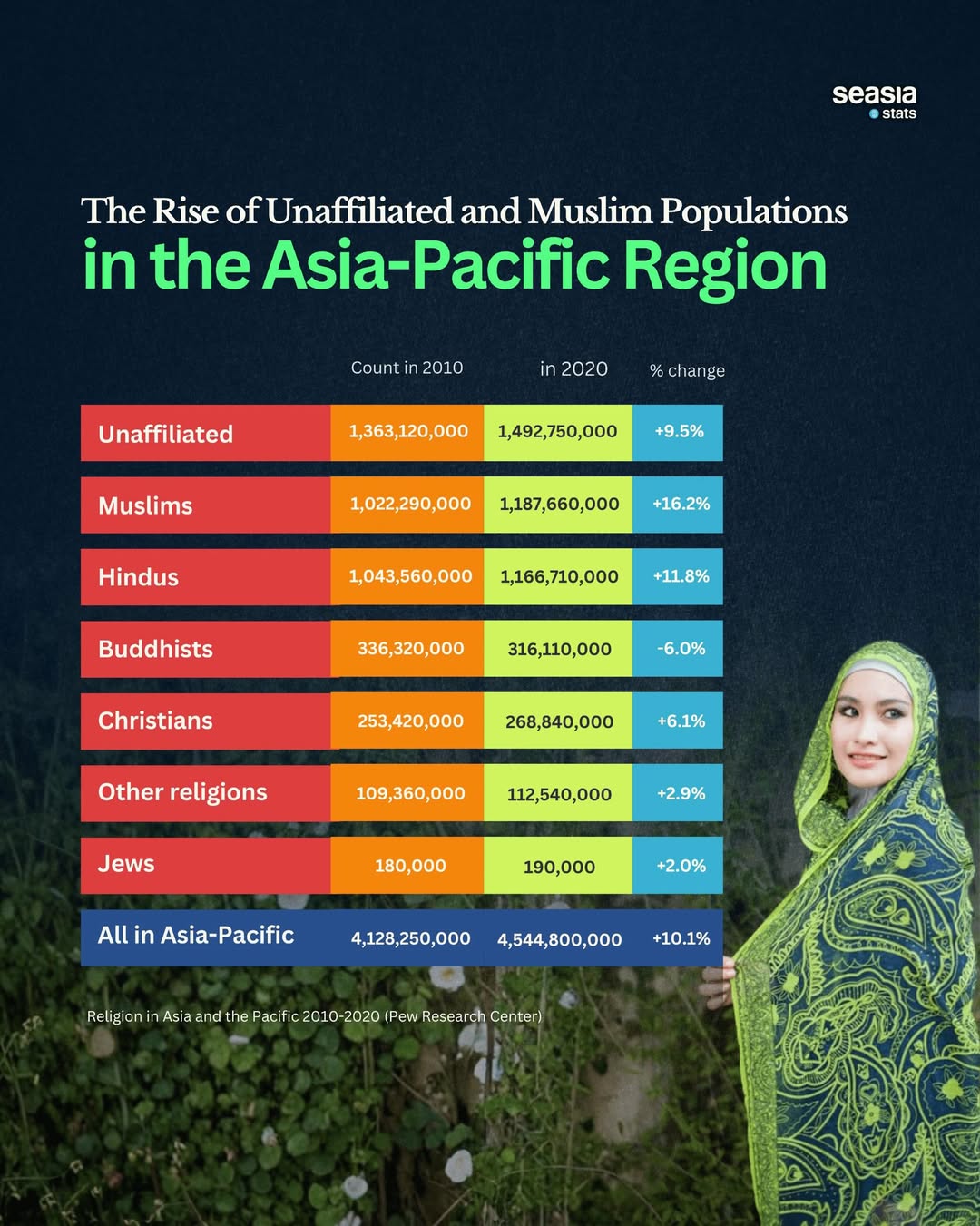
The Asia-Pacific region remained the world's largest center of religious diversity between 2010 and 2020, experiencing substantial demographic changes across nearly all major religious groups. Population growth, migration, urbanization, and shifting patterns of religious affiliation contributed to changes in the size of various faith communities during the decade.
The largest religious category in the region continued to be the religiously unaffiliated population, which includes atheists, agnostics, and people who do not identify with any particular religion.
Their numbers increased from 1.36 billion in 2010 to 1.49 billion in 2020, representing a 9.5% rise. This growth was driven largely by demographic trends in East Asia, where secular and non-religious identities remain widespread.
Muslims recorded one of the strongest increases among major religious groups. The Muslim population grew from 1.02 billion in 2010 to 1.19 billion in 2020, an increase of 16.2%.
High fertility rates and population growth in countries such as Indonesia, Pakistan, Bangladesh, and other parts of South and Southeast Asia contributed significantly to this expansion. By 2020, Muslims represented one of the fastest-growing religious communities in the region.
The Hindu population also experienced notable growth. Rising from 1.04 billion in 2010 to 1.17 billion in 2020, Hindus increased by 11.8% over the decade. Most of this growth occurred in India, which remains home to the overwhelming majority of the world's Hindus.
In contrast, Buddhists were the only major religious group in Asia-Pacific to experience a decline. Their population fell from 336.3 million in 2010 to 316.1 million in 2020, a decrease of 6.0%. Aging populations, low birth rates, and religious disaffiliation in several Buddhist-majority societies contributed to this downward trend.
Christianity continued to grow modestly across the region. The number of Christians increased from 253.4 million to 268.8 million, a gain of 6.1%. Growth was particularly evident in parts of Southeast Asia and the Pacific, where Christian communities remain influential.
Followers of other religions—including traditional folk religions, Sikhism, Jainism, and various indigenous faiths—rose from 109.4 million to 112.5 million, an increase of 2.9%. Meanwhile, the Jewish population, though comparatively small, grew from 180,000 to 190,000, representing a 2.0% increase.
Overall, the decade from 2010 to 2020 highlighted the continued demographic dynamism of Asia-Pacific. While most religious groups expanded in absolute numbers, the decline of Buddhism and the rapid growth of Muslim, Hindu, and unaffiliated populations underscored the region's evolving religious landscape.