

The Safest Places If World War III Starts
If you're paranoid about World War III, these are the best countries to go.

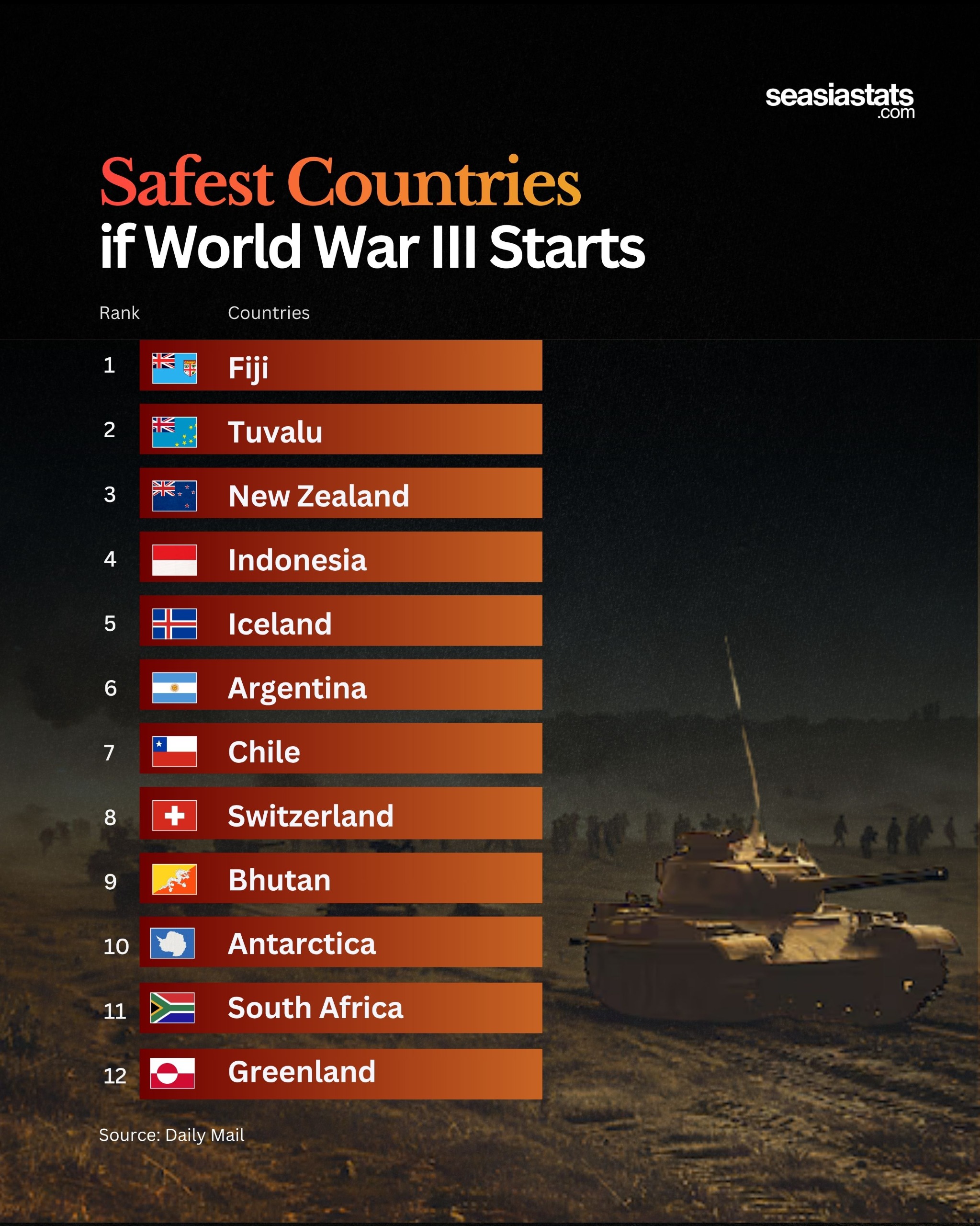
The possibility of a future global conflict raises an unsettling question: where would people be safest if World War III were to break out? According to a list published by the Daily Mail, several countries and remote regions could potentially be less exposed to the direct effects of a major international conflict.
Many of these locations share geographical characteristics that could reduce their exposure to a conventional conflict. Fiji and Tuvalu, for example, are small Pacific island nations located far from the major military and political centers of Europe, Asia and North America. Their geographical isolation could make them less likely to become direct targets, although their distance also creates challenges involving food, fuel and other supplies.
New Zealand is another country frequently discussed in this context. Its remote location in the South Pacific, relatively low population density and agricultural capacity are among the factors that could make it comparatively resilient during a global crisis. Indonesia, despite being much more populous and strategically important, is also included on the Daily Mail's list, reflecting the country's vast geography and many remote areas.
In the Northern Hemisphere, Iceland and Greenland stand out for their isolation. Iceland is situated between Europe and North America, while Greenland's enormous territory and small population mean that large areas are extremely remote. However, both would still be affected by disruptions to international trade and transportation.
In South America, Argentina and Chile are highlighted because of their distance from many potential conflict zones and their substantial agricultural resources. Switzerland, meanwhile, has a long-established policy of military neutrality and extensive civil-defense infrastructure, although neutrality would not necessarily protect it from the wider consequences of a global war.
The list also includes Bhutan, South Africa and Antarctica. Bhutan's mountainous terrain provides natural geographic isolation, while South Africa is far from many of the world's principal military powers. Antarctica is exceptionally remote, although its extreme environment and international legal status make it very different from a conventional refuge.
Ultimately, no location could be guaranteed to be safe during a hypothetical World War III. Nuclear weapons, cyberattacks, economic disruption, supply shortages and global environmental effects could reach far beyond traditional battlefields. The Daily Mail's list should therefore be understood as an assessment based largely on geography and isolation, rather than a prediction of what would actually happen in a future global conflict.