

The Similarities of the Word “Visit” in Eleven Languages
The word for "visit" has striking similarities in these eleven languages, mostly in Europe.

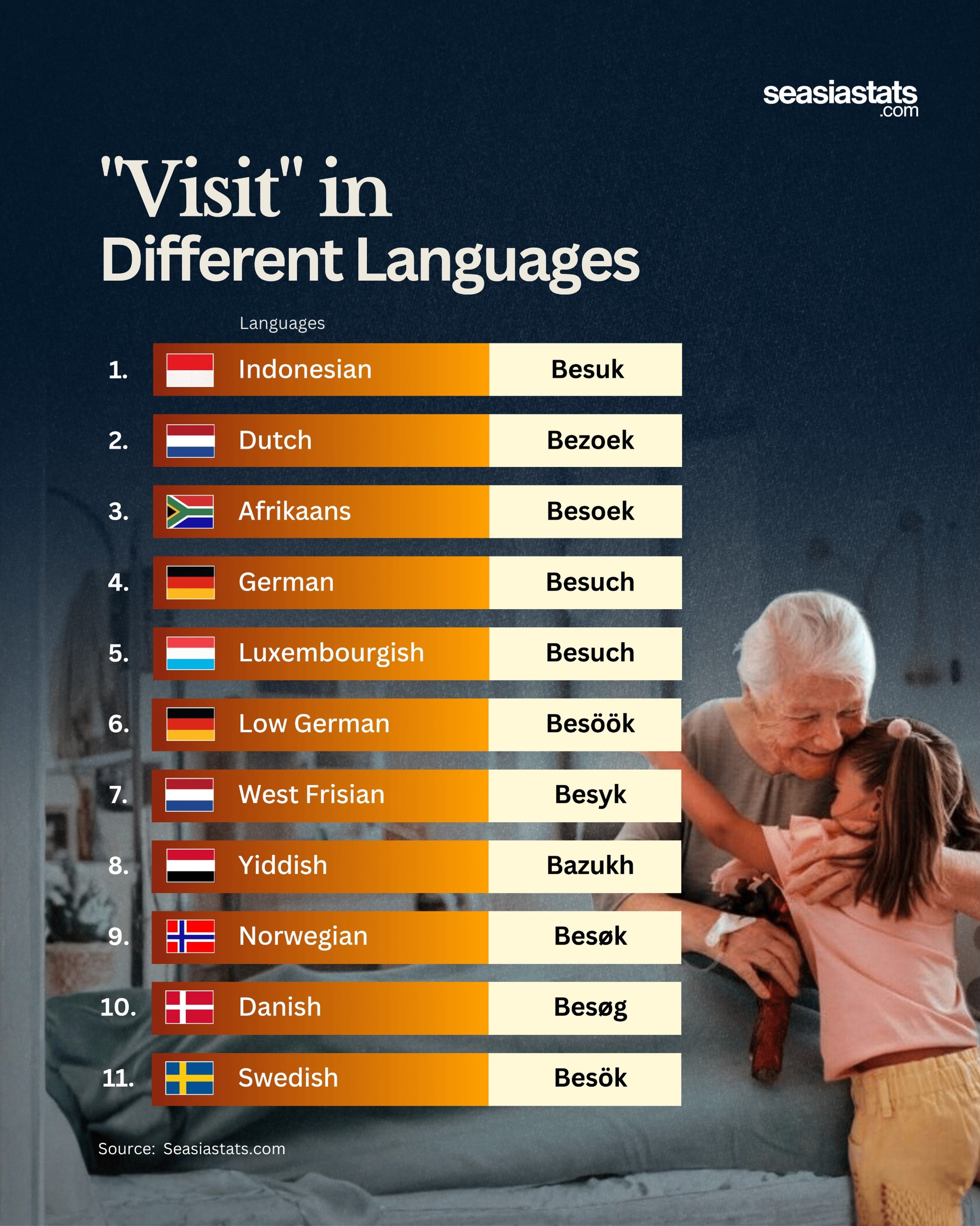
The word “visit” has fascinating similarities across several languages, particularly in the way they preserve related sounds and structures. These eleven examples show an interesting connection between Indonesian vocabulary and words found across the Germanic language family.
In Indonesian, besuk commonly refers to visiting someone, especially visiting a sick person in a hospital or someone who is ill. This is just one of the many examples of Dutch words being incorporated to the Indonesian language due to a long history of Dutch colonization.
Dutch uses bezoek for “visit”. The similarity between besuk and bezoek is immediately noticeable, especially in their be-/bes- beginning and k sound at the end. The Dutch form is part of the historical Germanic vocabulary associated with visiting.
Afrikaans, which developed primarily from Dutch, has besoek. Its close resemblance to Dutch bezoek is expected. The main difference is the vowel and spelling, while the overall bes-oek structure remains remarkably similar.
German uses Besuch for “visit.” Compared with Dutch bezoek, the spelling has changed considerably, but the consonants b-s-ch preserve a recognizable relationship. The word is pronounced with a final sound similar to “sh.”
Luxembourgish also uses Besuch. Its similarity to German is unsurprising because Luxembourgish is a West Germanic language closely related to German. The identical spelling makes the relationship particularly clear.
Low German has besöök. The use of ö reflects the vowel system and spelling conventions of Low German. Nevertheless, the familiar b-s- beginning and final k remain.
West Frisian uses besyk. Although its spelling differs from Dutch bezoek, the consonant pattern and general structure are similar. Frisian is another West Germanic language, helping explain this connection.
Yiddish has bazukh, meaning “visit.” Its spelling and pronunciation differ somewhat, but the underlying form is recognizably related to Germanic vocabulary. The change from e to a illustrates how sounds can develop differently in related languages.
Norwegian uses besøk. Its ø is characteristic of Norwegian spelling and pronunciation. Despite this vowel difference, it closely resembles Dutch bezoek and Swedish besök.
Danish has besøg. The letter ø again represents a distinctive vowel, while the final g corresponds historically to the final consonant found in related forms.
Finally, Swedish uses besök. It closely resembles Norwegian besøk, with the primary difference being the final vowel spelling. Together, these words demonstrate how related languages can preserve a common linguistic pattern while developing distinctive pronunciations and spellings.