

The Tallest Buildings in Southeast Asia’s Second-Largest Cities
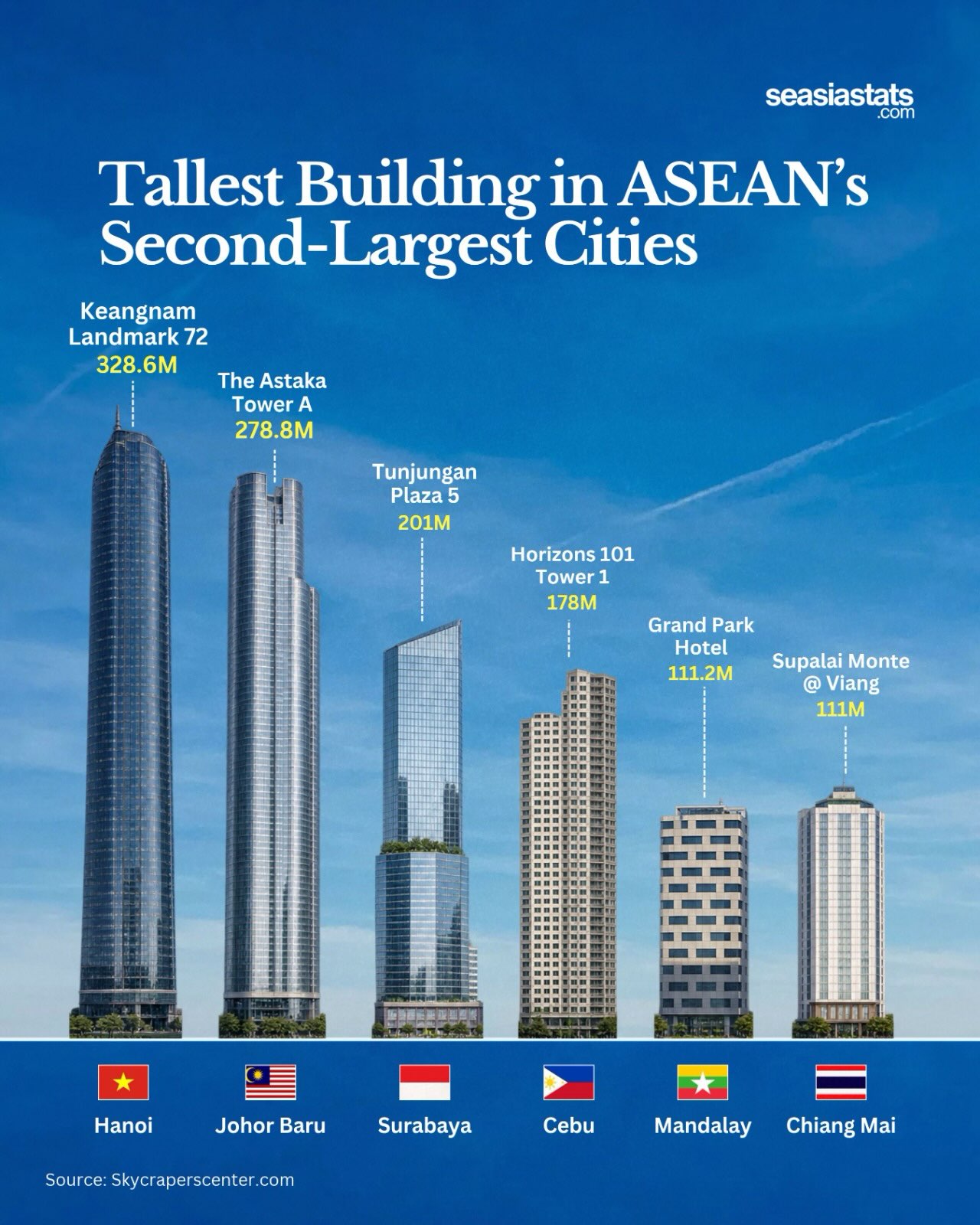
Keangnam Landmark 72 in Hanoi is the largest building in second-largest cities in Southeast Asia.

Southeast Asia’s urban landscape is changing rapidly, with skyscrapers and high-rise developments transforming the skylines of major cities beyond national capitals.
From Vietnam to Malaysia, Indonesia, the Philippines, Myanmar, and Thailand, these buildings reflect economic growth, urbanization, and the increasing demand for residential, commercial, and hospitality spaces. Among the region’s second-largest cities, several prominent structures stand out for their impressive heights and architectural significance.
At the top of this selection is Keangnam Landmark 72 in Hanoi, Vietnam, rising to an impressive 328.6 meters. Although Hanoi is Vietnam’s capital rather than its second-largest city, the tower remains a notable example of the country’s modern high-rise architecture.
The mixed-use complex includes office space, hotels, and other commercial facilities, symbolizing Vietnam’s economic development and international business ambitions.
In Johor Bahru, Malaysia, The Astaka Tower A reaches 278.8 meters, making it one of the city’s most recognizable skyscrapers.
Located near Singapore, Johor Bahru has experienced substantial urban development, supported by cross-border commerce, tourism, and residential demand. The Astaka’s luxury residential apartments and distinctive design highlight the city’s growing metropolitan character.
Indonesia’s Surabaya, the country’s second-largest city, features Tunjungan Plaza 5, which stands approximately 201 meters tall.
Part of the expansive Tunjungan Plaza shopping complex, the tower reflects Surabaya’s importance as a commercial and economic center in eastern Indonesia. Its integration with a major retail destination demonstrates how high-rise development can combine shopping, business, and urban lifestyles.
In Cebu City, the Philippines, Horizons 101 Tower 1 rises to approximately 178 meters. As a prominent residential skyscraper, it contributes to Cebu’s increasingly vertical urban landscape. Cebu City serves as a major economic, tourism, and transportation hub in the central Philippines, attracting investment and residents seeking modern urban housing.
Myanmar’s Mandalay features the Grand Park Hotel, with a reported height of 111.2 meters. The building represents the presence of high-rise hospitality development in a city known for its cultural heritage, historic landmarks, and commercial importance. Its scale illustrates the gradual modernization of Mandalay’s urban environment.
Meanwhile, Supalai Monte @ Viang in Chiang Mai, Thailand, reaches approximately 111 meters. The residential development reflects Chiang Mai’s growing demand for condominium living, driven by tourism, education, and its appeal as a regional lifestyle destination.
Together, these six buildings illustrate the diversity of Southeast Asia’s urban skylines. From towering mixed-use complexes to residential landmarks and hotels, they demonstrate how cities across the region are adapting to economic growth and changing lifestyles.
Their heights also reveal the contrasting scales of development between major metropolitan centers and emerging urban markets.