

The Wettest Places on Earth
These ten spots receive the most rainfall in the world.

Rainfall plays a major role in shaping ecosystems, agriculture, and human life around the world. While many regions experience seasonal rain, a few extraordinary places receive enormous amounts of precipitation every year.
These locations are known as the wettest places on Earth, recording annual rainfall totals that can exceed 10,000 millimeters. Most of these areas are located in tropical or mountainous regions where moist air is constantly forced upward, creating intense and frequent rainfall.
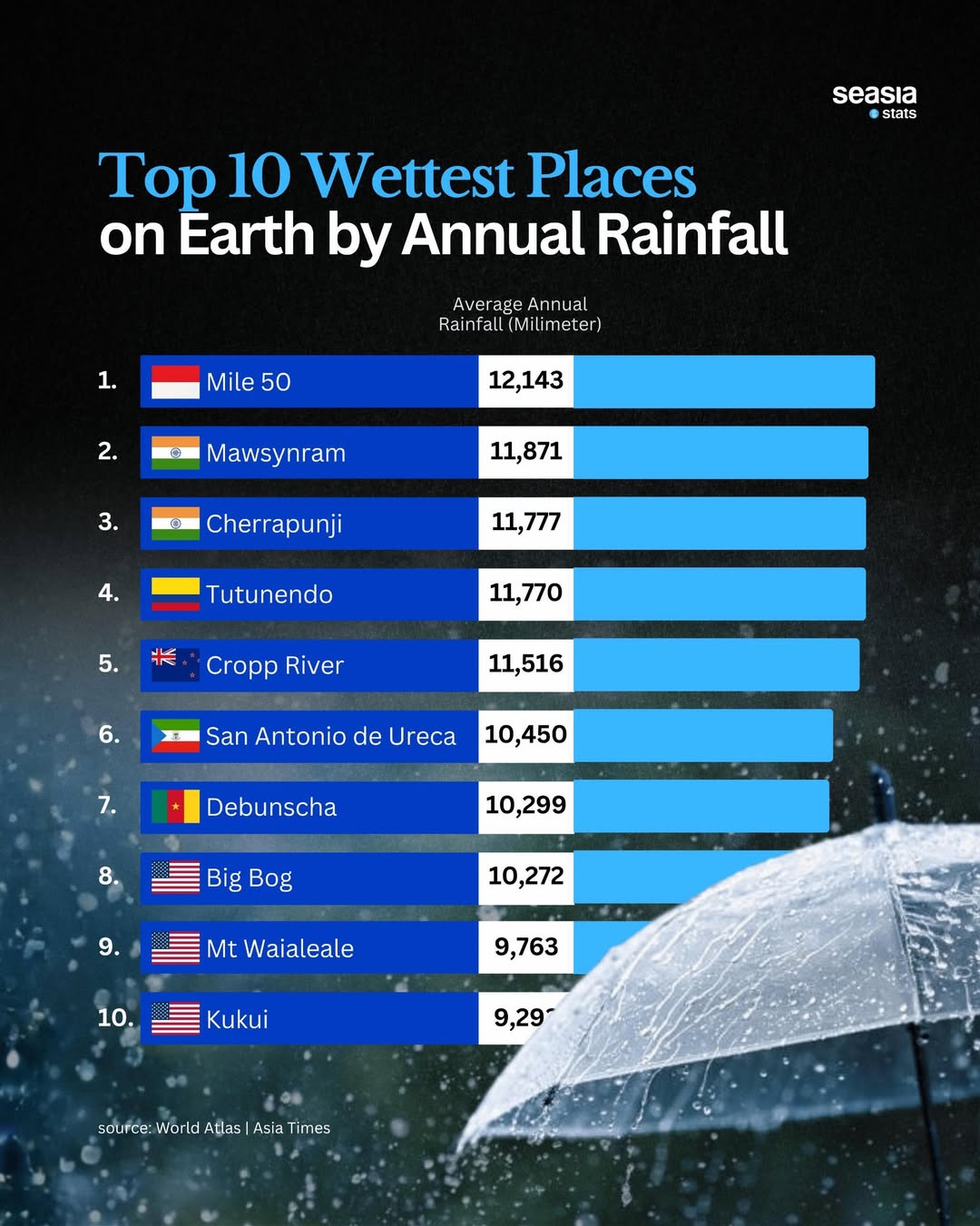
The wettest place on Earth is Mile 50 in Indonesia, which receives an astonishing 12,143 millimeters of rain annually. Located in a tropical rainforest region, Mile 50 experiences heavy rainfall almost year-round due to warm ocean temperatures and humid air currents.
Dense forests and mountainous terrain also contribute to the extreme precipitation levels found there.
India is home to the second and third wettest places in the world: Mawsynram and Cherrapunji. Mawsynram receives around 11,871 millimeters of rain annually, while nearby Cherrapunji records about 11,777 millimeters.
Both locations are situated in the northeastern state of Meghalaya, where monsoon winds from the Bay of Bengal collide with steep hills, causing massive rainfall. These towns are famous for dramatic waterfalls, misty landscapes, and lush green vegetation.
In South America, Tutunendo in Colombia records approximately 11,770 millimeters of annual rainfall. Its location near the Pacific Ocean and tropical rainforest climate create constant moisture and frequent storms.
New Zealand’s Cropp River follows with 11,516 millimeters of rain each year. Surrounded by mountains and influenced by moist winds from the Tasman Sea, the region experiences persistent rainfall throughout the year.
Several African locations also rank among the wettest places on Earth. San Antonio de Ureca in Equatorial Guinea receives around 10,450 millimeters annually, while Debunscha in Cameroon records approximately 10,299 millimeters. These tropical coastal areas experience intense rain because of their proximity to warm ocean waters and nearby mountains.
The United States also appears on the list with three exceptionally wet locations in Hawaii. Big Bog receives about 10,272 millimeters of rainfall each year, while Mount Waialeale records 9,763 millimeters and Kukui receives around 9,293 millimeters. Hawaii’s mountainous terrain and exposure to moist Pacific winds create ideal conditions for heavy rainfall.
These remarkably wet regions demonstrate the incredible diversity of Earth’s climate systems. Although extreme rainfall can create challenges such as flooding and landslides, it also supports rich biodiversity and vibrant ecosystems found nowhere else in the world.