

The Wettest Places on Earth
These places receive the most rainfall per year, making them the wettest on Earth.

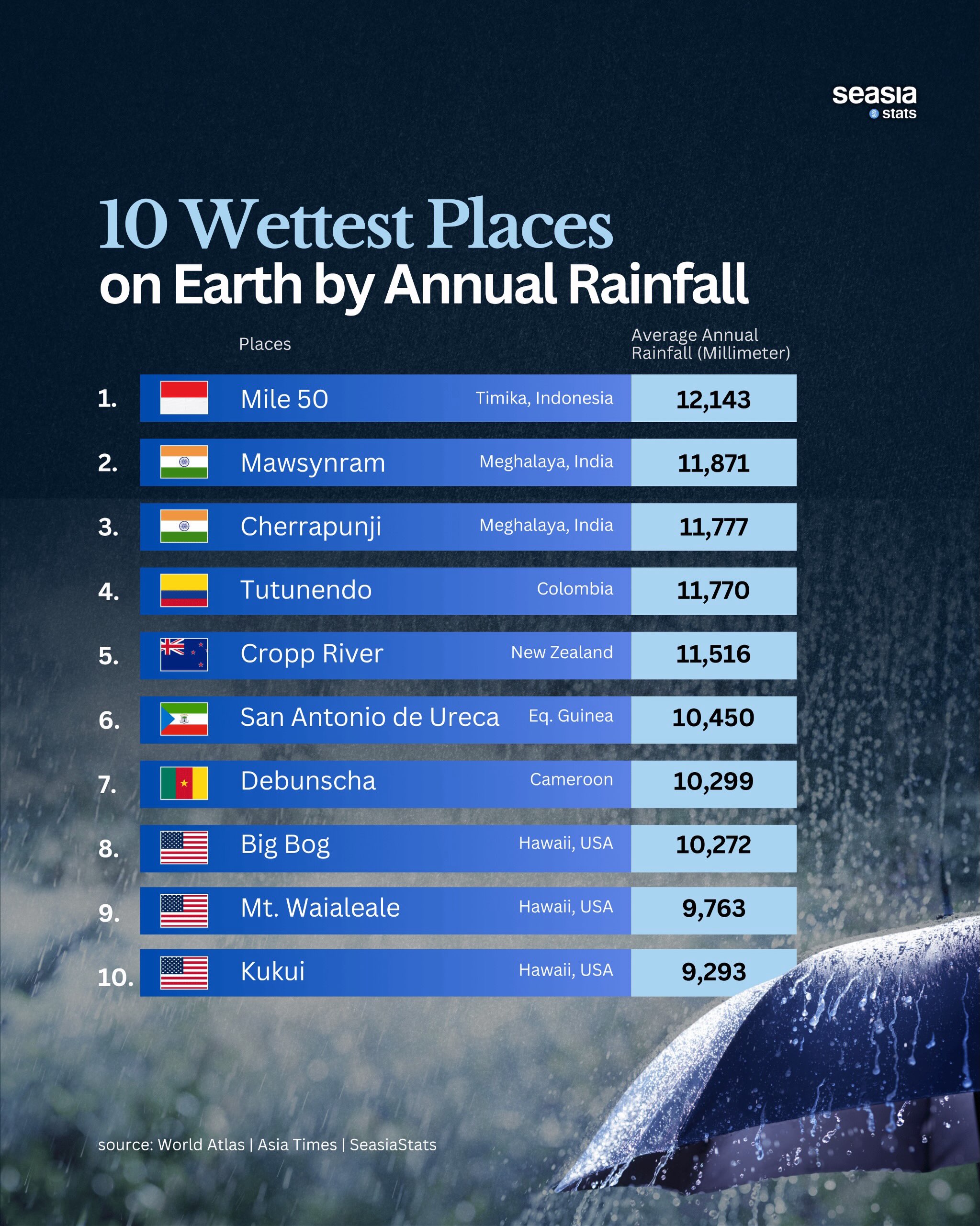
When people think of the wettest places on Earth, tropical rainforests often come to mind. However, only a handful of locations experience truly extraordinary levels of rainfall year after year. These regions receive well over 9,000 millimeters of precipitation annually, creating some of the planet's most humid and water-rich environments.
Topping the list is Mile 50 in Indonesia, which records an astonishing average annual rainfall of 12,143 millimeters, making it the wettest known location on Earth. Situated in one of the world's most moisture-laden tropical regions, Mile 50 receives relentless rainfall driven by warm ocean waters, mountainous terrain, and persistent equatorial weather systems.
Second place belongs to Mawsynram in India's Meghalaya state, with 11,871 millimeters of annual rainfall. Long recognized as one of the wettest inhabited places on Earth, Mawsynram experiences intense monsoon rains as moisture-laden winds from the Bay of Bengal are forced upward by surrounding hills.
Nearby Cherrapunji, also in Meghalaya, ranks third with 11,777 millimeters, just narrowly behind its neighboring town.
South America is represented by Tutunendo in Colombia, which averages 11,770 millimeters of rainfall each year. Located in the country's humid Pacific region, it benefits from warm tropical air masses and frequent storms throughout the year.
New Zealand's Cropp River comes next with 11,516 millimeters annually. Its exceptional rainfall is caused by moist westerly winds from the Tasman Sea rising over the Southern Alps, producing almost constant precipitation.
Africa also features prominently on the list. San Antonio de Ureca in Equatorial Guinea receives around 10,450 millimeters of rainfall each year, while Debunscha in Cameroon records 10,299 millimeters, thanks to its location at the foot of Mount Cameroon, where moist Atlantic air is forced upward.
The United States is represented by three locations in Hawaii. Big Bog leads the state with 10,272 millimeters of annual rainfall, followed by Mount Waialeale on Kauai with 9,763 millimeters, a mountain famous for its near-daily rainfall and lush green crater. Completing the top ten is Kukui, also in Hawaii, which averages 9,293 millimeters annually.
These remarkable locations demonstrate how geography, mountains, prevailing winds, and tropical climates combine to create some of the wettest environments on Earth.
Despite being spread across Asia, South America, Africa, Oceania, and North America, they all share one defining characteristic: an abundance of rainfall that shapes their landscapes, ecosystems, and ways of life, making them among the planet's most extraordinary natural environments.