

The World's 15 Largest Economies by Purchasing Power Parity (PPP) in 2026
Based on PPP, these fifteen countries are the largest economies in the world.

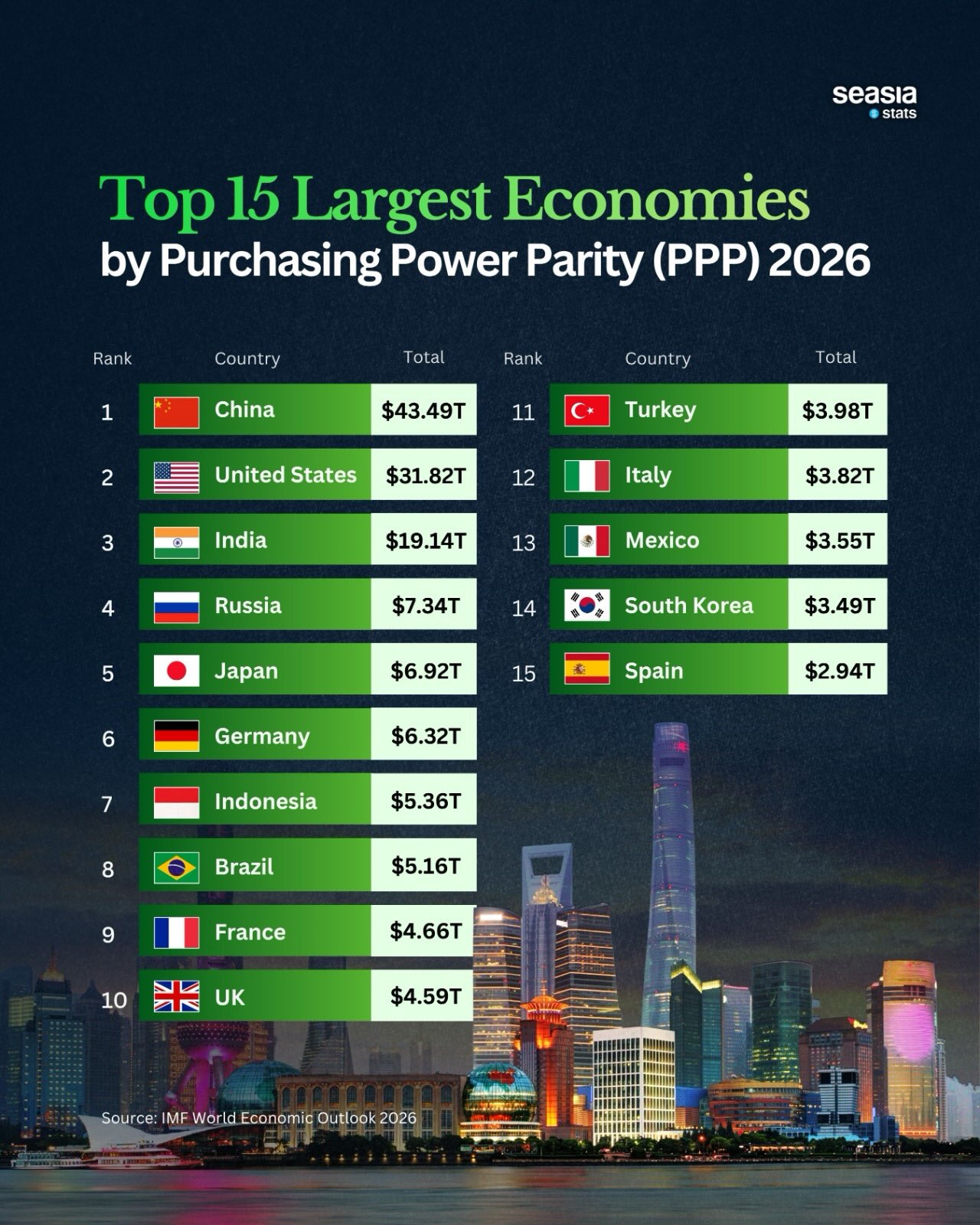
According to the IMF World Economic Outlook 2026, the global economic landscape continues to be led by major powers whose economies are measured by Purchasing Power Parity (PPP), a metric that compares the value of goods and services produced while accounting for differences in price levels across countries.
China remains the world's largest economy by PPP, highlighting the continued shift toward emerging markets alongside established economic giants.
China tops the ranking with a PPP-based GDP of US$43.49 trillion, maintaining a significant lead over the United States, which ranks second at US$31.82 trillion. India secures third place with US$19.14 trillion, reflecting its rapid economic expansion and growing domestic market.
Russia ranks fourth with US$7.34 trillion, followed by Japan at US$6.92 trillion and Germany at US$6.32 trillion. These economies continue to play vital roles in global manufacturing, energy, technology, and international trade.
Indonesia stands out as Southeast Asia's largest economy, ranking seventh globally with US$5.36 trillion. It is followed closely by Brazil with US$5.16 trillion, underscoring the growing influence of emerging economies in shaping the world's economic future.
France ranks ninth with US$4.66 trillion, narrowly ahead of the United Kingdom at US$4.59 trillion. Both countries remain among Europe's leading economic powers, supported by diversified industries and advanced service sectors.
Turkey occupies the eleventh position with US$3.98 trillion, followed by Italy at US$3.82 trillion. Mexico ranks thirteenth with US$3.55 trillion, benefiting from its large industrial base and close integration with North American supply chains.
South Korea claims fourteenth place with US$3.49 trillion, driven by its globally competitive technology, automotive, and electronics industries. Spain rounds out the top fifteen with US$2.94 trillion, maintaining its position as one of Europe's largest economies.
The IMF's PPP rankings demonstrate that economic influence extends beyond nominal GDP by reflecting the real purchasing power within each country. Large populations, expanding consumer markets, industrial capacity, and productivity continue to shape these rankings.
Emerging economies such as China, India, Indonesia, Brazil, and Turkey are steadily increasing their share of global output, while advanced economies like the United States, Japan, Germany, France, the United Kingdom, Italy, South Korea, and Spain remain essential pillars of the international economy.
Together, these fifteen economies account for the overwhelming majority of global economic activity and will continue to drive growth, trade, innovation, and investment throughout 2026 and beyond.