

The World's Biggest Muslim Economies in 2026
With GDP of $1.64 trillion, Turkey leads the Muslim world as the biggest economy.

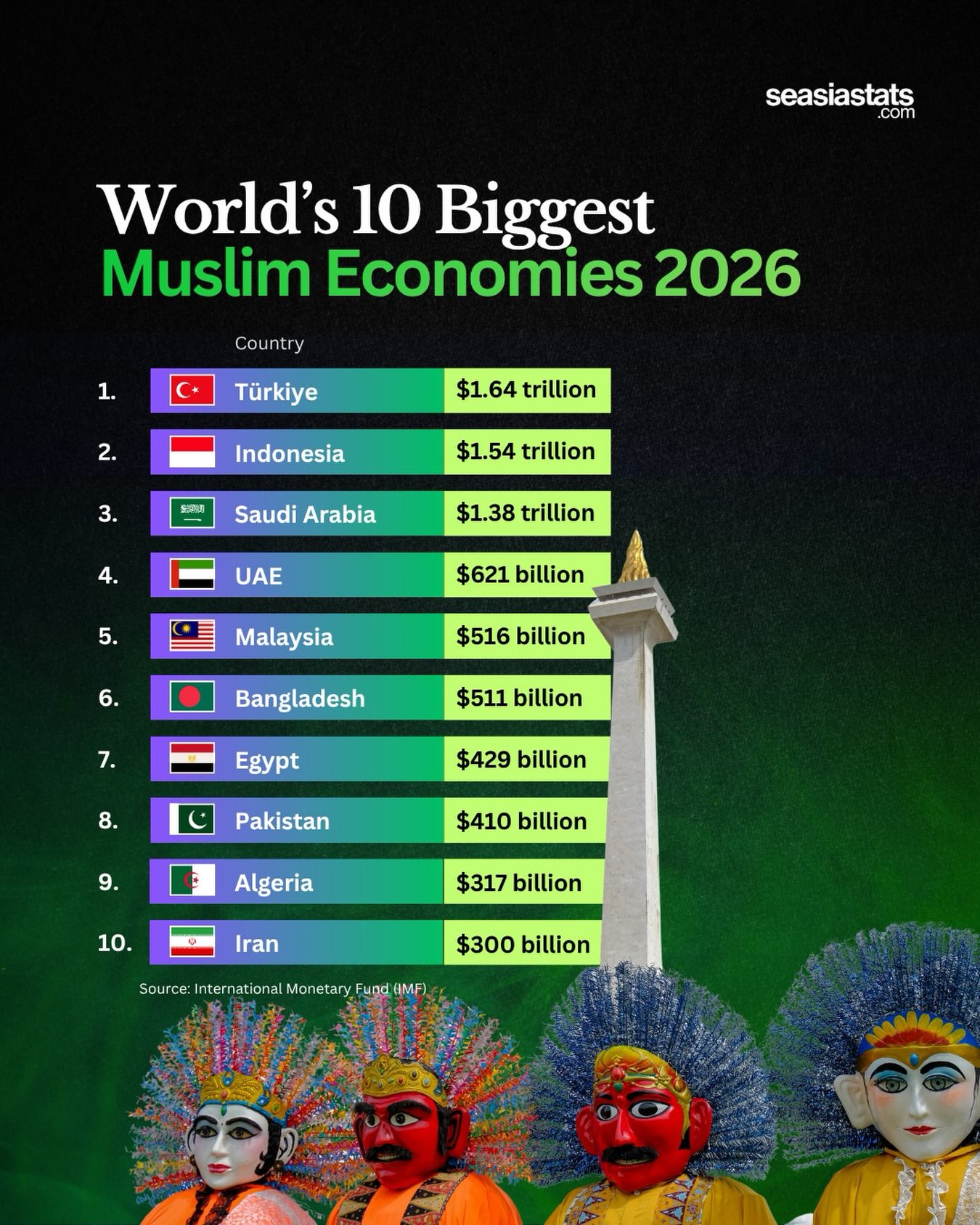
The Muslim world is home to some of the fastest-growing and most significant economies across the globe. Based on estimates from the International Monetary Fund (IMF), several Muslim-majority nations now rank among the world’s biggest economies, supported by industry, trade, natural resources, manufacturing, technology, and growing consumer demand.
Turkey leads the list with an economy worth approximately $1.64 trillion. Its strategic position connecting Europe and Asia provides major advantages, while manufacturing, tourism, defense, and infrastructure development remain important pillars of its economy.
Indonesia comes next with $1.54 trillion. As Southeast Asia’s largest economy and the world’s most populous Muslim-majority nation, Indonesia continues to expand through natural resources, digital industries, manufacturing, and strong domestic consumption.
Saudi Arabia ranks third at $1.38 trillion. Traditionally recognized as a global energy leader, the kingdom is working to broaden its economy through the Vision 2030 initiative, with major investments in tourism, entertainment, sports, and technology.
The United Arab Emirates follows with $621 billion. Cities such as Dubai and Abu Dhabi have developed into major international centers for finance, aviation, logistics, and luxury tourism, helping establish the UAE as one of the Middle East’s most advanced economies.
Malaysia recorded a GDP of $516 billion. Its economic strength comes from electronics manufacturing, palm oil exports, Islamic finance, and a well-developed services industry.
Meanwhile, Bangladesh reached $511 billion, largely driven by its rapidly expanding textile and garment sectors. During the past two decades, Bangladesh has developed into one of Asia’s fastest-growing economies.
In North Africa, Egypt recorded a GDP of $429 billion. The country’s economy is supported by tourism, the Suez Canal, agriculture, and expanding urban development and infrastructure projects.
Pakistan follows with $410 billion. With a population of more than 240 million, the country has considerable economic potential across agriculture, manufacturing, and technology.
Algeria recorded a GDP of $317 billion, with its economy relying heavily on oil and natural gas exports. These energy resources continue to play a central role in the country’s economic activity.
Finally, Iran recorded $300 billion despite facing years of economic sanctions. The country continues to maintain substantial industrial and energy sectors, supported by a large domestic consumer market.
Together, these ten countries highlight the expanding economic importance of the Muslim world. With large populations, extensive natural resources, and developing industries, they continue to play an important role in global trade, investment, and economic development throughout the 21st century.