

The World’s Biggest Tea Producers in 2024
China alone is responsible for more than half of global tea production.

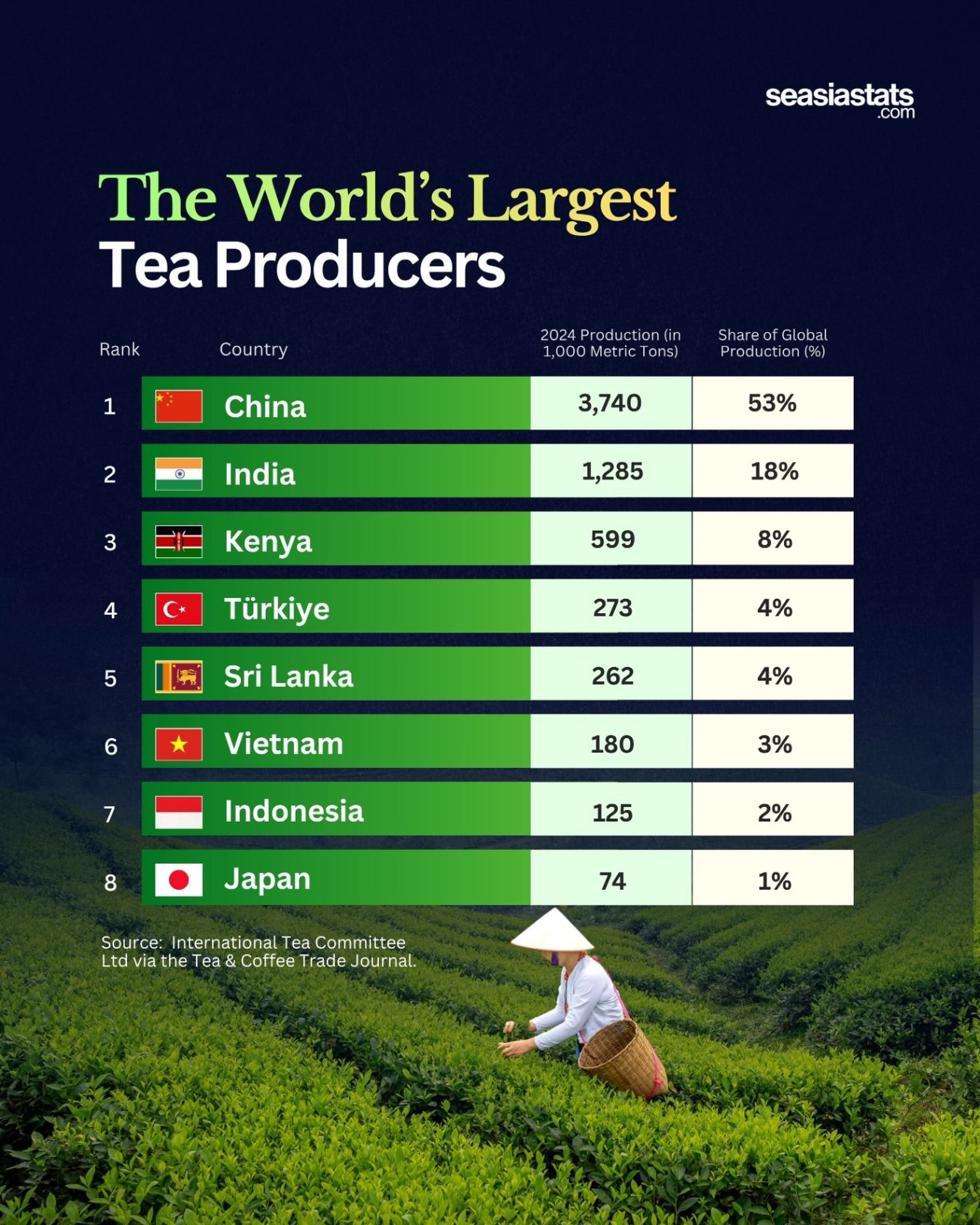
Tea remains one of the world’s most important agricultural commodities, with production concentrated heavily in Asia. According to data from the International Tea Committee (ITC), global tea production reached approximately 7.05 million metric tons in 2024.
China was by far the world’s largest tea producer in 2024, producing 3,740,000 tons and accounting for 53% of global production.
Its output was almost three times that of the second-largest producer, reflecting the enormous scale and long history of China’s tea industry. China produces a wide range of teas, including green, black, oolong, white, and pu-erh teas.
India ranked second, with production of 1,285,000 tons, representing 18% of global output. Together, China and India accounted for approximately 71% of the world's tea production, demonstrating the extraordinary concentration of the global tea industry in these two countries.
Kenya was the third-largest producer, harvesting 599,000 tons, or 8% of global production. Kenya is particularly important to the international tea trade because a large proportion of its production is exported. It is also the only African country among the eight largest tea producers.
The next major producers were Türkiye, with 273,000 tons (4%), and Sri Lanka, with 262,000 tons (4%). Both countries have internationally recognized tea industries, with Sri Lanka especially famous for its Ceylon tea.
Vietnam produced 180,000 tons (3%), followed by Indonesia with 125,000 tons (2%). Japan completed the top eight with 74,000tons, equivalent to 1% of global production.
Overall, these eight countries represented about 93% of global tea production in 2024, highlighting how concentrated tea cultivation is geographically. Seven of the eight largest producers are located in Asia, while Kenya stands as the major exception.
The figures demonstrate that China remains the undisputed center of global tea production, while India, Kenya, and other established producers continue to play crucial roles in supplying tea to consumers around the world.