

The World's Busiest Train Stations
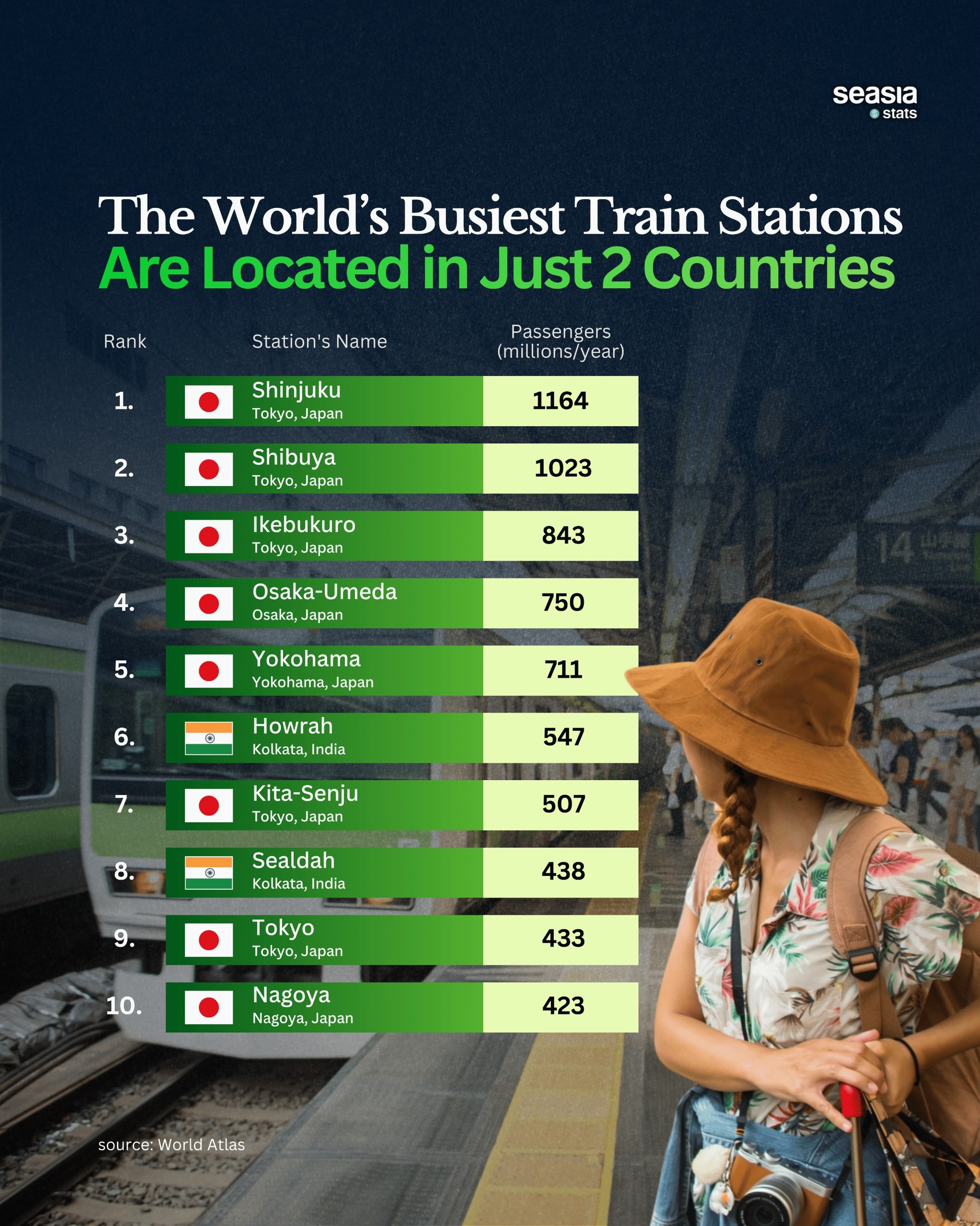
The busiest train stations in the world are located in Japan and India only.

When people think about the world's busiest transportation hubs, airports often come to mind. However, railway stations move an astonishing number of passengers every day, particularly in two countries: Japan and India.
Remarkably, the world's ten busiest train stations are located exclusively in these two nations, highlighting their extensive rail networks and the vital role trains play in everyday life.
Japan dominates the list with eight of the top ten busiest stations. Leading the world is Shinjuku Station in Tokyo, which handles approximately 1.164 billion passengers each year. Serving as a major interchange for multiple railway companies and subway lines, Shinjuku is a symbol of Japan's highly efficient public transportation system.
The second busiest station is Shibuya Station, also in Tokyo, with 1.023 billion annual passengers. Famous for its iconic pedestrian crossing, Shibuya is both a transportation hub and a vibrant commercial district.
Ikebukuro Station follows in third place with 843 million passengers, while Osaka-Umeda Station serves 750 million travelers annually, making it western Japan's busiest rail hub.
Yokohama Station ranks fifth with 711 million passengers, connecting Japan's second-largest city with the Tokyo metropolitan area. Kita-Senju Station records 507 million annual passengers, reflecting its importance as a key transfer point in northern Tokyo.
Tokyo Station itself, despite being the country's primary gateway for high-speed Shinkansen services, ranks ninth with 433 million passengers, while Nagoya Station completes the top ten with 423 million annual passengers.
India claims the remaining two positions on the list. Howrah Junction, located near Kolkata, is the sixth busiest train station in the world, serving approximately 547 million passengers annually. The station has long been one of India's most important railway terminals, connecting eastern India with destinations across the country.
Sealdah Station, also serving the Kolkata metropolitan region, ranks eighth with 438 million passengers per year. Together, Howrah and Sealdah demonstrate the immense scale of India's rail network, which serves millions of commuters and long-distance travelers every day.
The concentration of the world's busiest train stations in Japan and India reflects more than just population size. It highlights decades of investment in rail infrastructure, efficient operations, and a cultural reliance on public transportation.
As urban populations continue to grow and sustainable mobility becomes increasingly important, these stations stand as powerful examples of how rail systems can efficiently move enormous numbers of people while supporting the economic and social life of some of the world's largest cities.