

The World’s Cities with the Largest Populations
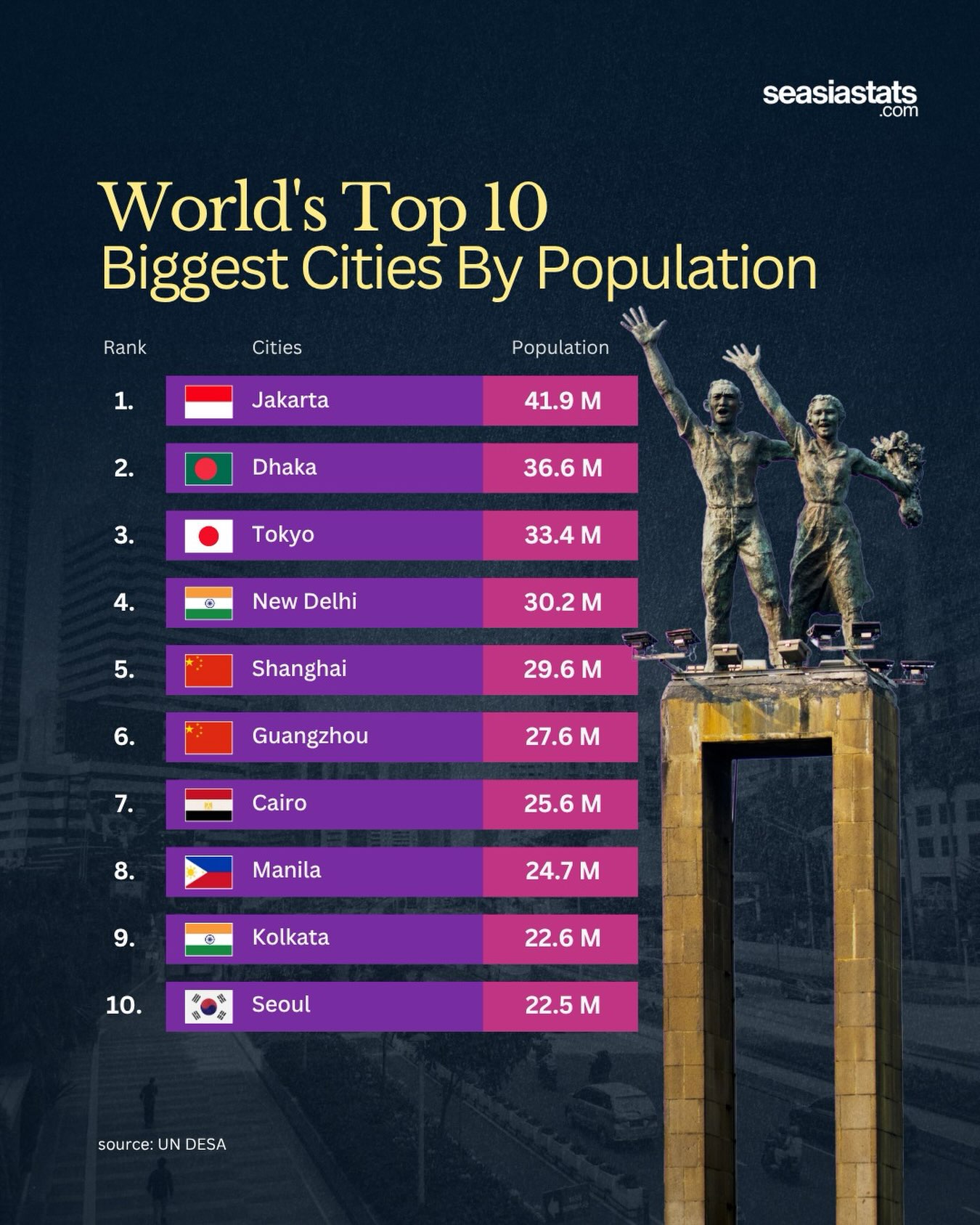
Jakarta has 41.9 million residents, making it the largest city in the world by population.

The world's urban population continues to grow as people move toward cities in search of employment, education, healthcare, and better economic opportunities.
Some metropolitan areas have expanded to extraordinary sizes, creating megacities with populations comparable to those of entire countries. Among the world's largest urban areas, Jakarta leads the ranking followed by Dhaka and Tokyo.
Jakarta, Indonesia, ranks first with 41.9 million people. As the country's economic and political center, Jakarta attracts people from across Indonesia and has developed into a vast metropolitan area extending well beyond the city's administrative boundaries.
Its enormous population creates both opportunities and challenges, including traffic congestion, housing demand, and pressure on infrastructure.
Second is Dhaka, Bangladesh, with 36.6 million residents. Dhaka's rapid expansion has been driven by population growth, rural-to-urban migration, and its importance as Bangladesh's economic and industrial center. The city's density makes transportation, housing, and urban planning particularly important issues.
Tokyo, Japan, ranks third with 33.4 million people. Despite Japan's overall population decline, the Tokyo metropolitan area remains one of the world's most important centers for business, technology, culture, and finance. Its extensive public transportation system allows millions of residents and commuters to navigate the enormous urban region.
New Delhi, India, follows with 30.2 million inhabitants. India's capital is surrounded by a rapidly expanding metropolitan area and serves as a major political, commercial, and cultural center. Shanghai, China, ranks fifth with 29.6 million people, reflecting its status as one of China's most important financial, manufacturing, and international trade hubs.
With 27.6 million residents, Guangzhou, China, is another enormous urban center. Its location in the Pearl River Delta has helped it become a major manufacturing, transportation, and commercial hub.
Cairo, Egypt, ranks seventh with 25.6 million people, making it the largest city on the list outside Asia. The Egyptian capital remains the country's dominant political, economic, and cultural center.
Manila, Philippines, has approximately 24.7 million residents and ranks eighth. Its metropolitan area is a densely populated economic powerhouse that plays a central role in the Philippines' services, commerce, and culture. Kolkata, India, follows with 22.6 million, while Seoul, South Korea, completes the top ten with 22.5 million.
Together, these cities demonstrate the extraordinary scale of modern urbanization. Nine of the ten cities listed are located in Asia, highlighting the continent's enormous population and rapid urban development.
Their growth brings economic opportunities and cultural dynamism, but also challenges involving transportation, housing, pollution, infrastructure, and sustainability. Managing these megacities effectively will be essential as urban populations continue to expand.