

The World's Largest Active Calderas
Lake Toba in North Sumatra Indonesia is the largest caldera in the world.

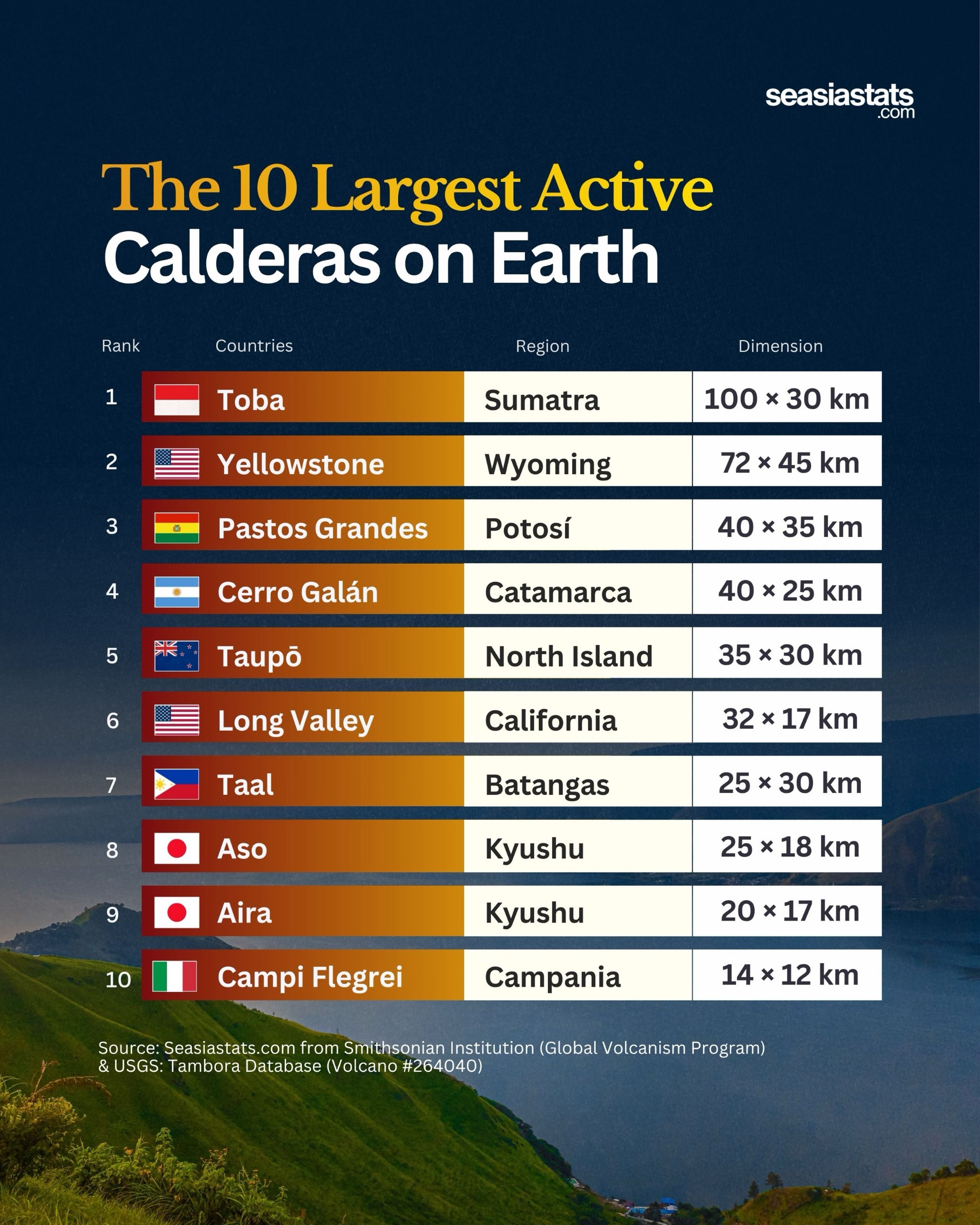
Calderas are among the largest volcanic structures on Earth. Unlike ordinary volcanic craters, which are generally relatively small depressions around a vent, calderas form when a volcanic system experiences a major eruption and the ground above a partially emptied magma reservoir collapses.
Some calderas extend for tens of kilometers and encompass lakes, mountains, cities, and entire volcanic landscapes.
Among the world's largest active or potentially active caldera systems, Toba in Indonesia is one of the most enormous.
Located on Sumatra, the Toba caldera measures approximately 100 × 30 kilometers. Its enormous dimensions were produced by the catastrophic Youngest Toba Tuff eruption roughly 74,000 years ago. The eruption ranks among the largest known explosive events in Earth's recent geological history.
The Yellowstone Caldera in the United States is another giant, measuring approximately 72 × 45 kilometers in the dimensions provided. Yellowstone has experienced several enormous caldera-forming eruptions, including the eruption of the Lava Creek Tuff about 631,000 years ago. The USGS describes the modern Yellowstone caldera as roughly 70 × 45 kilometers.
In Bolivia, Pastos Grandes measures about 40 × 35 kilometers, while Argentina's Cerro Galán extends approximately 40 × 25 kilometers. Both belong to the enormous volcanic systems of the Central Andes, where large ignimbrite-producing eruptions have shaped the high-altitude landscape over millions of years.
New Zealand's Taupō caldera measures around 35 × 30 kilometers. It remains one of the world's most significant active volcanic systems, with major eruptions occurring during the Quaternary period. The Taupō Volcanic Zone is also associated with several other large calderas. Frontiers
The United States is also home to Long Valley Caldera in California, measuring approximately 32 × 17 kilometers. The USGS describes its topographic dimensions as about 12 × 32 kilometers and notes that it formed approximately 760,000 years ago.
Asia contains several other enormous calderas. The Philippines' Taal measures roughly 25 × 30 kilometers, while Japan's Aso extends approximately 25 × 18 kilometers. Japan's Aira Caldera, meanwhile, measures around 20 × 17 kilometers and is associated with the active Sakurajima volcanic system.
Finally, Italy's Campi Flegrei, near Naples, measures approximately 14 × 12 kilometers. Although smaller than Toba or Yellowstone, it is a major active volcanic system and has experienced enormous explosive eruptions in the geological past.
Together, these calderas demonstrate the immense scale of Earth's volcanic processes. Their dimensions range from roughly 168 square kilometers to 3,000 square kilometers if simply approximated as rectangles, making them some of the most spectacular volcanic structures on the planet.