

The World's Largest Central Banks
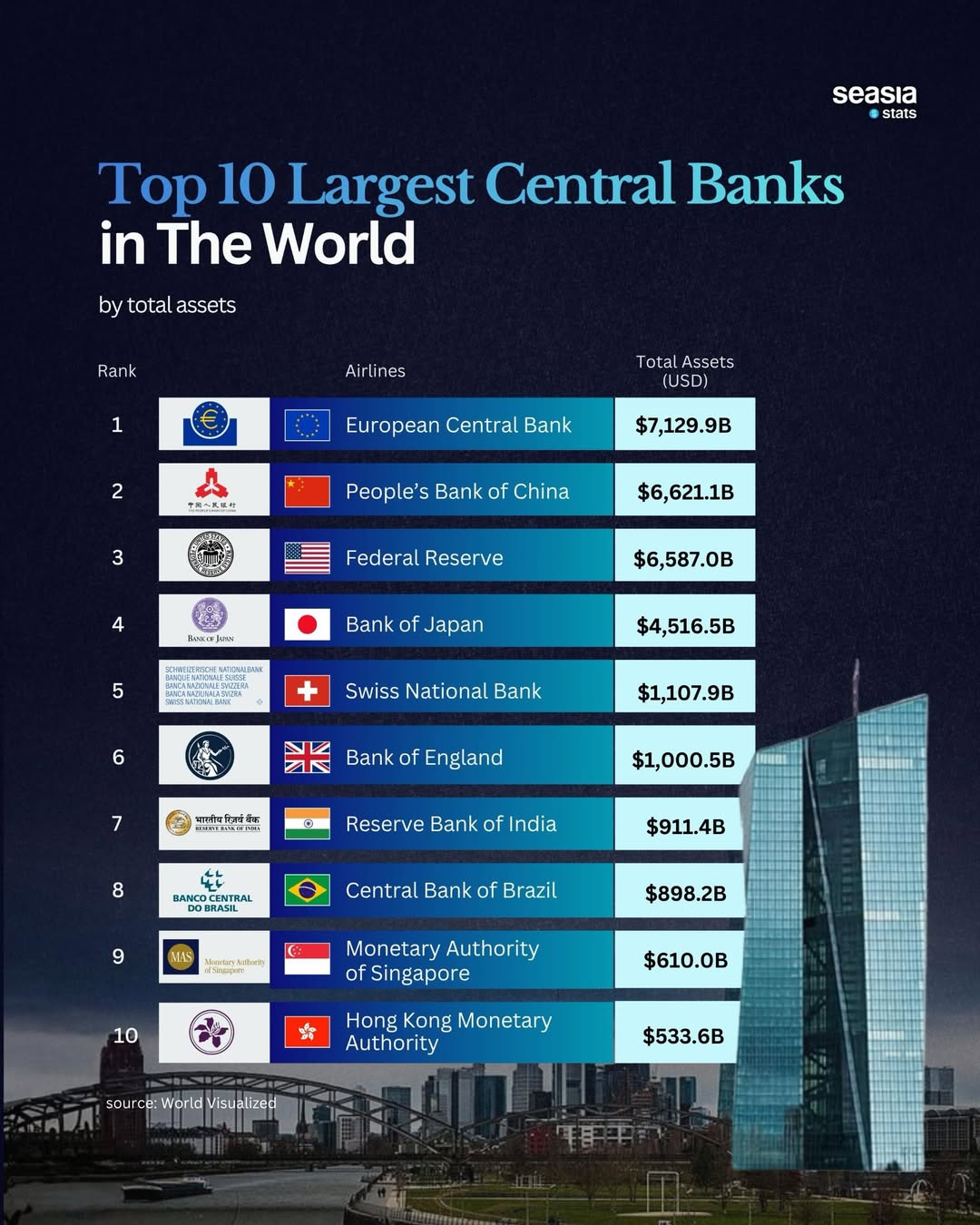
These central banks are the largest in the world, ranked by their total assets.

Central banks play a crucial role in maintaining financial stability, managing monetary policy, and supporting economic growth. In recent years, many central banks significantly expanded their balance sheets through asset purchases, foreign exchange reserves, and other monetary policy measures.
As a result, the size of their total assets has become an important indicator of their influence in the global financial system.
The largest central bank in the world by total assets is the European Central Bank (ECB), with assets totaling $7,129.9 billion. The ECB oversees monetary policy for the euro area and has expanded its balance sheet considerably through bond-buying programs aimed at supporting economic growth and controlling inflation.
Close behind is the People's Bank of China (PBOC), holding $6,621.1 billion in assets. As the central bank of the world's second-largest economy, the PBOC manages substantial foreign exchange reserves and plays a key role in maintaining financial stability in China.
The United States Federal Reserve ranks third with $6,587.0 billion in assets. Following the global financial crisis and the COVID-19 pandemic, the Fed expanded its balance sheet through quantitative easing programs designed to support liquidity and economic recovery.
Japan's central bank, the Bank of Japan (BOJ), holds $4,516.5 billion in assets. The BOJ has long pursued aggressive monetary easing policies to combat deflation and stimulate economic activity, making it one of the most active central banks in terms of asset purchases.
The Swiss National Bank ranks fifth with assets of $1,107.9 billion, followed by the Bank of England at $1,000.5 billion. Both institutions have accumulated significant assets through monetary policy operations and reserve management activities.
Among emerging economies, the Reserve Bank of India holds $911.4 billion in assets, while the Central Bank of Brazil manages $898.2 billion. These figures reflect the growing economic importance of both countries and the need to maintain substantial reserves and financial stability measures.
Rounding out the top ten are the Monetary Authority of Singapore with $610.0 billion and the Hong Kong Monetary Authority with $533.6 billion. Despite operating in relatively small economies, both institutions maintain large asset bases due to their roles as major international financial centers.
Together, these central banks represent a significant share of global financial assets. Their decisions influence interest rates, currency markets, inflation, and economic growth worldwide, underscoring their importance in the modern global economy.