

The World's Largest Merchant Fleets
From towering container vessels to fuel tankers and bulk carriers, the global merchant fleet is the backbone of modern trade.

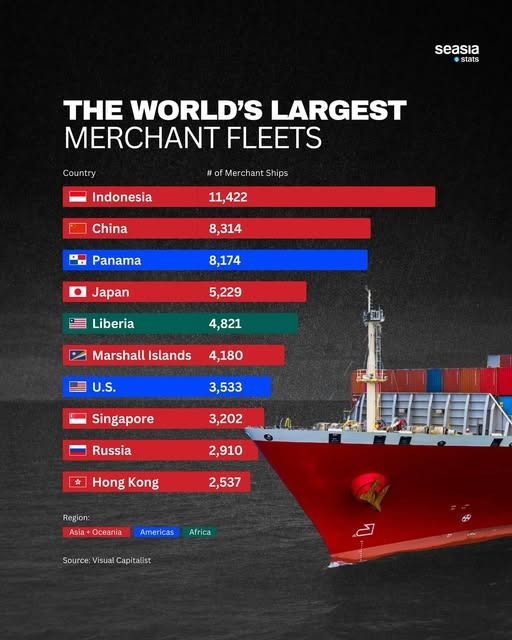
From towering container vessels to fuel tankers and bulk carriers, the global merchant fleet is the backbone of modern trade. In early 2026, new data compiled by Visual Capitalist and Seasia Stats reveals a striking leader: Indonesia, whose massive fleet of 11,422 ships makes it the largest maritime trading force in the world. More than just a statistic, the ranking highlights how geography, policy, and trade networks shape the global shipping industry—especially across Southeast Asia.
Indonesia Leads the World’s Maritime Network
Indonesia’s position at the top of the global merchant fleet rankings reflects its identity as the world’s largest archipelagic nation. With more than 17,000 islands, maritime transport is not just an economic sector—it is the country’s lifeline. Shipping connects major industrial hubs like Jakarta and Surabaya with remote provinces from Aceh to Papua.
Beyond domestic logistics, Indonesia also sits along some of the world’s busiest sea routes, including the Strait of Malacca and key Indonesian archipelagic sea lanes. This strategic geography, combined with growing export industries such as coal, palm oil, and manufactured goods, has driven the steady expansion of its merchant fleet.
Within Southeast Asia, Indonesia is not alone in shaping maritime flows. Singapore, ranked eighth globally with 3,202 ships, remains one of the most efficient port and logistics hubs on Earth. Meanwhile, Malaysia and Thailand—though not in the global top ten—play vital roles as key transshipment and industrial shipping centers in the region.
Asia’s Dominance in Global Shipping
A clear trend emerges from the rankings: Asia dominates global merchant fleets. China holds second place with 8,314 ships, reflecting its position as the world’s largest exporter. Japan follows in fourth with 5,229 vessels, continuing its legacy as a major maritime and shipbuilding nation.
Hong Kong, another Asian powerhouse, rounds out the top ten with 2,537 ships, while Singapore’s strong presence underscores Southeast Asia’s role as a maritime crossroads.
In total, seven of the world’s top ten merchant fleets are based in the Asia–Oceania region, illustrating how the center of global trade has shifted decisively toward Asia in recent decades.
The Role of Global Ship Registries
Not all fleets represent domestic shipping demand. Panama, Liberia, and the Marshall Islands—ranked third, fifth, and sixth—are known as “flags of convenience.” These countries allow shipowners worldwide to register vessels under their jurisdiction, offering tax advantages and flexible regulations.
Panama’s fleet of 8,174 ships is therefore less about domestic trade and more about global registry services. The same applies to Liberia and the Marshall Islands, which together manage thousands of internationally owned vessels.
Southeast Asia as a Maritime Crossroads
Southeast Asia’s strategic importance in global shipping cannot be overstated. The Strait of Malacca alone carries a significant portion of global oil and container traffic. Ports such as Singapore, Port Klang in Malaysia, and Tanjung Priok in Indonesia are critical nodes linking East Asia, the Middle East, and Europe.
Vietnam and the Philippines are also rapidly expanding their port infrastructure, reflecting rising trade volumes and regional integration under ASEAN frameworks. These developments reinforce Southeast Asia’s position as one of the most dynamic maritime regions in the world.
The Future of Global Shipping
As global trade continues to evolve, the dominance of Asian and Southeast Asian fleets is expected to grow even further. Investments in green shipping technology, digital port systems, and regional connectivity will shape the next chapter of maritime logistics.
For Indonesia and its neighbors, the sea is not just geography—it is opportunity. And in 2026, that opportunity is clearly reflected in the world’s largest merchant fleet sailing under the red-and-white flag.