

The World's Loneliest Countries
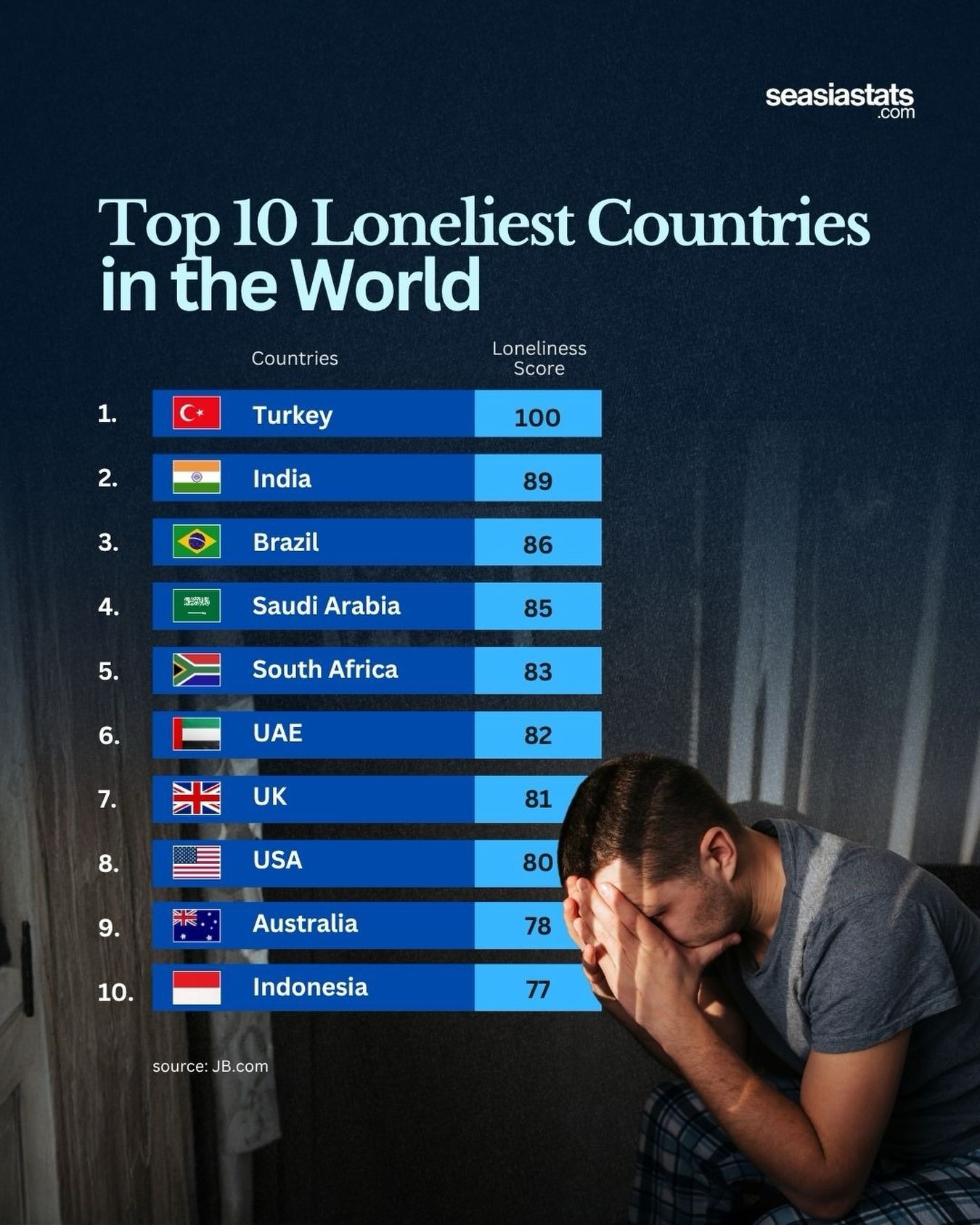
According to JB.com, Turkish people are the loneliest in the world.

Loneliness has become an important social issue around the world, affecting people regardless of age, culture, or living situation.
A 2026 global study by JB.com, covering 36 countries, ranked nations according to a composite “loneliness score” based on factors including feelings of loneliness and isolation, sadness, happiness, depression, and household patterns. Higher scores indicate a greater overall risk of loneliness.
Turkey ranks first, receiving a loneliness score of 100, the highest possible score in the ranking. The study reported that 61% of Turkish respondents experience loneliness, while 45% said they feel isolated. The findings suggest that loneliness can be connected to changing social structures and emotional well-being rather than simply living alone.
India ranks second with a score of 89. Its position is particularly notable because India has traditionally been associated with large families and strong community relationships.
According to reports on the study, 58% of Indian respondents said they feel lonely and 34% reported feeling isolated. Only 3.7% of Indian households are single-person households, demonstrating that people can experience loneliness even when surrounded by family members.
Brazil comes third with 86, followed by Saudi Arabia with 85 and South Africa with 83. These results demonstrate that loneliness is not limited to wealthy or highly individualistic societies. Different social, economic, and cultural circumstances can contribute to people's feelings of emotional disconnection.
The United Arab Emirates ranks sixth with 82, while the United Kingdom follows with 81. The United States receives a score of 80, placing it eighth overall. Australia, with 78, ranks ninth, while Indonesia completes the top ten with a score of 77.
One of the most interesting aspects of the study is that loneliness does not necessarily correspond to the number of people living in a household. A person can live with parents, children, relatives, or roommates and still feel emotionally disconnected.
Conversely, living alone does not automatically mean that someone feels lonely. The study therefore emphasizes the importance of meaningful relationships and emotional connection, rather than simply physical proximity to other people.
Overall, the JB.com ranking highlights the complexity of loneliness in modern societies. From Turkey and India to the United States and Indonesia, people can experience isolation in very different cultural environments.
The findings suggest that addressing loneliness requires more than simply bringing people together, it also requires creating opportunities for genuine friendship, communication, trust, and meaningful social connections.