

The World's Most Linguistically Diverse Countries
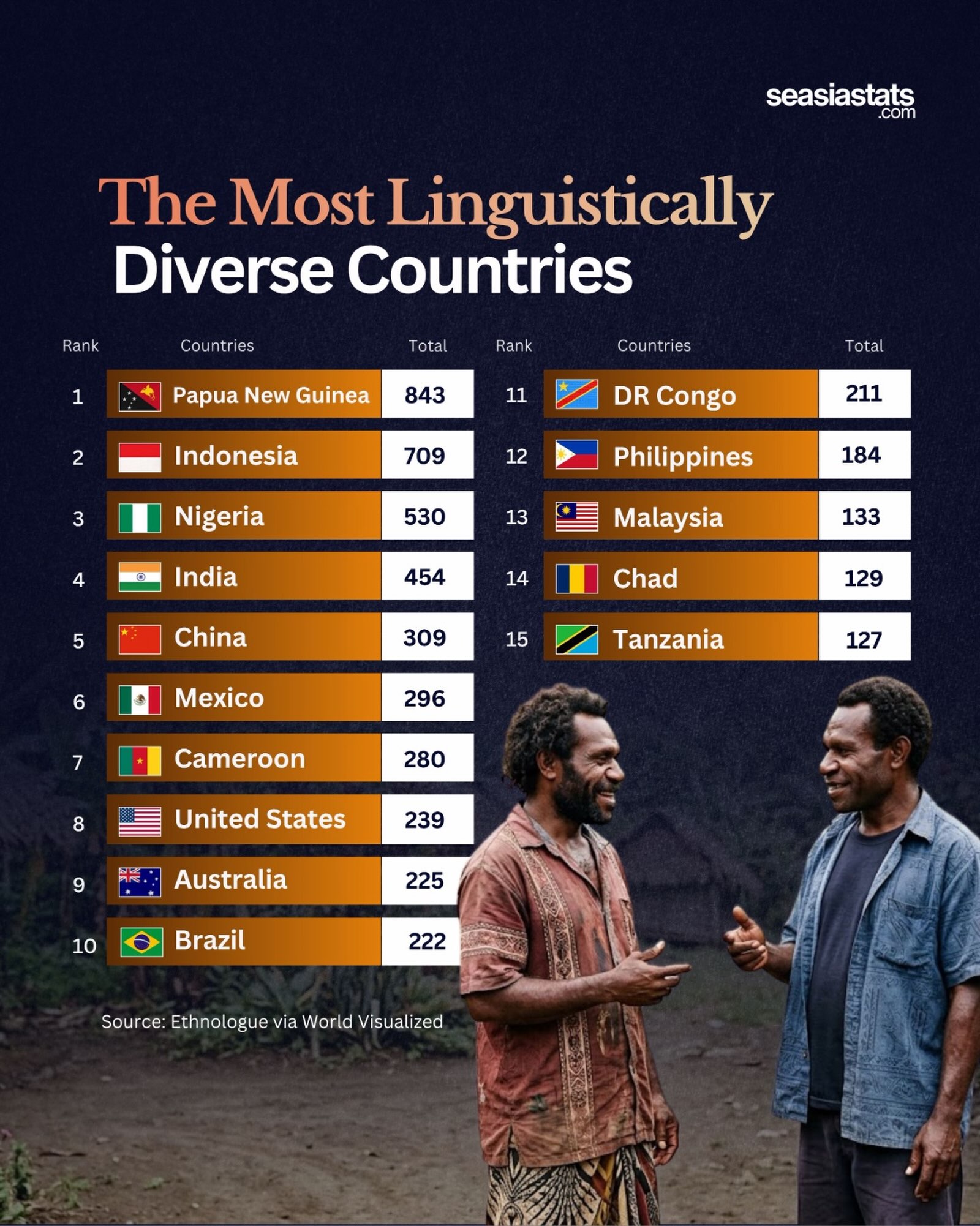
Papua New Guinea has the most languages in the world with 843.

Language is an important part of human culture because it allows people to communicate, express their identities, and preserve their traditions. Around the world, thousands of languages are spoken by different communities, making linguistic diversity an essential part of cultural heritage.
According to the figures from Ethnologue, several countries stand out for having exceptionally large numbers of languages, reflecting their complex histories, diverse populations, and rich cultural traditions.
Papua New Guinea ranks first among the most linguistically diverse countries in the world, with 843 languages. Despite its relatively small population, its mountainous terrain and isolated communities have contributed to the development of many distinct languages.
Indonesia ranks second, with 709 languages, reflecting its thousands of islands and numerous ethnic groups. Nigeria follows with 530 languages, demonstrating the country's remarkable cultural diversity and the presence of many ethnic communities.
India ranks fourth, with 454 languages, representing its wide variety of regional identities and linguistic traditions.
China has 309 languages, including numerous languages and varieties associated with its many ethnic groups. Mexico follows with 296 languages, many of which belong to Indigenous communities that have preserved their linguistic heritage for generations.
Cameroon has 280 languages, making it one of Africa's most linguistically diverse countries. The United States has 239 languages, reflecting Indigenous languages, immigrant communities, and the country's long history of migration.
Australia, with 225 languages, is also notable for its Aboriginal and Torres Strait Islander languages, although many Indigenous languages face serious threats of extinction.
Brazil has 222 languages, including Portuguese and numerous Indigenous languages that represent the country's original inhabitants.
The Democratic Republic of the Congo follows with 211 languages, illustrating the linguistic richness of Central Africa. Meanwhile, the Philippines has 184 languages, reflecting the diversity of its island communities and regional cultures.
Malaysia has 133 languages, representing its Indigenous peoples and its Malay, Chinese, Indian, and other communities. Chad has 129 languages, highlighting its diverse ethnic groups and cultural traditions across the Sahel region.
Tanzania completes the list with 127 languages, demonstrating the linguistic richness of East Africa, where many communities continue to use their traditional languages alongside national and international languages.
Overall, these countries demonstrate that linguistic diversity is closely connected to geography, migration, history, and cultural identity. However, having many languages also presents challenges, particularly in education, communication, and language preservation.
Many languages face declining numbers of speakers as younger generations adopt more widely used languages. Protecting linguistic diversity is therefore essential for preserving traditional knowledge, cultural identity, and the unique heritage of communities around the world.