

The World's Most Powerful Navies
The United States Navy is still the most powerful in the world.

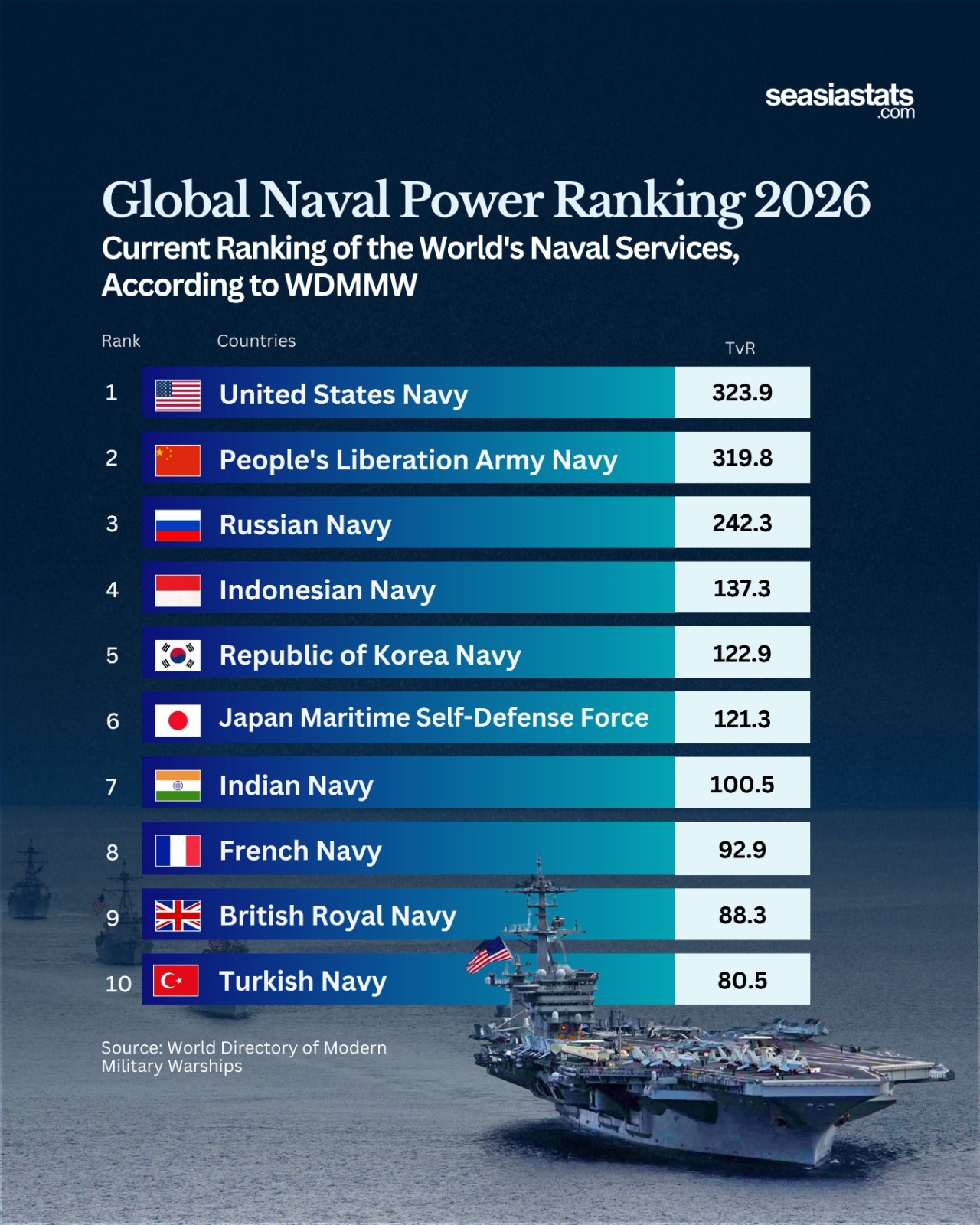
Naval power remains a critical component of national security, maritime trade protection, and geopolitical influence in 2026.
According to the World Directory of Modern Military Warships (WDMMW), the world's leading navies demonstrate varying levels of capability based on a range of factors used to assess their overall strength. The ranking highlights the continuing competition between established maritime powers and the growing capabilities of naval forces across Asia.
The United States Navy ranks first with a score of 323.9, maintaining its position as a leading global maritime force. Its extensive fleet, aircraft carriers, nuclear-powered submarines, advanced destroyers, and worldwide operational reach enable the United States to project military power across multiple oceans.
In second place, the People's Liberation Army Navy (PLAN) of China scores 319.8. Its rapid modernization, expanding fleet, and increasing emphasis on aircraft carriers, submarines, and advanced surface combatants reflect China's ambitions to strengthen its maritime influence and protect its regional interests.
The Russian Navy ranks third with a score of 242.3. Its capabilities include nuclear-powered submarines, strategic missile platforms, and surface vessels designed for a range of military operations. Despite challenges involving fleet modernization and maintenance, Russia retains significant naval capabilities, particularly in its submarine forces.
A notable result in the 2026 ranking is the Indonesian Navy, which places fourth with 137.3. Indonesia's position reflects the strategic importance of its extensive archipelago, which stretches across vital maritime routes between the Indian and Pacific oceans. Protecting territorial waters and maintaining maritime security are central priorities for the country.
The Republic of Korea Navy ranks fifth with 122.9, followed closely by Japan's Maritime Self-Defense Force, scoring 121.3. Both forces possess modern warships and sophisticated maritime technologies, supporting regional security and cooperation in Northeast Asia.
India's Navy occupies seventh place with 100.5, reflecting its growing emphasis on aircraft carriers, submarines, and indigenous shipbuilding. France ranks eighth with 92.9, maintaining a capable blue-water navy with nuclear-powered submarines and an aircraft carrier.
The British Royal Navy takes ninth place with 88.3, supported by its aircraft carriers, nuclear submarine fleet, and international operational commitments. Completing the top ten, the Turkish Navy scores 80.5, benefiting from a substantial regional fleet and ongoing naval modernization programs.
Overall, the 2026 ranking illustrates the diversity of global naval capabilities, from worldwide power projection to regional maritime defense. However, these scores should not be interpreted as direct measures of combat effectiveness or guaranteed battlefield outcomes.
Naval strength also depends on training, logistics, readiness, technology, and operational experience. The ranking offers a comparative overview, while the strategic value of each navy ultimately depends on its missions and the maritime environment in which it operates.