

The World's Top Financial Centers in 2026
New York City is still the world's top financial center according to Global Financial Centres Index.

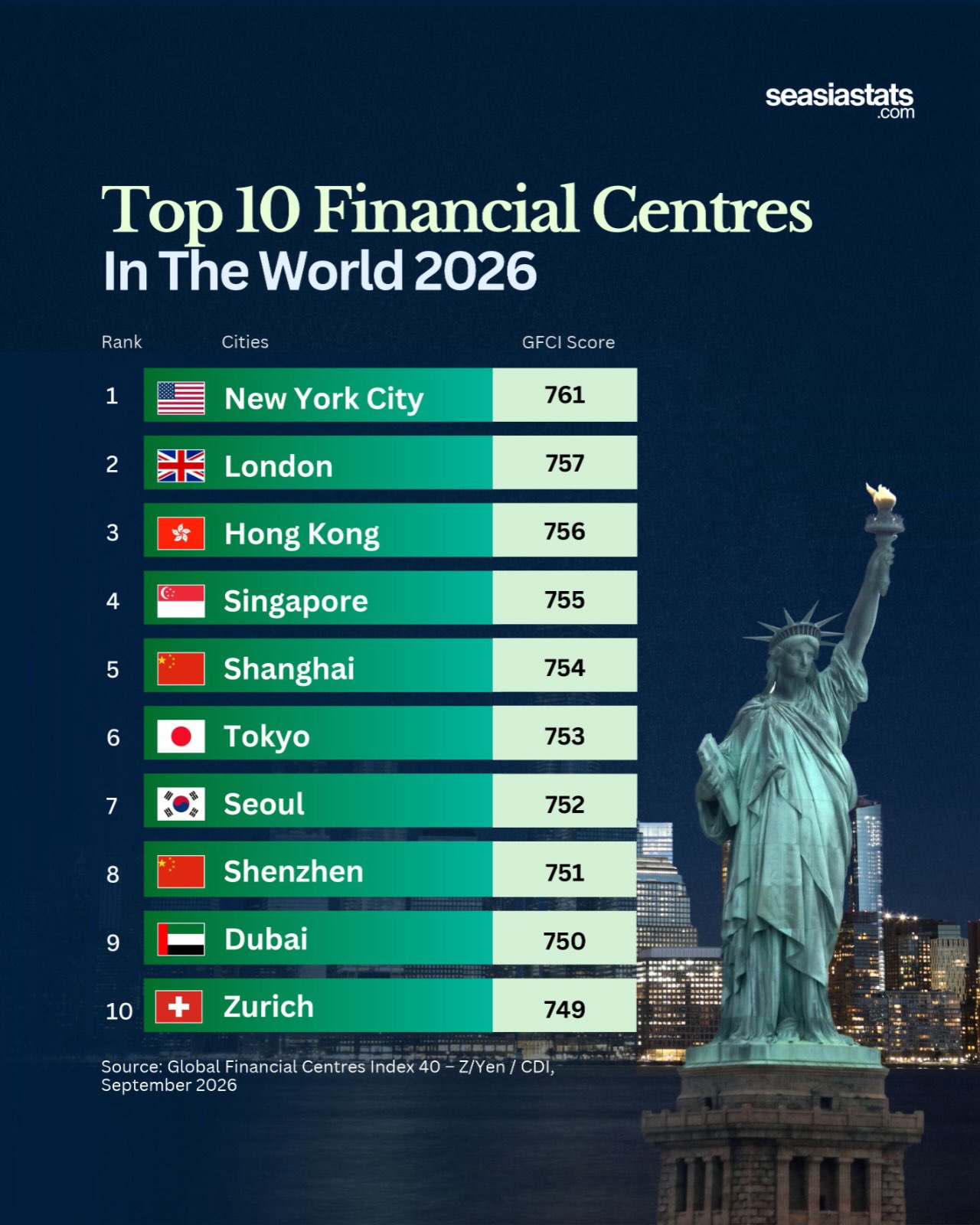
Financial centers play a vital role in the global economy by facilitating international trade, investment, banking, and financial services. According to the Global Financial Centres Index (GFCI) 2026, these are the top 10 financial centers in the world.
The rankings highlight the importance of these cities in shaping global financial markets and supporting economic growth.
New York City takes first place with a score of 761 points. As home to Wall Street, the New York Stock Exchange, and numerous international financial institutions, the city remains a major hub for investment, securities trading, and capital markets. Its strong financial infrastructure and influence over the global economy help maintain its leading position.
London ranks second with 757 points, demonstrating its continued importance in international finance. The British capital is widely recognized for its foreign exchange market, banking industry, insurance services, and connections to financial markets worldwide.
Meanwhile, Hong Kong occupies third place with 756 points. Its strategic position as a gateway between mainland China and international markets makes it an essential center for investment, banking, and securities trading.
Singapore follows closely in fourth place with 755 points. The city-state has established itself as a leading Asian financial hub through its stable business environment, effective regulation, and strong wealth management industry.
Shanghai ranks fifth with 754 points, reflecting China's growing financial influence and the city's importance in banking, securities trading, and domestic capital markets.
Tokyo secures sixth place with 753 points, supported by Japan's advanced economy and established financial institutions. As one of Asia's most significant financial hubs, the Japanese capital plays an important role in investment, banking, and international business.
Seoul ranks seventh with 752 points, benefiting from technological innovation, modern infrastructure, and the strength of South Korea's corporate sector.
Shenzhen takes eighth place with 751 points. Known for its technology industry and entrepreneurial spirit, the Chinese city has become an increasingly important center for financial services and innovation.
Dubai ranks ninth with 750 points, benefiting from its strategic location between Europe, Asia, and Africa. Its international business environment attracts financial institutions, investors, and multinational companies.
Finally, Zurich completes the top ten with 749 points. Switzerland's financial expertise, particularly in private banking, wealth management, and asset management, strengthens the city's global reputation.
Overall, the 2026 rankings demonstrate the continued dominance of established financial hubs alongside the growing influence of Asian and Middle Eastern cities.
With scores separated by only 12 points between first and tenth place, the competition remains intense, highlighting the importance of innovation, stability, infrastructure, and international connectivity in maintaining global financial leadership.