

The World's Top Rice Producing Countries in 2025/2026
India and China are leading the rice production worldwide.

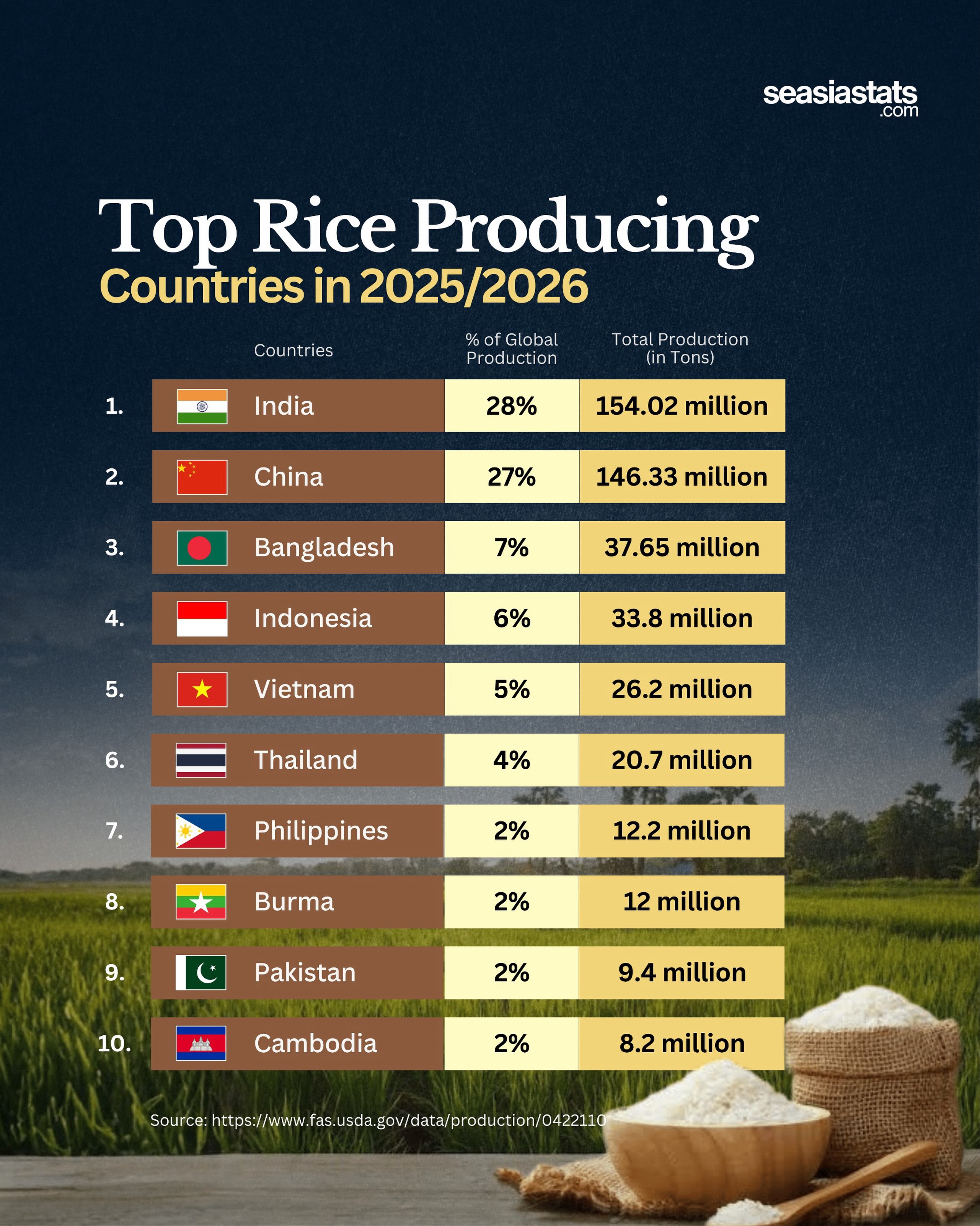
Rice remains one of the world's most important staple foods, feeding more than half of the global population and serving as a cornerstone of food security. In the 2025/2026 production season, Asia continues to dominate global rice production, with the world's leading producers accounting for the majority of total output.
Their strong agricultural capacity, favorable climates, and extensive farming traditions ensure a stable supply for both domestic consumption and international trade.
India remains the world's largest rice producer, contributing 28% of global production with an estimated 154.02 million tons. Its vast agricultural land, diverse growing regions, and continued improvements in farming practices have enabled the country to maintain its leading position.
Closely following is China, which accounts for 27% of global production with 146.33 million tons. China's advanced agricultural technologies and high-yield cultivation methods help sustain its enormous domestic demand while supporting overall global supply.
Bangladesh ranks third, producing 37.65 million tons, representing 7% of global rice production. Rice is central to the country's agriculture and food security. Indonesia follows with 33.8 million tons, contributing 6% of the global total. Government initiatives to improve productivity and strengthen food self-sufficiency continue to support the country's rice sector.
Vietnam contributes 26.2 million tons, accounting for 5% of world production. In addition to meeting domestic demand, Vietnam is one of the world's leading rice exporters. Thailand, another major exporter, produces 20.7 million tons, representing 4% of global output. Thai rice is widely recognized for its quality and remains highly competitive in international markets.
The next group of producers each contributes 2% of global production. The Philippines produces 12.2 million tons, while Myanmar follows closely with 12 million tons. Pakistan contributes 9.4 million tons, supported by its irrigated farming systems and growing export market.
Cambodia rounds out the top ten with 8.2 million tons, continuing to expand its presence in the global rice trade through improved production efficiency and premium rice varieties.
Together, these ten countries account for the overwhelming majority of global rice production, highlighting Asia's dominant role in the world's rice industry. Their combined output supports billions of consumers, stabilizes international food markets, and contributes significantly to global food security.
As demand for rice continues to grow alongside population increases, these leading producers will remain essential in ensuring a reliable and sustainable supply of one of the world's most important food crops.