

These Countries Are Where AI Talent Is Growing the Most
AI talent is having its best development in these countries.

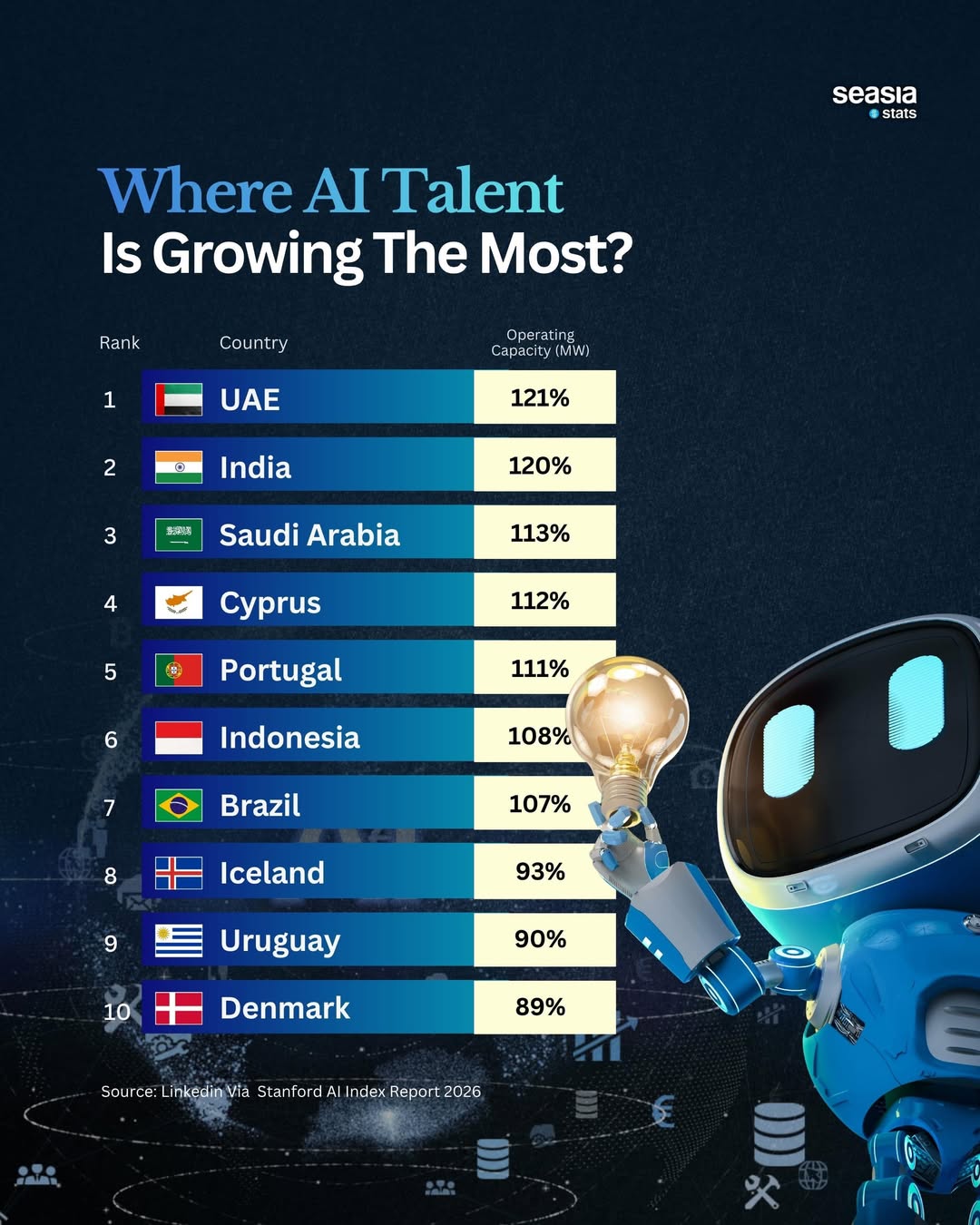
The global artificial intelligence (AI) landscape is undergoing a significant transformation as emerging economies rapidly build both human capital and computing infrastructure. According to the Stanford AI Index Report 2026, several countries recorded exceptional growth in AI talent, reflecting increasing investments in education, research, and digital innovation.
At the same time, governments and industry leaders are expanding AI computing capacity, measured in megawatts (MW), to support the growing demand for AI training and deployment.
The United Arab Emirates (UAE) leads the ranking with a remarkable 121% increase in AI talent. The country has positioned itself as a regional AI hub through ambitious national strategies, major investments in data centers, and partnerships with global technology firms.
India follows closely with 120% growth, benefiting from its large pool of engineers, expanding startup ecosystem, and government initiatives aimed at accelerating AI adoption across industries.
Saudi Arabia ranks third with 113% growth in AI talent, supported by large-scale investments in sovereign AI infrastructure and workforce development programs. Cyprus (112%) and Portugal (111%) also demonstrated strong momentum, reflecting their efforts to attract technology investment and skilled professionals.
Indonesia, with 108% growth, has emerged as one of Southeast Asia’s most promising AI markets. Rapid digitalization, a young workforce, and growing interest from technology companies have strengthened the country’s AI ecosystem. Brazil (107%) similarly benefits from a large domestic market and increasing investments in innovation and research.
Among smaller but highly dynamic economies, Iceland recorded 93% growth, Uruguay 90%, and Denmark 89%. These countries are leveraging advanced digital infrastructure, strong educational systems, and supportive public policies to develop competitive AI sectors despite their relatively small populations.
The rise of AI talent is closely linked to the availability of computing infrastructure. Stanford’s AI Index 2026 reports that global AI compute capacity has expanded dramatically, while AI data-center power capacity reached approximately 29.6 gigawatts (29,600 MW) in 2025.
This rapid growth reflects the increasing need for high-performance computing resources to train advanced AI models and support large-scale deployment. Countries investing in both talent development and computing infrastructure are likely to gain a significant competitive advantage in the global AI economy.
As AI becomes a key driver of economic growth and technological leadership, the experiences of the UAE, India, Saudi Arabia, Indonesia, Brazil, and other fast-growing markets demonstrate that the future of AI innovation will be increasingly global, extending well beyond traditional technology centers.