

Top 10 Asian countries with the largest freshwater reserves
Asia is home to some of the world’s largest freshwater reserves, led decisively by China, Indonesia, and India. China tops the list with approximately 2,813 b

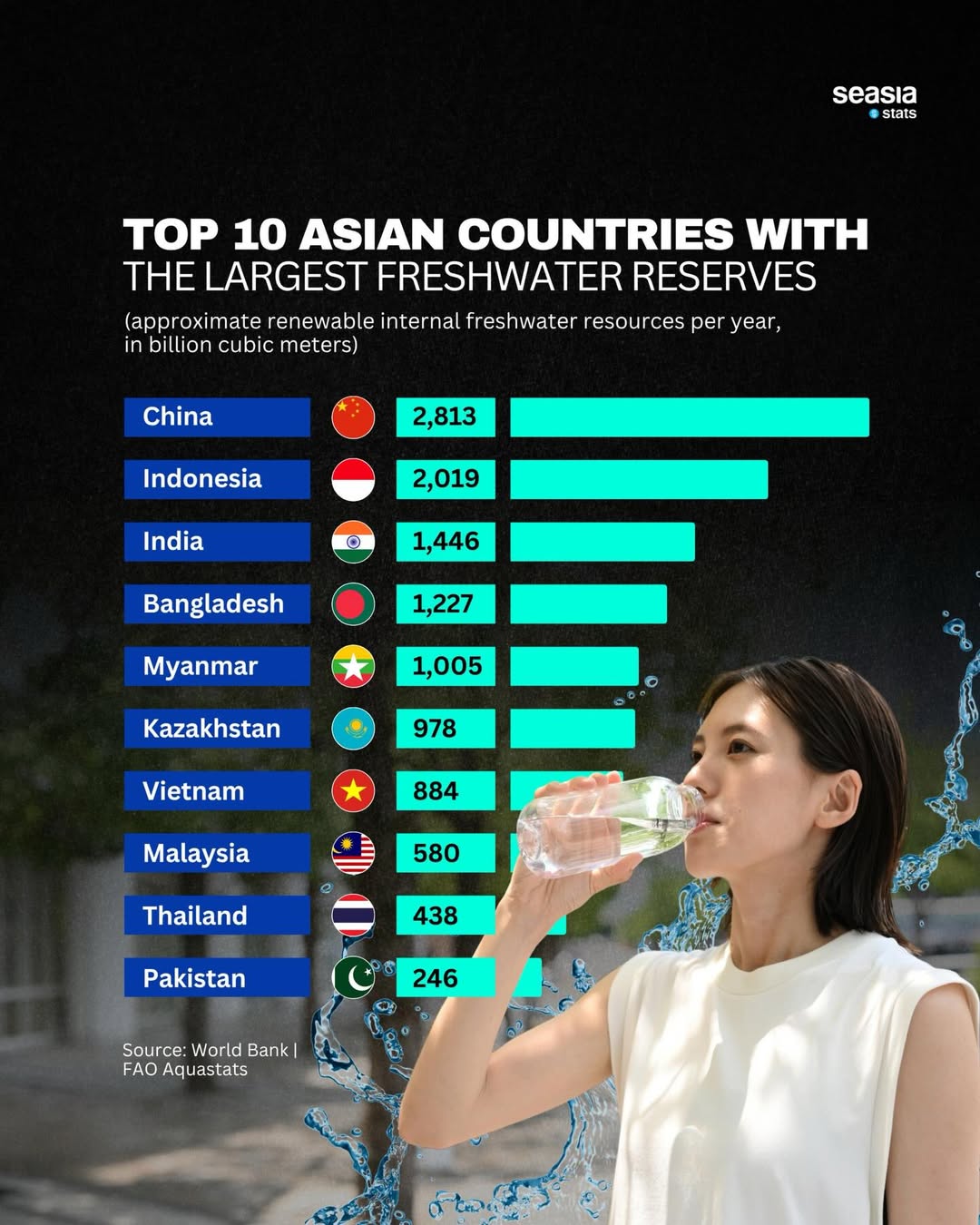
Asia is home to some of the world’s largest freshwater reserves, led decisively by China, Indonesia, and India. China tops the list with approximately 2,813 billion cubic meters of renewable internal freshwater resources per year, reflecting the scale of major river systems such as the Yangtze and Yellow rivers.
Indonesia ranks second with 2,019 billion cubic meters, standing out as Southeast Asia’s freshwater giant thanks to its vast archipelago, heavy rainfall, and dense river networks. India, in third place with 1,446 billion cubic meters, relies heavily on monsoon-fed rivers like the Ganges, Brahmaputra, and Indus to sustain its large population and agricultural base.
Beyond the top three, several Southeast Asian countries also feature prominently, underscoring the region’s overall water abundance. Vietnam, Malaysia, and Thailand all appear in the top 10, supported by river basins such as the Mekong and Chao Phraya.
This abundance plays a critical role in sustaining major cities—Ho Chi Minh City, Hanoi, Kuala Lumpur, and Bangkok—where freshwater underpins domestic use, industry, and food supply, while also supporting economic growth and urban expansion.
However, the presence of large freshwater reserves does not automatically guarantee water security for cities. Rapid urbanization, pollution, climate change, and uneven distribution pose growing challenges across Southeast Asia. Cities like Jakarta, despite Indonesia’s vast national reserves, face flooding, groundwater depletion, and water quality issues.
As the data shows, Southeast Asia is rich in water resources, but sustainable management will be crucial to ensure that its cities can continue to thrive in the decades ahead.