

Top 10 Biggest Economies in Asia 2025
According to the International Monetary Fund’s 2026 projections, Asia continues to anchor a massive share of global economic output, though the scale is far fro

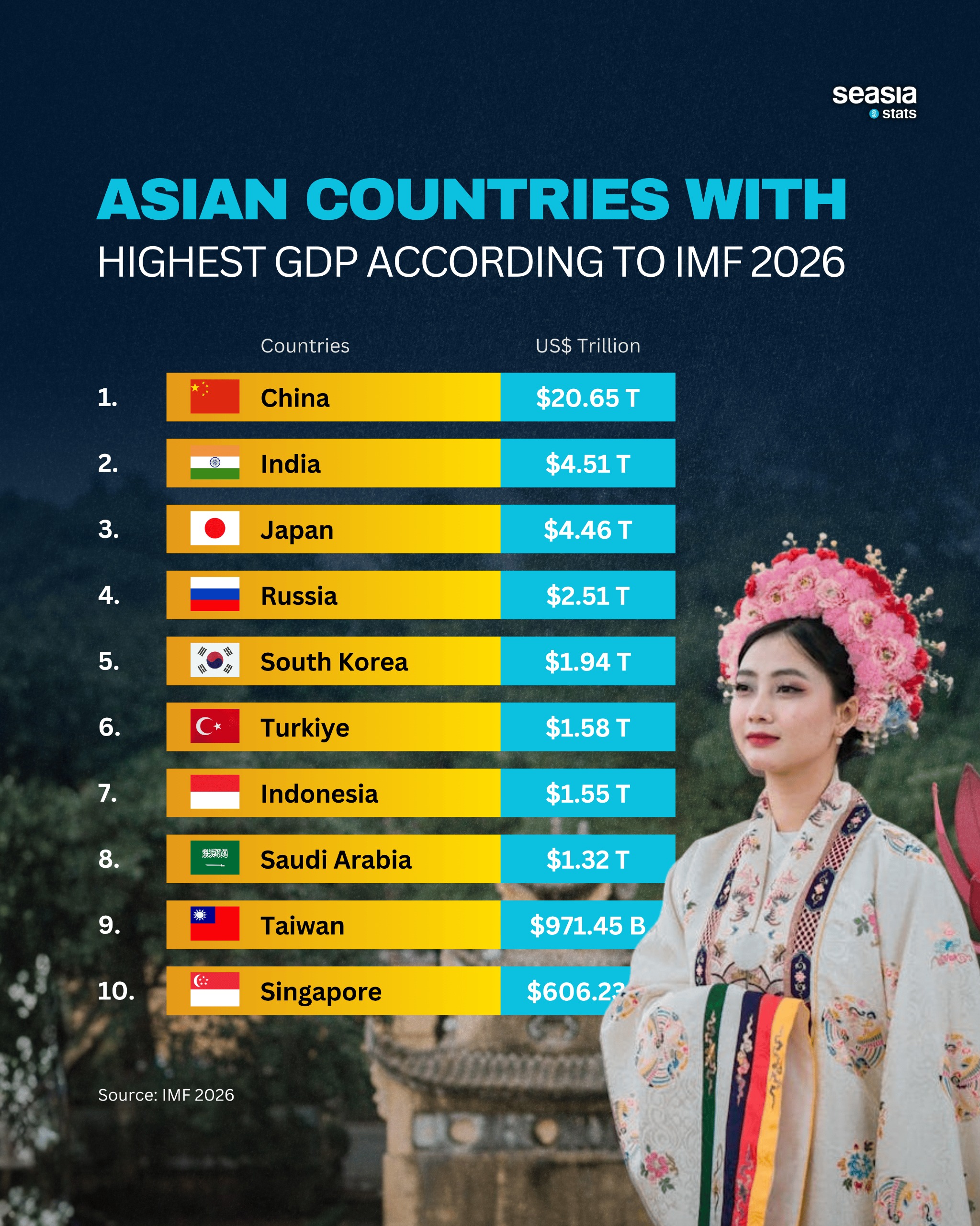
According to the International Monetary Fund’s 2026 projections, Asia continues to anchor a massive share of global economic output, though the scale is far from evenly distributed. The top 10 economies on the continent alone account for tens of trillions of dollars in output, reflecting a mix of population giants, advanced manufacturers, and resource-rich states.
China remains in a league of its own with a projected GDP of $20.65 trillion, more than four times the size of the next largest Asian economy. Its dominance is driven by manufacturing scale, a vast domestic market, and continued investment in infrastructure and technology sectors. While growth has moderated compared to the 2010s, the sheer base size keeps China as the undisputed regional heavyweight.
The battle for second place has tightened dramatically. India edges ahead with $4.51 trillion, narrowly surpassing Japan at $4.46 trillion. India’s position reflects years of strong services and consumption growth, plus a demographic dividend that keeps labor force expansion positive. Japan, despite decades of slower growth and an aging population, maintains its spot through high productivity, advanced industry, and global export strength in autos and electronics.
Russia comes in fourth at $2.51 trillion. Its economy is heavily influenced by energy exports and commodities, making it distinct from the manufacturing-led economies around it. Following closely is South Korea with $1.94 trillion, a testament to its global leadership in semiconductors, consumer tech, and shipbuilding despite a population under 52 million.
The middle of the top 10 shows how close the competition has become among emerging and mid-sized powers. Türkiye posts $1.58 trillion, driven by a large domestic market and a strategic location bridging Europe and Asia. Just behind is Indonesia at $1.55 trillion, the largest economy in Southeast Asia. Indonesia’s growth is underpinned by natural resources, a population of over 280 million, and rising domestic consumption, which is a key story for the ASEAN region overall.
Saudi Arabia ranks eighth with $1.32 trillion, with oil and ongoing diversification efforts under Vision 2030 shaping its trajectory. The final two spots highlight the economic punch of smaller but highly developed territories. Taiwan records $971.45 billion, powered by its world-leading semiconductor ecosystem that makes it indispensable to global supply chains. Singapore rounds out the list at $606.23 billion, remarkable for a city-state of 6 million people, built on finance, trade, and high-value services.
Taken together, the 2026 IMF snapshot shows Asia’s economic story in three layers. China stands alone at the top, India and Japan form a competitive second tier, and a diverse group of resource, manufacturing, and service economies make up the rest. The narrow gaps between India and Japan, and between Türkiye and Indonesia, suggest the rankings could continue to shift as demographics, tech cycles, and energy markets evolve.