

Top 10 Foreign Nationalities Living in South Korea
Chinese is the most common foreign nationality living in South Korea in 2025.

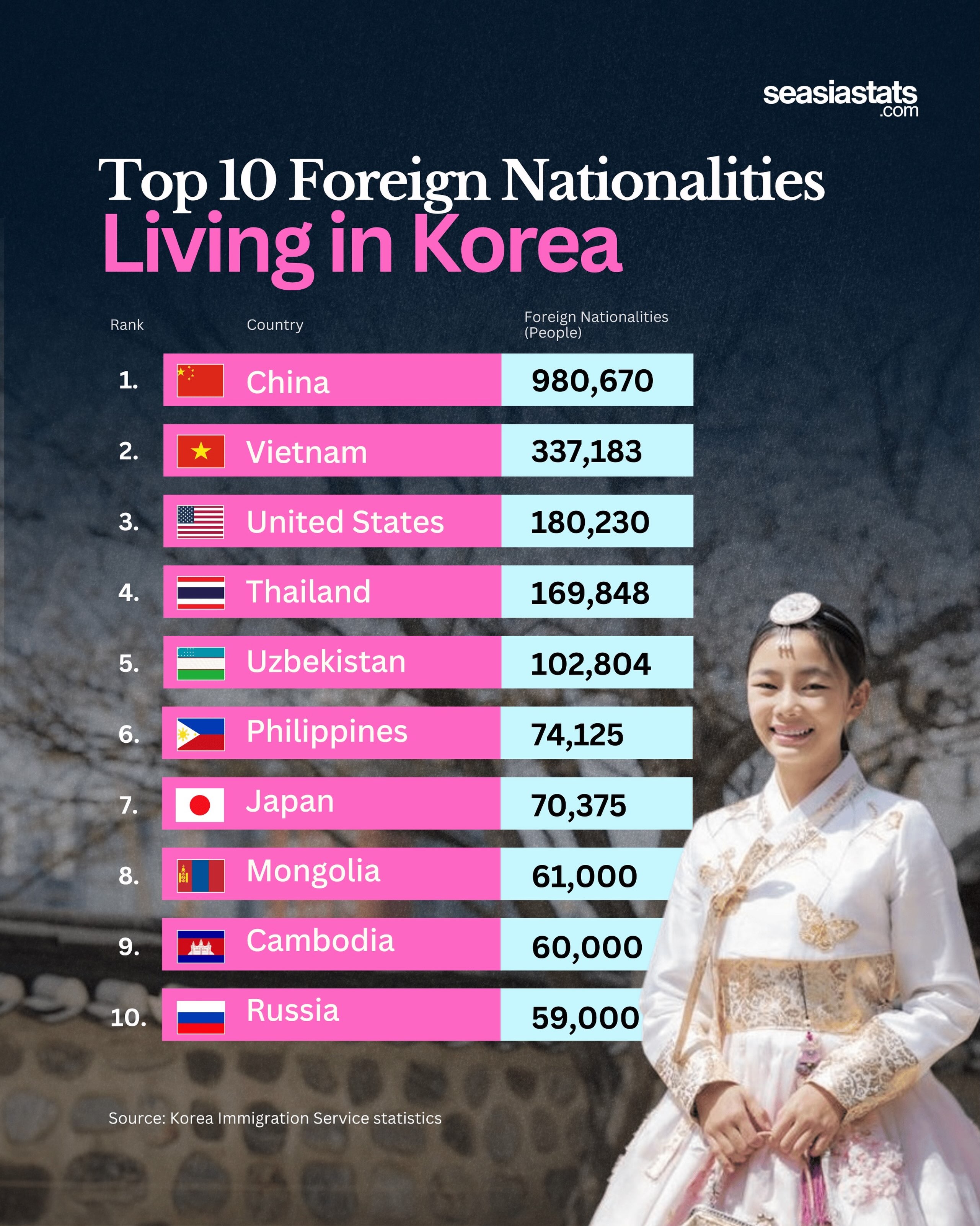
South Korea has become increasingly diverse, with millions of foreign nationals living, working, studying, and building communities across the country. According to the Korea Immigration Service’s latest statistics, there were 2,783,247 foreign residents in South Korea at the end of 2025, representing a continued increase in the country’s foreign population.
Among the foreign nationalities, Chinese nationals form by far the largest group, numbering 980,670, or about 35.2 percent of all foreign residents. The figure includes Korean-Chinese nationals, making China’s community particularly significant in South Korea’s demographic landscape.
Vietnamese nationals are the second-largest group, with 337,183 people, accounting for 12.1 percent. The Vietnamese population has grown substantially in recent years, reflecting expanding economic, educational, and family connections between the two countries.
The United States ranks third, with 180,230 American nationals, followed closely by Thailand, which has 169,848 nationals living in Korea. The Uzbekistani community ranks fifth, with 102,804 people. Together, these figures demonstrate that South Korea’s foreign population is increasingly diverse, with communities originating from both Asia and the West.
The remaining five nationalities in the top ten are the Philippines, Japan, Mongolia, Cambodia, and Russia. There are 74,125 Filipinos and 70,375 Japanese living in South Korea. The Mongolian and Cambodian communities each number approximately 60,000, while the Russian community is estimated at around 59,000 according to the figures provided.
These communities contribute to many aspects of Korean society, including manufacturing, construction, education, international business, hospitality, agriculture, and cultural exchange. Their presence is also visible in neighborhoods, restaurants, businesses, schools, and community organizations throughout the country.
The statistics highlight an important demographic change in South Korea. As the country faces population aging and a declining birth rate, foreign residents are becoming an increasingly important part of its workforce and society.
The steady growth of communities from Vietnam, Uzbekistan, the Philippines, and other countries also shows that migration to South Korea is no longer limited to a small number of nationalities.
Overall, the top ten nationalities illustrate South Korea’s transition toward a more multicultural society. With foreign residents now numbering more than 2.7 million, their contributions and integration will likely play an increasingly important role in the country’s social and economic future.