

Top 10 Most Beautiful Cities in Asia 2026
Beauty rankings are always subjective, but they still tell us something important about how a region is being seen.

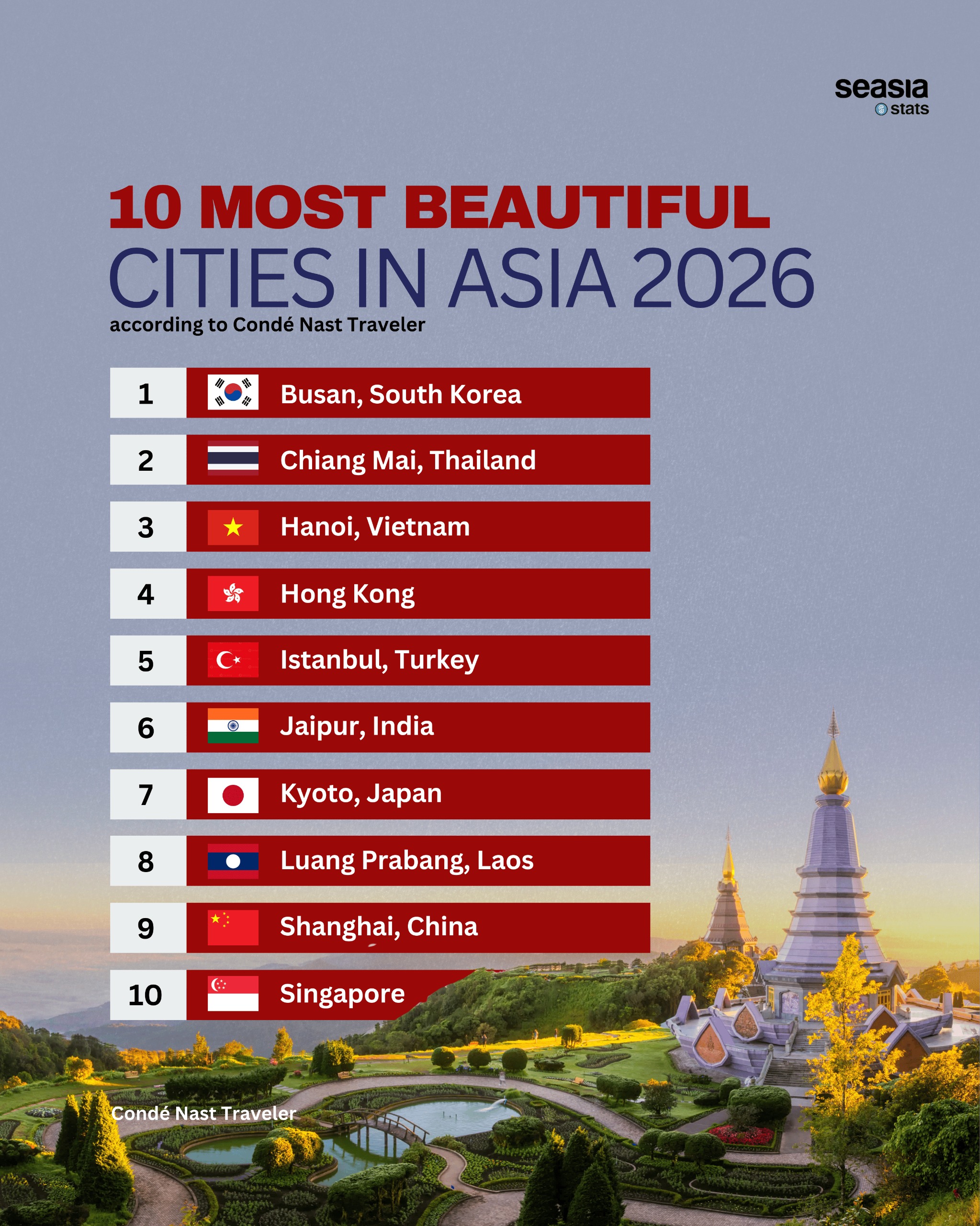
Beauty rankings are always subjective, but they still tell us something important about how a region is being seen. In Condé Nast Traveler’s 2026 list of Asia’s most beautiful cities, Southeast Asia doesn’t just appear—it dominates. From temple towns and colonial quarters to mountain capitals and futuristic garden skylines, the region makes a powerful case that beauty in Asia is not defined by one style alone, but by layers of history, atmosphere, and everyday life.
Southeast Asia Owns the List
Among the top 10, five cities come from Southeast Asia: Chiang Mai at No. 2, Hanoi at No. 3, Luang Prabang at No. 8, and Singapore at No. 10, with the broader regional travel conversation also heavily favoring Southeast Asia in recent years. Even with Busan taking the top spot overall, the deeper story here is that Southeast Asia remains one of the most visually and culturally compelling urban regions in the world.
Condé Nast Traveler’s own language captures why these places resonate. Describing Hanoi, the magazine wrote that the Vietnamese capital feels like “a distilled version of Southeast Asia itself—elegant, timeworn, and delicious.” It is hard to find a better summary of why cities in this region keep capturing travelers’ imagination.
That same list praised Chiang Mai as a city that has “evolved into a must-do on the Southeast Asia circuit,” highlighting not just its old temples and mountain air, but its mood—creative, spiritual, and quietly cinematic.
Why These Cities Feel So Magnetic
What makes an Asian city “beautiful” in 2026 is not just postcard architecture. It is the ability to combine place, memory, and movement.
Take Chiang Mai. Its appeal lies not in grand skyline spectacle, but in how nature and culture fold into each other. Forest temples, old Lanna walls, artisan cafés, and mountain roads all coexist within a city that feels contemplative rather than overwhelming. It is a beauty you walk through slowly.
Hanoi, by contrast, is beautiful in layers. French-era villas, yellow façades, incense-filled pagodas, tree-lined boulevards, and a constant ballet of scooters and street food all create a city that feels alive rather than polished. Its beauty is not sterile; it is textured.
Then there is Luang Prabang, perhaps the most understated city on the list. With its saffron-robed monks, Mekong River light, French-colonial architecture, and Buddhist calm, it represents the softer side of urban beauty—one rooted in stillness and ritual. It is no surprise that Laos continues to gain admiration among travelers seeking slower, more soulful destinations.
And Singapore proves that beauty in Asia does not have to be ancient to be profound. The city-state’s appeal lies in its meticulous blending of nature and modernity: skyline and canopy, glass and orchid, hawker center and luxury district. It may be hyper-modern, but it is also deeply intentional.
Southeast Asia’s Urban Renaissance
This ranking also reflects a wider travel shift. Southeast Asia is no longer seen merely as a backpacker route or beach region—it is increasingly being appreciated as a civilizational crossroads where cities carry centuries of trade, migration, religion, and empire.
Condé Nast Traveler recently emphasized this broader regional fascination in its 2026 Southeast Asia feature, noting the region’s “pristine tropical beaches, lush landscapes, beautiful ancient ruins, and vibrant cultural scenes.” That same sensibility explains why its cities are now standing shoulder to shoulder with iconic destinations like Kyoto, Istanbul, and Hong Kong.
For Southeast Asia, that matters. Rankings like this are not just vanity lists—they shape tourism flows, city branding, and how global travelers imagine the region.
More Than Pretty Places
In the end, the most beautiful cities are not simply the most photogenic. They are the ones that leave an emotional afterimage.
That is why this list feels so telling. From Chiang Mai’s spiritual hush to Hanoi’s romantic chaos, from Luang Prabang’s serenity to Singapore’s engineered elegance, Southeast Asia is not offering one version of beauty. It is offering many.
And perhaps that is exactly why the region keeps winning hearts: not because it looks perfect, but because it feels unforgettable.