

Top 10 Most Respected "Made In" Labels Worldwide
In a world where supply chains stretch across continents and consumers can buy almost anything with a tap one small phrase still carries enormous weight Made in

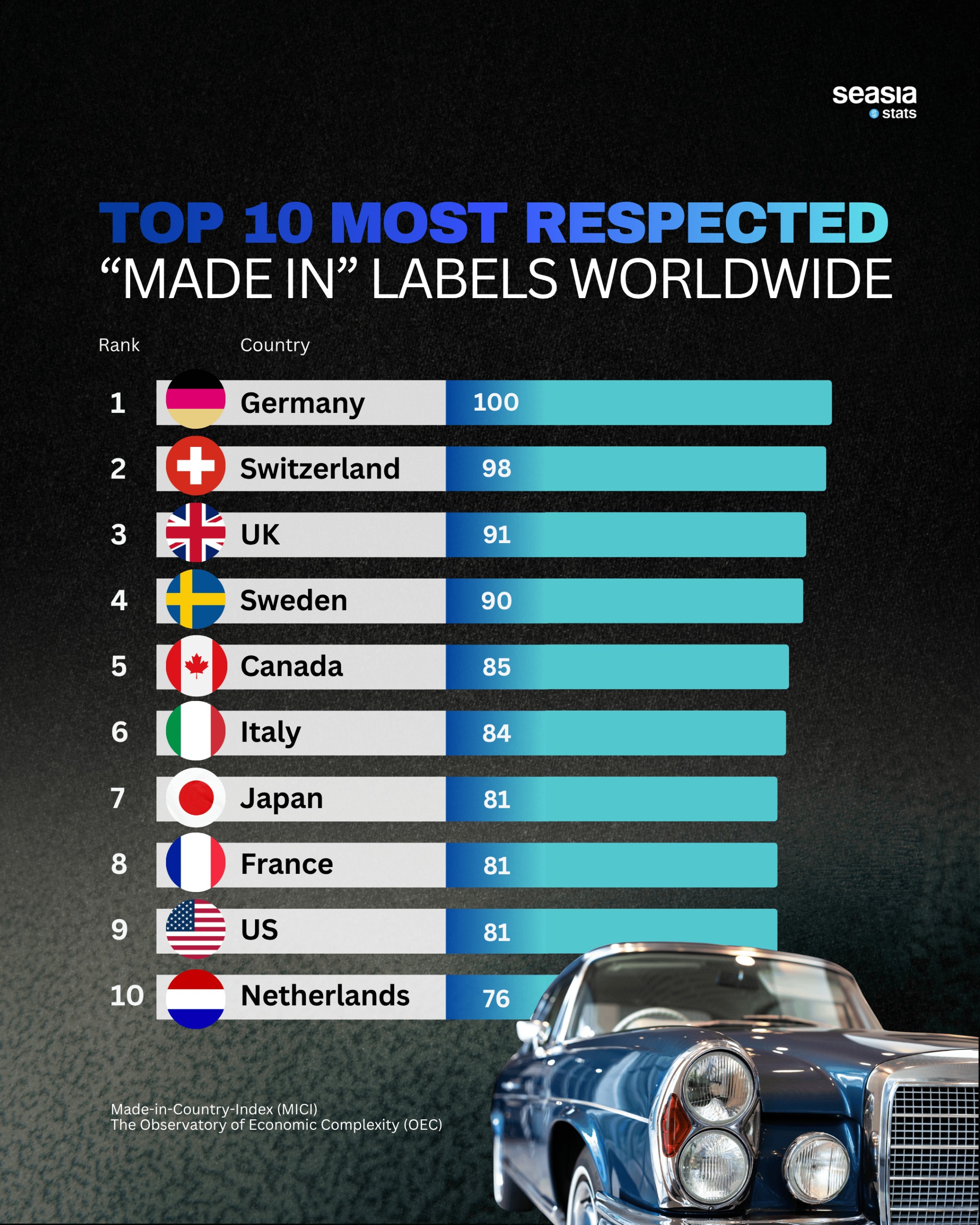
In a world where supply chains stretch across continents and consumers can buy almost anything with a tap, one small phrase still carries enormous weight: Made in. It is more than a label. It is shorthand for trust, craftsmanship, durability, and national reputation. According to the Made-in-Country-Index (MICI), as highlighted by Seasia Stats and the Observatory of Economic Complexity, Germany remains the world’s most respected “Made in” label—proof that in global commerce, perception can be just as powerful as production.
Why “Made in Germany” still matters
Germany tops the ranking with a perfect score of 100, ahead of Switzerland at 98, the United Kingdom at 91, and Sweden at 90. Canada and Italy follow, while Japan, France, and the United States are tied at 81. The Netherlands rounds out the top ten with 76.
This is not simply a popularity contest. These labels represent decades—sometimes centuries—of industrial consistency. Germany’s reputation rests on engineering precision, manufacturing discipline, and a long association with reliability, especially in machinery, automotive products, industrial tools, and premium household goods. Switzerland carries similar prestige, though often through a more luxury-oriented image: watches, medical devices, and precision instruments.
What makes these labels powerful is that they function almost like unofficial quality seals. Consumers often do not know the factory, the supplier, or the corporate structure behind a product—but they know what a country’s name suggests.
Reputation is built over generations
A respected “Made in” label is never built overnight. It grows through education systems, supplier ecosystems, product consistency, and one crucial factor: trust that survives economic shocks. Japan’s continued place in the top tier, for instance, reflects a global image built on meticulous manufacturing and product longevity, even as competition from newer Asian producers intensifies.
As The Economist once observed in its writing on German industry, the country’s industrial strength is rooted in “engineering excellence and a dense network of specialist firms.” That ecosystem matters. Reputation is not only about famous brands—it is also about the invisible web of subcontractors, technicians, logistics, and standards behind them.
This is where the “Made in” conversation becomes especially relevant for Asia beyond Japan.
Southeast Asia’s quiet manufacturing rise
Southeast Asia may not yet dominate this ranking, but the region is becoming increasingly important in the global story of manufacturing reputation. Countries like Vietnam, Thailand, Malaysia, Indonesia, and Singapore are moving from low-cost production bases toward more specialized and higher-value manufacturing.
The World Economic Forum has noted that ASEAN is increasingly becoming “a major global production hub,” particularly in electronics, electrical goods, advanced manufacturing, and battery-related industries. It also highlights how Malaysia, Singapore, Thailand, and Vietnam are building industrial clusters that support competitiveness and innovation, not just assembly-line output.
That shift matters because global respect for a country’s label usually begins when that country stops being seen merely as a subcontractor and starts being associated with quality in its own right.
Singapore already carries strong credibility in advanced electronics, pharmaceuticals, and precision engineering. Malaysia has long built strength in semiconductors and electrical manufacturing. Thailand has earned trust in automotive and appliance supply chains. Vietnam, meanwhile, has emerged as one of the biggest winners of global supply chain diversification, especially in electronics and consumer goods. Indonesia’s challenge—and opportunity—is to convert its enormous industrial base into stronger value-added branding and quality perception. The World Economic Forum has pointed out that Indonesia still participates in global value chains more weakly in manufacturing than some ASEAN peers, even as its potential remains enormous.
The next battle is not only cost—but credibility
For decades, many emerging economies competed on labor cost. That is no longer enough. The next stage of industrial competition is about reliability, design, after-sales confidence, and national brand equity. In short, it is about whether consumers believe a product made in your country is worth paying more for.
That is why this ranking matters far beyond Europe. It is a mirror of industrial prestige—and a challenge to Southeast Asia. The region has already proven it can manufacture at scale. The next step is harder, but more rewarding: building a “Made in” reputation that people actively seek out.
Because in the end, the most valuable exports are not just products. They are confidence, consistency, and the quiet promise that what carries your country’s name will not disappoint.