

Top 15 Teams at the International Physics Olympiad
China is the most successful country in the International Physics Olympiad.

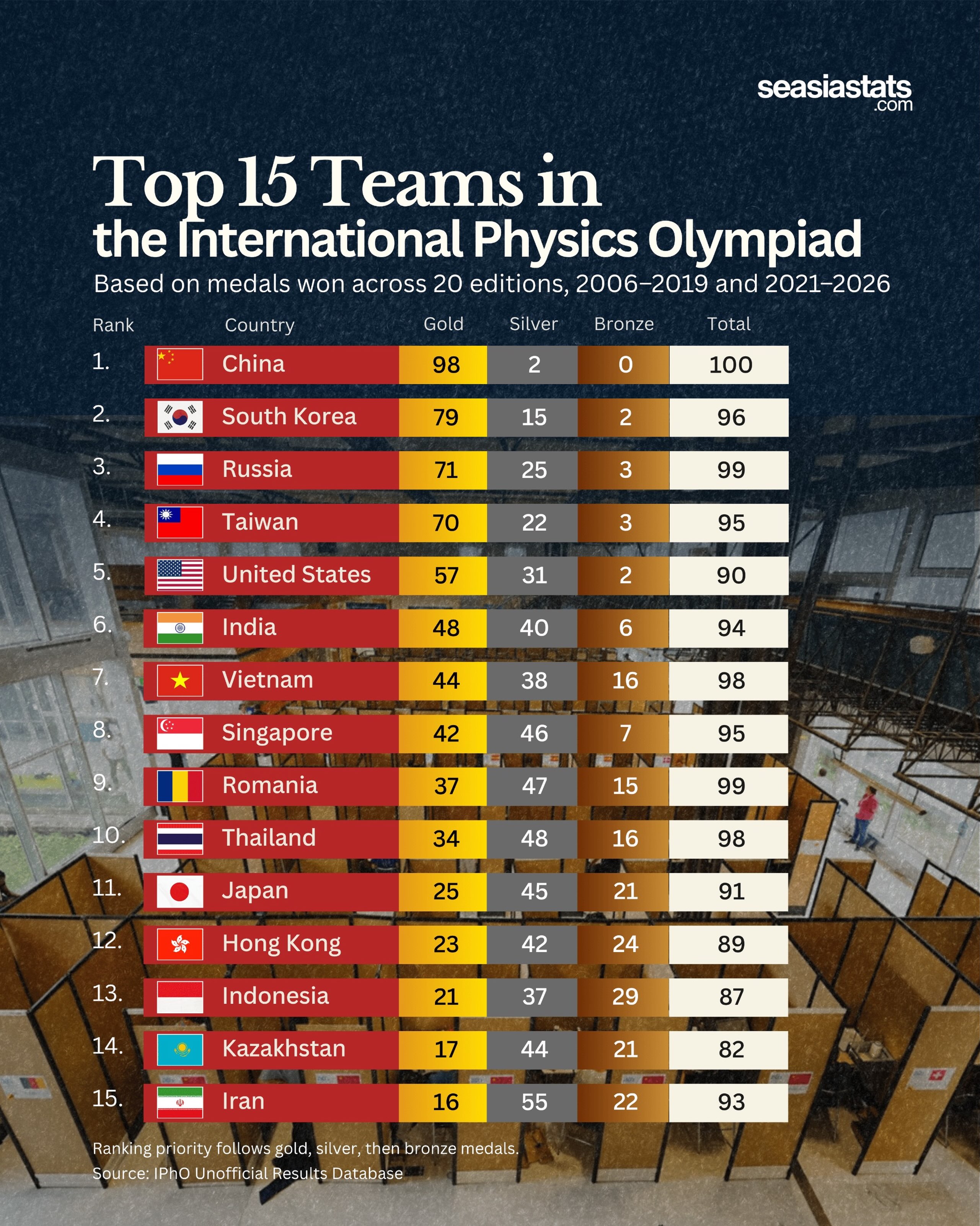
Over 20 editions of the International Physics Olympiad (IPhO), spanning 2006–2019 and 2021–2026, teams from across the world have competed for gold, silver, and bronze while showcasing the extraordinary depth of young scientific talent.
Based on the medal totals provided, these 15 teams stand out for their remarkable consistency and achievements on the international stage.
China occupies the top position with a remarkable 100 medals: 98 gold, 2 silver, and 0 bronze. Its extraordinary collection of gold medals is a testament to the country's dominance and consistency in physics competition.
South Korea follows with 96 medals, including 79 gold, 15 silver, and 2 bronze. With nearly four-fifths of its medals being gold, South Korea has established an exceptionally strong record of top-level performances.
Russia has amassed 99 medals, comprising 71 gold, 25 silver, and 3 bronze. Its impressive tally reflects a long tradition of excellence in mathematics and the physical sciences.
Taiwan comes next with 95 medals, including 70 gold, 22 silver, and 3 bronze. Its outstanding gold-medal count places it firmly among the world's elite IPhO teams.
The United States has secured 90 medals, consisting of 57 gold, 31 silver, and 2 bronze. The American delegation's record demonstrates its sustained ability to produce exceptional physics students.
India has collected 94 medals, with 48 gold, 40 silver, and 6 bronze. Its relatively balanced distribution across the three medal categories highlights a consistently strong team.
Vietnam has earned 98 medals, including 44 gold, 38 silver, and 16 bronze. Its impressive total places it among the most successful teams in overall medal accumulation.
Singapore has recorded 95 medals, made up of 42 gold, 46 silver, and 7 bronze. Its large number of silver medals reflects the team's ability to consistently finish near the very top.
Romania has also achieved an extraordinary 99 medals, consisting of 37 gold, 47 silver, and 15 bronze. Its total is one of the highest in the group, highlighting decades of strong participation and performance.
Thailand has accumulated 98 medals, including 34 gold, 48 silver, and 16 bronze. This impressive record demonstrates the country's sustained competitiveness against the world's strongest physics teams.
Japan follows with 91 medals, comprising 25 gold, 45 silver, and 21 bronze. Its broad medal distribution reflects a consistently successful presence at the Olympiad.
Hong Kong has won 89 medals, including 23 gold, 42 silver, and 24 bronze, demonstrating considerable depth and consistency across the editions.
Indonesia has earned 87 medals, consisting of 21 gold, 37 silver, and 29 bronze. Its record reflects a strong and sustained contribution to the international physics community.
Kazakhstan has collected 82 medals, including 17 gold, 44 silver, and 21 bronze. Its continued success demonstrates the strength of physics education and competition in the country.
Finally, Iran has achieved 93 medals, comprising 16 gold, 55 silver, and 22 bronze. Its exceptional silver-medal total is particularly notable, reflecting repeated high-level performances over the 20 editions.
Taken together, these records illustrate the remarkable global competitiveness of the International Physics Olympiad. From China's extraordinary gold-medal dominance to Iran's impressive consistency, each of these 15 teams has made a significant mark on the world's premier physics competition for secondary-school students.