

Top Countries with the Highest Biodiversity Contribution
These fifteen countries contribute the most of world's biodiversity.

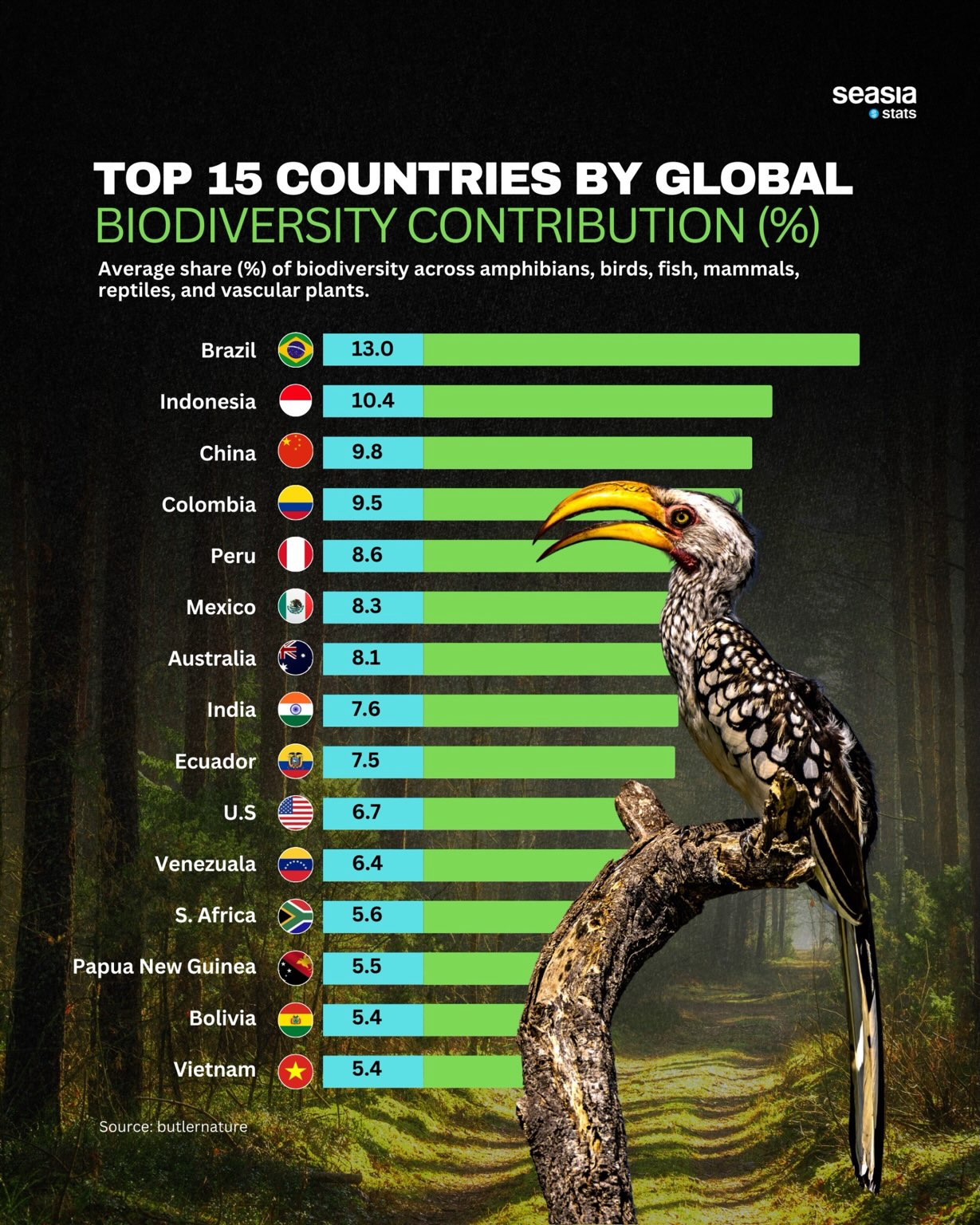
According to ButlerNature, a relatively small group of countries accounts for a remarkable share of the world's biodiversity. These nations are home to vast tropical forests, unique ecosystems, and thousands of endemic plant and animal species, making them indispensable to global conservation efforts.
The rankings highlight each country's estimated contribution to global biodiversity, reflecting the richness and variety of life within their borders.
Brazil ranks first, contributing 13.0% of global biodiversity. Home to the Amazon Rainforest, the Pantanal wetlands, the Cerrado savanna, and the Atlantic Forest, Brazil supports an extraordinary diversity of mammals, birds, reptiles, amphibians, insects, and plants, making it the world's leading biodiversity hotspot.
Indonesia follows in second place with 10.4%. As the world's largest archipelago, Indonesia spans two major biogeographic regions and contains tropical rainforests, coral reefs, mangroves, and volcanic ecosystems that shelter countless endemic species.
China ranks third with 9.8%, thanks to its immense geographic diversity ranging from tropical forests to alpine mountains and deserts.
Colombia holds fourth place with 9.5%, reflecting its exceptional variety of ecosystems, particularly within the Andes and Amazon Basin. Peru ranks fifth at 8.6%, while Mexico follows with 8.3%, both recognized for their rich combination of forests, mountains, deserts, and coastal habitats.
Australia contributes 8.1% of global biodiversity, supported by its long geographic isolation that has produced many unique species found nowhere else on Earth. India, with 7.6%, ranks eighth thanks to its diverse climates and habitats, including the Himalayas, Western Ghats, tropical forests, and extensive coastlines.
Ecuador follows closely with 7.5%, despite its relatively small size, owing to the biodiversity of the Amazon, Andes, Pacific coast, and the Galápagos Islands.
The United States ranks tenth with 6.7%, reflecting the country's wide range of ecosystems across North America and the Pacific. Venezuela contributes 6.4%, while South Africa accounts for 5.6%, both recognized for their remarkable ecological diversity and numerous endemic species.
Completing the top fifteen are Papua New Guinea with 5.5%, Bolivia with 5.4%, and Vietnam with 5.4%. Each possesses rich tropical forests, mountainous landscapes, and diverse freshwater and marine ecosystems that support an exceptional variety of wildlife.
These rankings demonstrate that biodiversity is concentrated in countries with diverse climates, complex geography, and extensive natural habitats.
Protecting these ecosystems is essential not only for preserving wildlife but also for maintaining global ecological balance, supporting food security, regulating the climate, and sustaining countless ecosystem services that benefit humanity.
Together, these fifteen countries represent the foundation of Earth's biological richness and remain central to international conservation efforts.