

Top Foreign Nationalities in South Korea
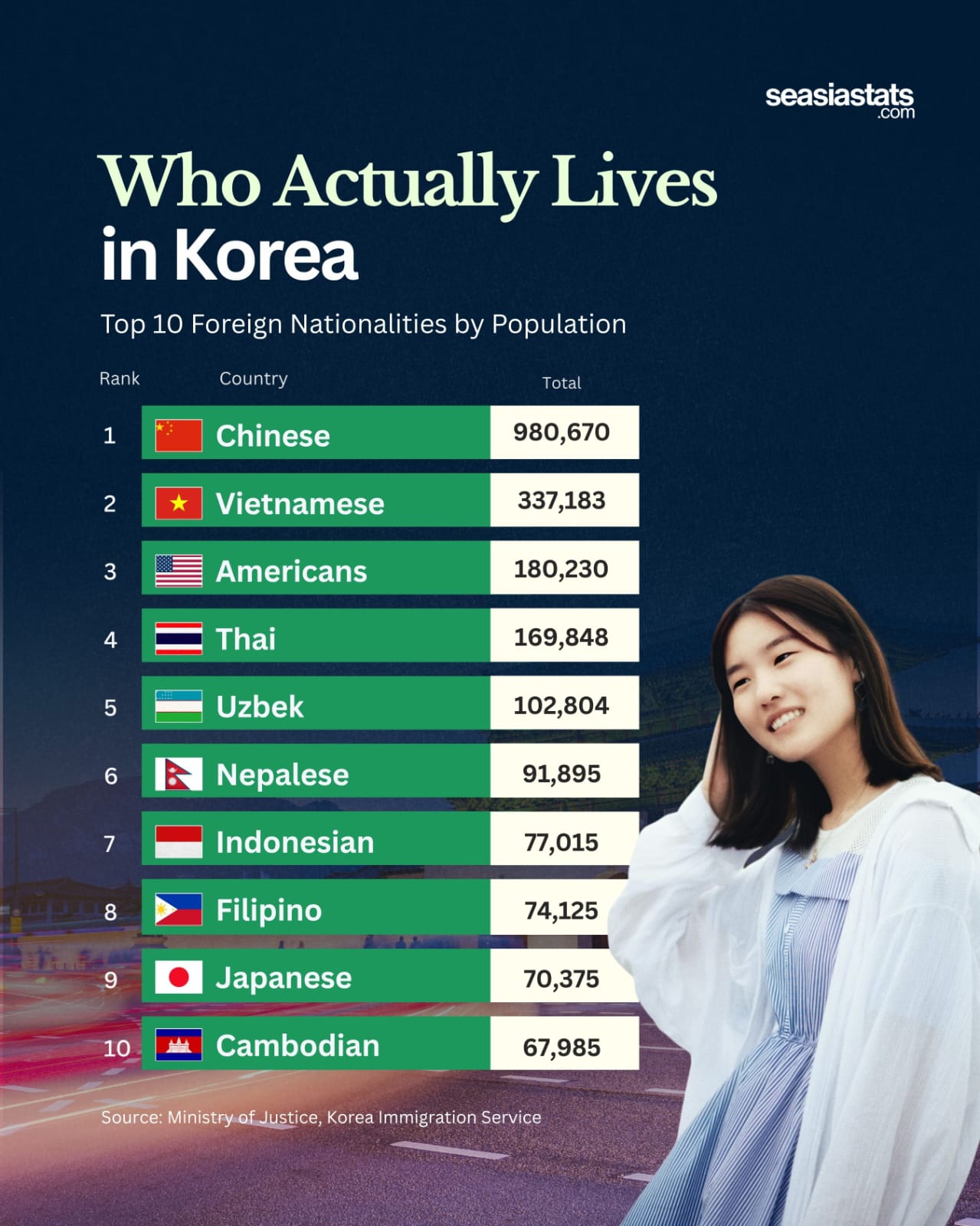
With 980,670 people, the Chinese are the biggest foreign community in South Korea.

South Korea has become an increasingly diverse country, with millions of foreign nationals living, working, studying, and building communities across the nation.
According to statistics from the Ministry of Justice and Korea Immigration Service, the country had 2,783,247 foreign residents at the end of 2025, representing 5.44 percent of South Korea’s total population. The statistics show that foreign residents come from a wide range of countries, with Asian nationalities making up a particularly large share.
Chinese nationals form by far the largest foreign nationality group, with 980,670 people, or 35.2 percent of all foreign residents. The figure includes Chinese nationals of Korean ethnic origin.
Their large presence reflects decades of economic, historical, family, and cultural connections between China and South Korea. Vietnamese nationals rank second, with 337,183 people, accounting for 12.1 percent of the foreign-resident population.
The United States ranks third, with 180,230 Americans, representing 6.5 percent. American residents include workers, educators, military personnel, students, businesspeople, and families.
Thailand follows with 169,848 residents, or 6.1 percent, making Thai nationals another major Southeast Asian community in South Korea. Uzbekistan ranks fifth, with 102,804 people, reflecting the growing Central Asian presence in Korean society.
Other important communities include Nepalese nationals, numbering 91,895, and Indonesians, with 77,015 residents.
The Philippines has 74,125 nationals living in South Korea, while Japan accounts for 70,375. Cambodian nationals complete the top ten, with 67,985 residents. Together, these communities contribute to South Korea’s increasingly multicultural society.
The figures also reveal important changes over time. Vietnam’s foreign-resident population increased substantially, from 208,740 in 2021. The number of Uzbek nationals also rose from 66,677 during the same period. The overall foreign-resident population increased from 1,956,781 in 2021 to 2,783,247 in 2025.
These trends demonstrate South Korea’s growing role as a destination for international workers, students, families, and long-term residents. Foreign communities are contributing to the country’s workplaces, universities, neighborhoods, and cultural life.
As South Korea’s population becomes more internationally diverse, understanding and supporting these communities will become increasingly important for the country’s future.
The nationality statistics therefore provide more than just numbers. They offer a picture of how migration is changing South Korean society and highlight the increasingly important connections between Korea and communities around the world.