

Top Manufacturing Hubs in Southeast Asia by Capacity
Thailand's Eastern Economic Corridor (EEC) in Chonburi and Rayong is the largest manufacturing hub in Southeast Asia.

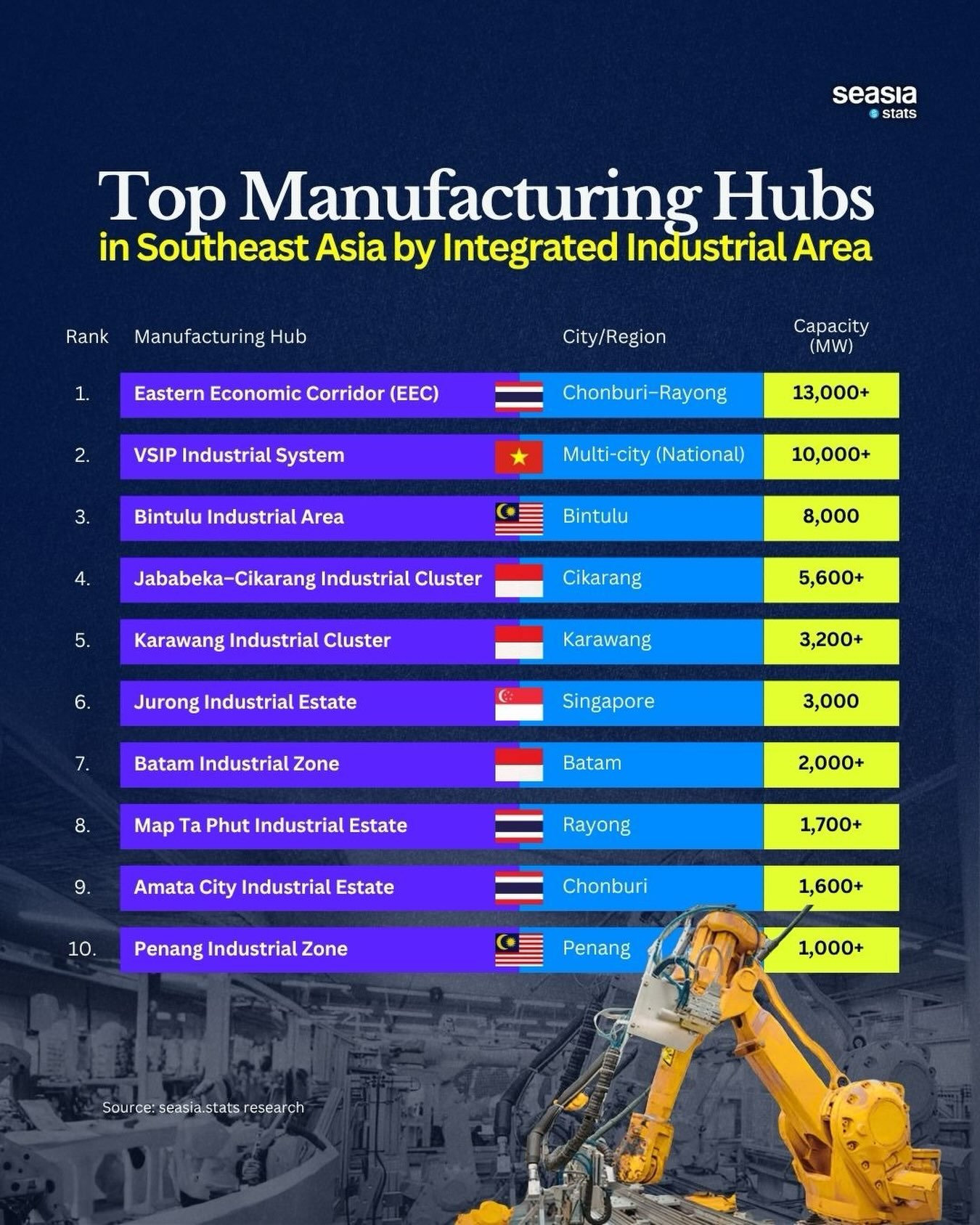
Southeast Asia has become one of the world’s most important manufacturing regions, supported by extensive industrial infrastructure, strategic ports, growing energy networks, and strong connections to global supply chains. A recent regional ranking highlights ten major manufacturing hubs based on their reported power capacity, measured in megawatts (MW).
At the top is Thailand’s Eastern Economic Corridor (EEC) in Chonburi and Rayong, with more than 13,000 MW of capacity.
The EEC is a major industrial and investment zone encompassing Chonburi, Rayong, and Chachoengsao, and contains numerous industrial estates serving automotive, electronics, petrochemicals, logistics, and advanced industries. Thailand’s government continues to position the EEC as a major destination for future-oriented investment.
Second is the VSIP Industrial System in Vietnam, with more than 10,000 MW according to the ranking. Developed across multiple cities and provinces, Vietnam Singapore Industrial Park (VSIP) has grown into a large network of integrated industrial parks.
VSIP says its developments span nearly 10,000 hectares and host hundreds of companies from around the world, demonstrating Vietnam’s growing role in regional manufacturing.
Bintulu Industrial Area in Malaysia ranks third with approximately 8,000 MW. The wider Bintulu region is particularly important for energy-intensive industries, with nearby Samalaju Industrial Park designed around sectors such as aluminium, steel, glass, and oil and gas.
Indonesia also has several prominent hubs. The Jababeka-Cikarang Industrial Cluster in Cikarang is listed at 5,600+ MW, followed by the Karawang Industrial Cluster in Karawang at 3,200+ MW.
These West Java industrial centers are strategically located near Jakarta and have become important bases for automotive, electronics, consumer goods, and other manufacturing industries.
Singapore’s Jurong Industrial Estate follows with around 3,000 MW, reflecting the city-state’s highly developed industrial and petrochemical infrastructure. Indonesia’s Batam Industrial Zone, with more than 2,000 MW, benefits from its strategic position close to Singapore and major international shipping routes.
Thailand appears twice more in the ranking. Map Ta Phut Industrial Estate in Rayong has approximately 1,700+ MW, reinforcing its importance as a major petrochemical and heavy-industry center. Amata City Industrial Estate in Chonburi follows with about 1,600+ MW and supports a broad manufacturing ecosystem.
Rounding out the list is Penang Industrial Zone in Malaysia, with more than 1,000 MW. Penang is particularly recognized for electronics and semiconductor manufacturing.
Together, these hubs illustrate Southeast Asia’s growing industrial strength and the crucial role that reliable power infrastructure plays in attracting large-scale manufacturing investment.