

Waste Entering Southeast Asia in 2020–2025: Imports by Volume and Value
Vietnam received the most waste from 2020–2025, according to UN.

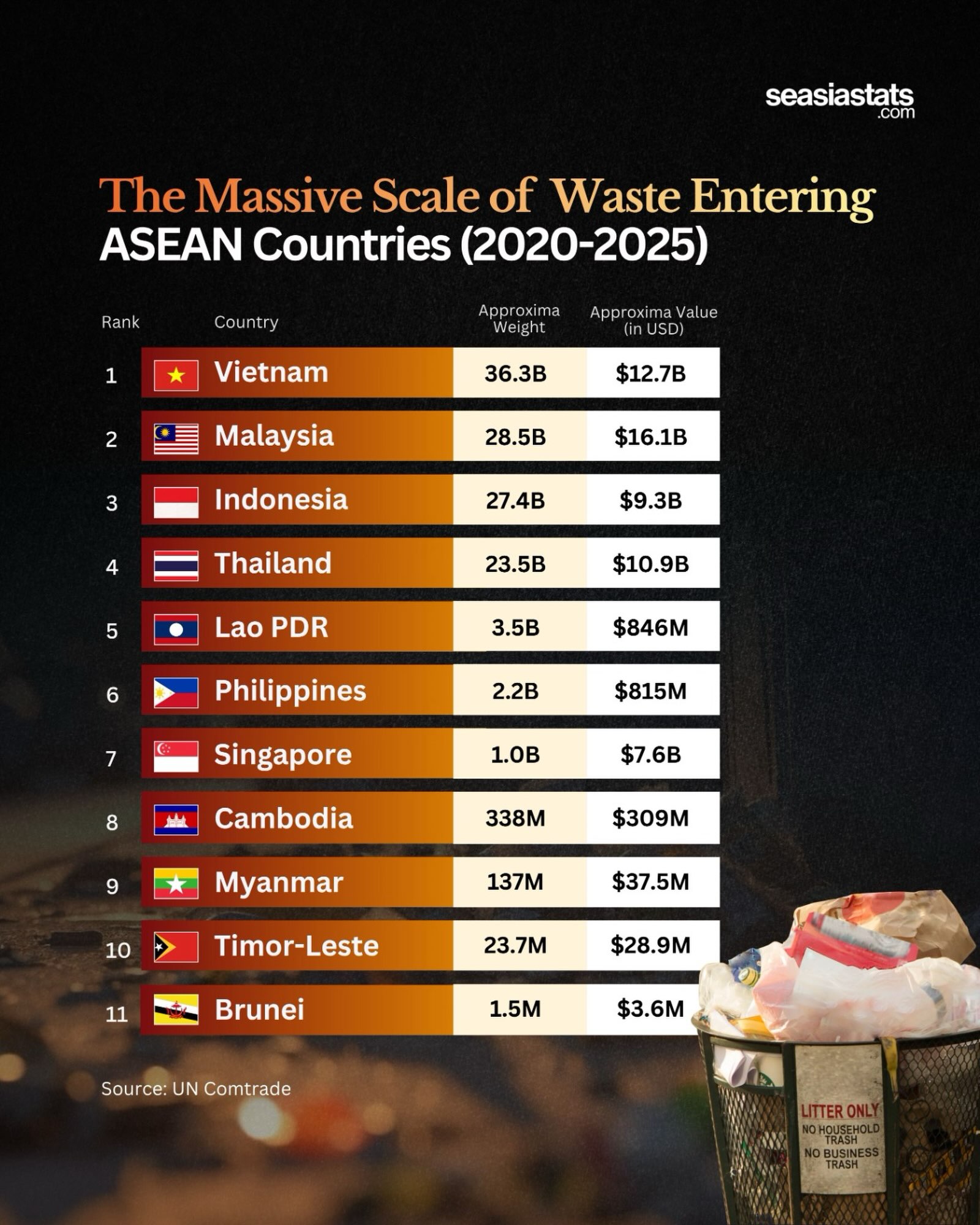
Data compiled from UN Comtrade for the period 2020–2025 show the scale of waste imports entering Southeast Asia for recycling, recovery, manufacturing, and other industrial uses.
The figures include both the quantity of waste imported, measured in units or weight equivalent, and its declared trade value in U.S. dollars. The data illustrate the region's significant role in the global trade of recyclable and reusable materials.
Vietnam recorded the largest volume of waste imports during the six-year period, receiving approximately 36.3 billion units (or weight equivalent) with a total declared value of US$12.7 billion. The country's extensive manufacturing sector and recycling industries have created sustained demand for imported recyclable materials.
Malaysia ranked second by volume, importing 28.5 billion units, while recording the highest total value among the countries listed at US$16.1 billion. The higher value reflects the import of waste streams with comparatively greater commercial worth, including materials processed by Malaysia's recycling and manufacturing industries.
Indonesia followed with 27.4 billion units valued at US$9.3 billion, while Thailand imported 23.5 billion units worth US$10.9 billion. Both countries possess large industrial bases that utilize imported recyclable materials as inputs for domestic production.
Among the remaining countries, Laos imported 3.5 billion units with a value of US$846 million, while the Philippines received 2.2 billion units valued at US$815 million.
Although their import volumes were considerably lower than those of the region's largest economies, both countries remained active participants in regional and international recycling supply chains.
Singapore imported approximately 1.0 billion units, yet the shipments were valued at US$7.6 billion, one of the highest totals in Southeast Asia despite its relatively modest volume. This difference suggests that Singapore handled waste materials with substantially higher average market values, consistent with its role as a global trading and logistics hub.
Smaller import volumes were recorded by Cambodia, with 338 million units valued at US$309 million, and Myanmar, with 137 million units worth US$37.5 million. Timor-Leste imported 23.7 million units valued at US$28.9 million, while Brunei recorded the smallest total, receiving 1.5 million units with a declared value of US$3.6 million.
Overall, the 2020–2025 UN Comtrade figures highlight the diverse roles Southeast Asian countries play in the international waste trade.
While import volumes varied widely, the relationship between quantity and value differed significantly among countries, reflecting differences in the types of materials imported, industrial demand, recycling capacity, and trade specialization across the region.