

Weekly Work Hours in ASEAN Countries
Across Southeast Asia, the rhythm of daily life is closely tied to work.

Across Southeast Asia, the rhythm of daily life is closely tied to work. From bustling offices in Singapore to factory floors in Vietnam and small businesses in rural Laos, working hours shape not only productivity but also lifestyle and well-being. New data from the International Labour Organization (ILO), compiled by Seasia Stats, reveals striking differences in how long people work across ASEAN countries in 2026—highlighting diverse economic structures, labor laws, and cultural norms.
Brunei Leads the Longest Workweek
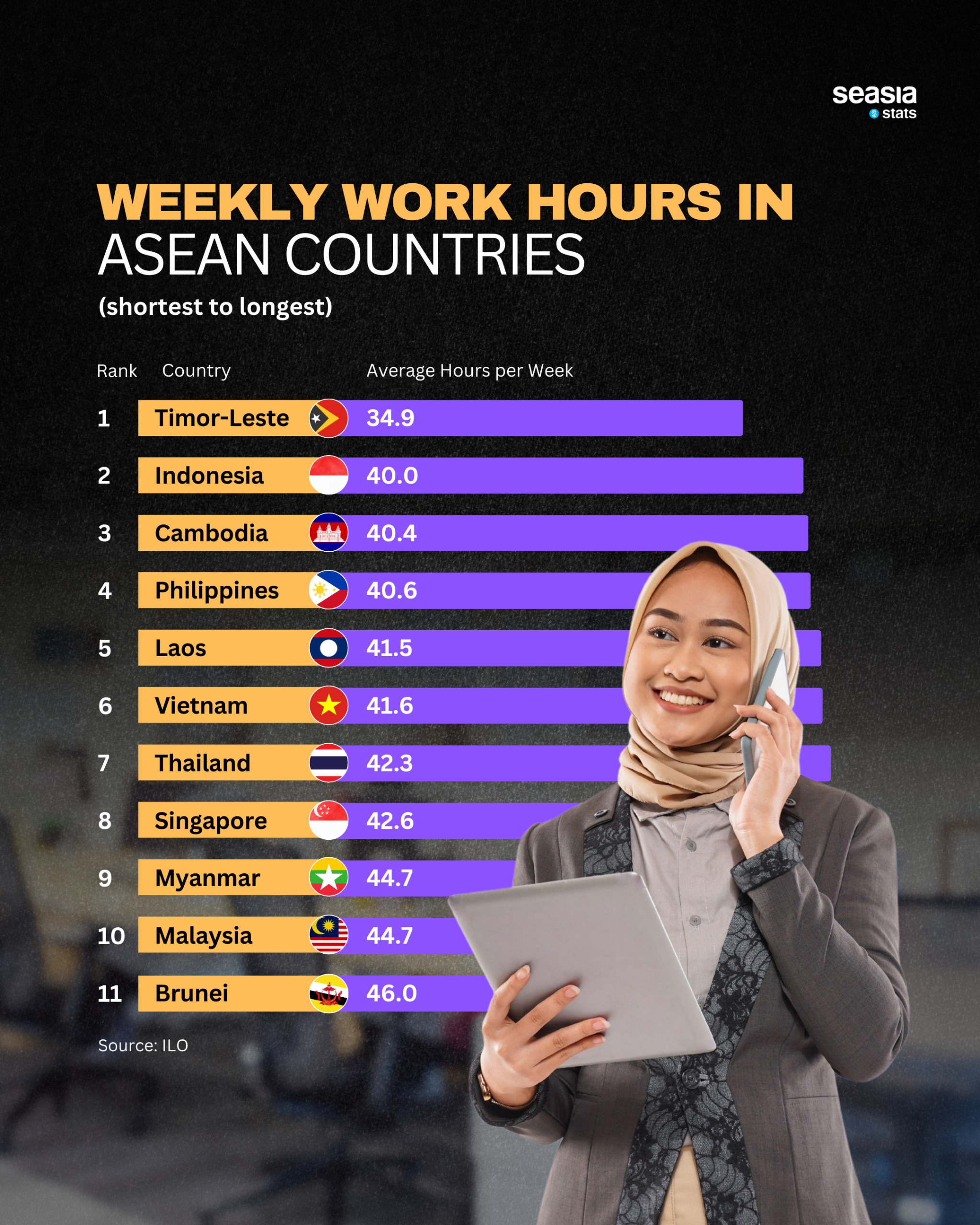
At the top of the list is Brunei, where employees work an average of 46.0 hours per week, the longest in the region. Close behind are Malaysia and Myanmar, both averaging 44.7 hours weekly. These figures suggest labor markets where extended working hours remain common, particularly in sectors such as oil and gas, manufacturing, and public administration.
Malaysia’s relatively high hours reflect its strong industrial and service economy, while Myanmar’s figure reflects a workforce where formal labor protections and standardized hours can vary widely across industries.
The 40–43 Hour Middle Ground
A large cluster of Southeast Asian nations sits in a middle band, with average workweeks between 40 and 43 hours. Singapore averages 42.6 hours, slightly above Thailand at 42.3 hours, followed by Vietnam at 41.6 hours and Laos at 41.5 hours.
These figures reflect a mix of modern service economies and export-oriented manufacturing hubs. Singapore’s longer-than-expected average shows that even highly developed economies in the region maintain relatively intensive work cultures. Thailand and Vietnam, meanwhile, combine strong tourism and industrial sectors that often require flexible and extended schedules.
Further down the middle tier are the Philippines (40.6 hours), Cambodia (40.4 hours), and Indonesia (40.0 hours)—countries where formal labor laws typically set a 40-hour standard, though informal sectors and overtime practices can extend actual working time.
Timor-Leste: A Distinctive Outlier
Standing apart from the rest is Timor-Leste, where employees average just 34.9 hours per week—the only country in the dataset below the 40-hour threshold. This significantly shorter workweek reflects the country’s smaller economy, a larger share of informal or subsistence-based work, and evolving labor structures as the nation continues its economic development.
Why Working Hours Differ Across ASEAN
Several factors explain these regional differences. Economic structure plays a major role: countries with large industrial and export sectors tend to have longer working hours due to production demands. Labor laws and enforcement also matter, as do cultural expectations about overtime and productivity.
Urbanization is another factor. Highly urbanized economies like Singapore or Malaysia often see longer office hours, while more rural or developing economies may show lower averages due to informal employment or seasonal work patterns.
The Work-Life Balance Debate
The variation in working hours across ASEAN also reflects a broader global conversation about work-life balance. While longer hours can boost productivity and income, they can also lead to burnout and reduced quality of life if not balanced with rest and social time.
Countries such as Thailand and Indonesia have increasingly introduced policies promoting flexible work arrangements, while Singapore has been encouraging companies to adopt more balanced workplace practices.
A Region in Transition
Ultimately, the ASEAN workweek tells a story of a region in transition—balancing rapid economic growth with evolving expectations about well-being and productivity. As Southeast Asia continues to develop, the question is no longer just how long people work, but how sustainably they can do so.
In the years ahead, the region’s ability to balance efficiency with quality of life may become just as important as economic growth itself.