

Who (Not) Excited About AI?
As artificial intelligence (AI) continues to revolutionize industries and personal lives, its acceptance and excitement vary greatly across different regions. A

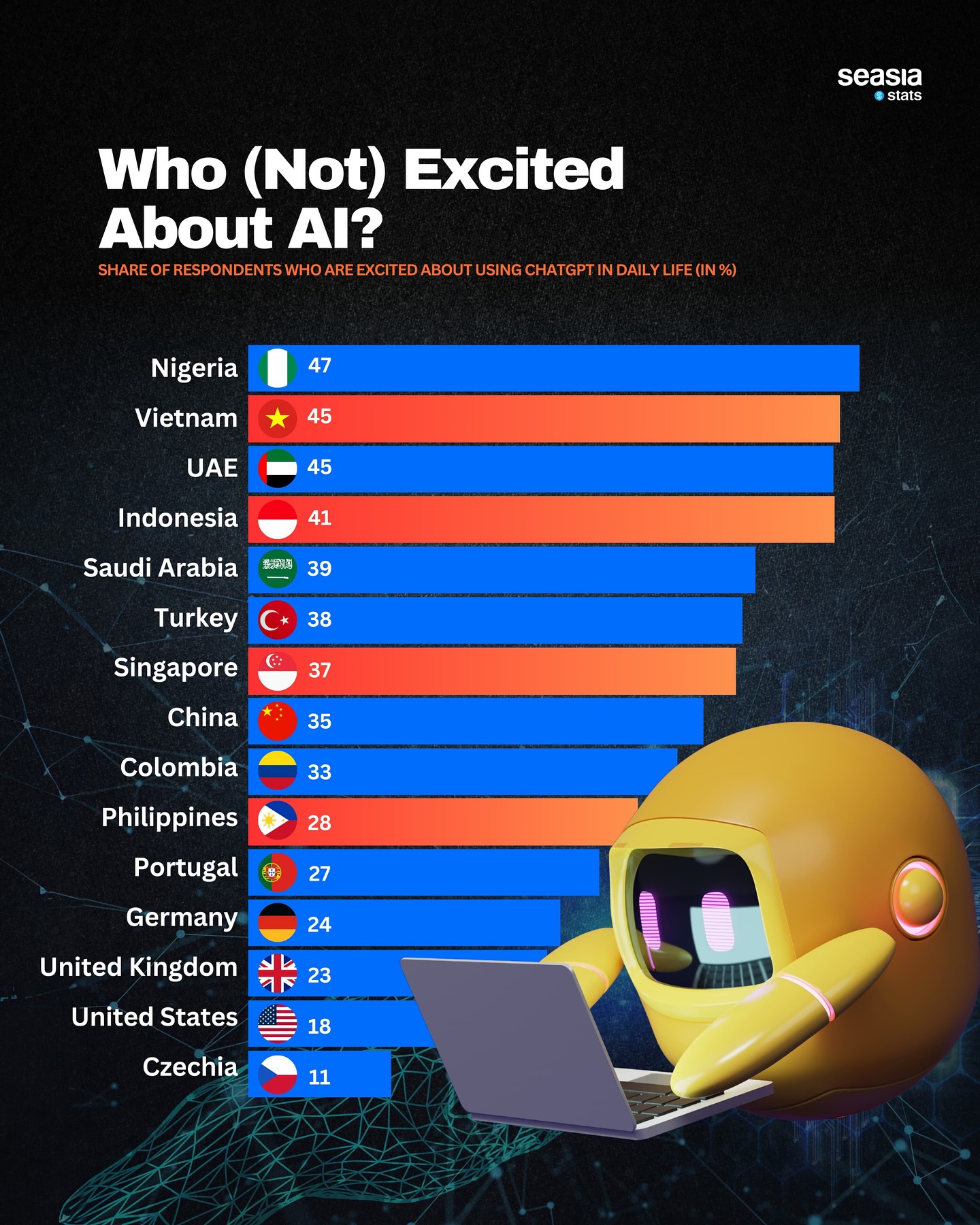
As artificial intelligence (AI) continues to revolutionize industries and personal lives, its acceptance and excitement vary greatly across different regions. A recent survey by Statista Consumer Insights offers a glimpse into how respondents worldwide feel about using AI applications like ChatGPT in their daily routines. While some countries embrace this technological shift, others remain skeptical.
In Nigeria, for example, an impressive 47% of respondents expressed excitement about incorporating AI into everyday activities. This places Nigeria at the top of the list, highlighting the country's openness to innovation and its growing digital landscape. However, other regions—especially in Europe—have displayed a more cautious approach. In Czechia, only 11% of respondents are enthusiastic about AI, reflecting the region's hesitation to fully embrace the technology.
Asia and the Middle East: Strong Enthusiasm for AI
Asia and the Middle East are showing a positive response toward AI adoption, particularly with applications like ChatGPT. In Viet Nam, 45% of respondents expressed excitement about using AI in their daily lives, placing the country among the most enthusiastic in Southeast Asia. Indonesia, another leading Southeast Asian nation, saw 41% of respondents embrace the idea of AI integration. These numbers reflect the growing presence of AI in the region's digital economy, where governments and private sectors alike are investing in new technologies to drive innovation.
The enthusiasm continues in the Middle East, with the United Arab Emirates (UAE) and Saudi Arabia reporting high levels of excitement at 45% and 39%, respectively. Both countries are known for their ambitious technological goals, particularly in AI development. The Middle East’s interest in AI aligns with its broader vision of diversifying its economies beyond oil and embracing cutting-edge technologies.
Europe and North America: A More Skeptical Approach
While Asia and the Middle East show excitement, the response in Europe and North America tells a different story. In Portugal, only 27% of respondents expressed excitement about using AI, and the figures drop even further in Germany (24%), the United Kingdom (23%), and the United States (18%). These numbers reflect the more cautious attitude toward AI in Western countries, where concerns about privacy, data security, and the potential for job displacement may temper excitement.
The skepticism is especially pronounced in Czechia, where just 11% of respondents are excited about integrating AI into their daily routines. Cultural attitudes, as well as slower adoption of AI technologies, may play a role in these results. Europeans are more likely to demand regulatory frameworks and ethical standards before fully embracing AI.
AI Knowledge and Awareness in Asia: Leading the Way
In addition to the enthusiasm reported in several Asian countries, there is also a significant level of knowledge and awareness about AI technology in the region. Data from Ipsos indicates that in China, 81% of respondents claimed to have a good understanding of AI, while 80% of respondents in Indonesia reported the same. This knowledge base likely contributes to the region's optimism about integrating AI into everyday life.
Countries like China and Indonesia are not only enthusiastic about AI but are also investing heavily in its development. China, for instance, is a global leader in AI research and innovation, with widespread applications in industries ranging from healthcare to autonomous driving. Indonesia, while still developing its AI infrastructure, has shown tremendous interest in leveraging AI for its rapidly growing digital economy.
Balancing Enthusiasm with Caution
While the excitement surrounding AI is clear in many parts of the world, it's important to note the cautious approach that persists in other regions. The global variation in attitudes toward AI highlights the complex relationship people have with this technology. For some, AI represents an opportunity to improve efficiency, streamline tasks, and enhance daily life. For others, it raises questions about privacy, ethics, and the future of human employment.
As AI continues to evolve, these differing perspectives will shape how governments, businesses, and individuals approach its integration. The balance between innovation and regulation will be crucial in ensuring that AI development benefits society as a whole. Whether excited or skeptical, the world is undeniably moving toward a future where AI plays a central role in daily life.