

Women's Representation in Southeast Asian Parliaments
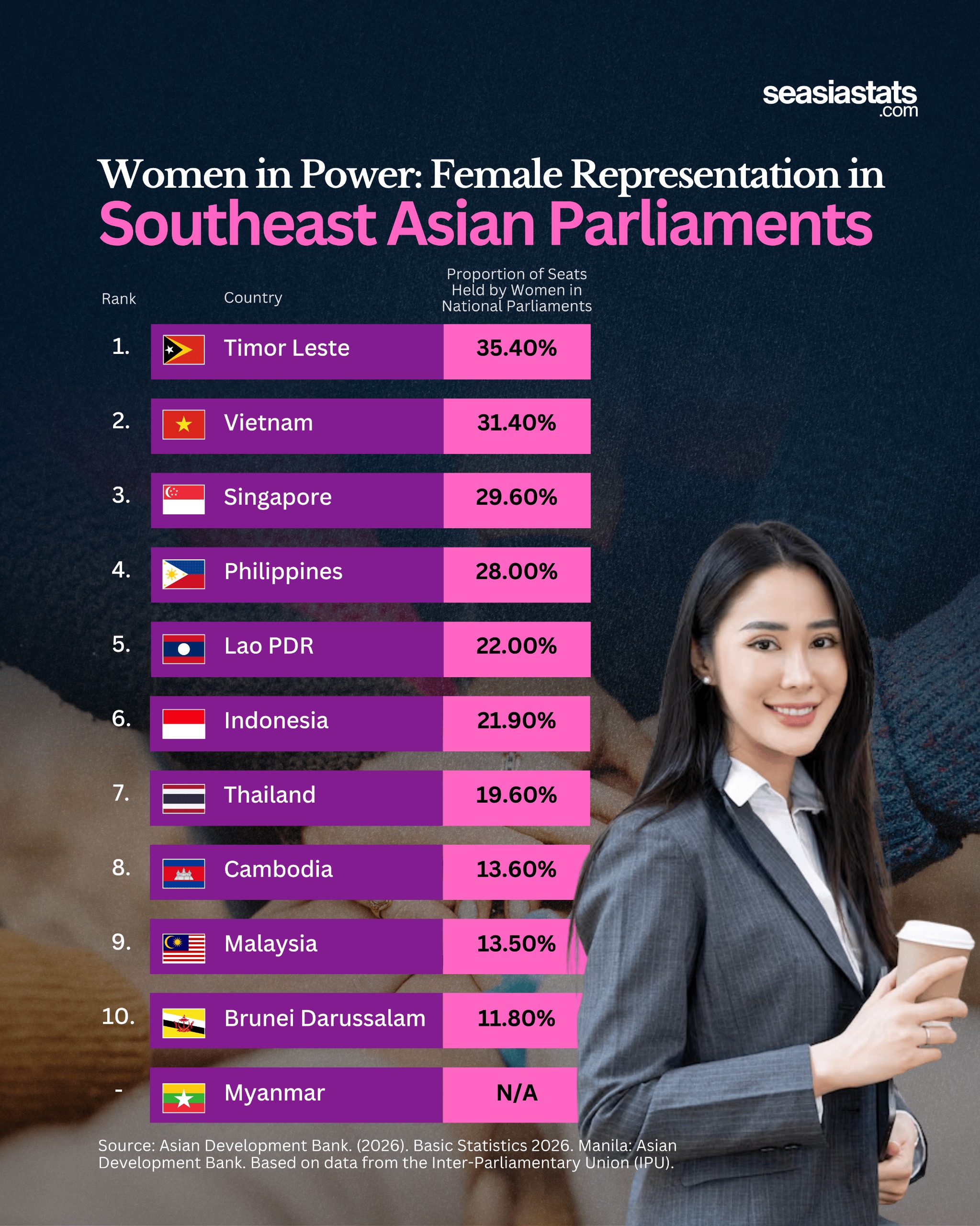
Timor-Leste leads Southeast Asia in female representation in the parliament with 35.40%.

The presence of women in national legislatures is an important indicator of political inclusivity and progress toward gender equality. Increasing women's participation in government can introduce a broader range of viewpoints into policymaking while ensuring that legislative institutions more accurately represent the diverse populations they serve.
Across Southeast Asia, women's representation in national parliaments differs significantly from one country to another. These variations reflect the different levels of progress countries have made in promoting gender equality and providing women with opportunities to participate in political leadership.
Timor-Leste leads the region, with women occupying 35.40% of parliamentary seats. This makes the country the strongest performer among the Southeast Asian nations included in the comparison. Its relatively high proportion of female lawmakers reflects ongoing efforts to strengthen women's involvement in national politics and decision-making.
Vietnam ranks second, with female representation reaching 31.40%, followed by Singapore at 29.60%. Both countries have achieved comparatively strong levels of women's participation in their legislative institutions, placing them among the regional leaders in female political representation.
The Philippines also records a relatively high figure, with women holding 28.00% of parliamentary seats. Filipino women have historically maintained an important presence in politics, government, and public administration, helping the country establish a comparatively strong position in terms of women's involvement in public leadership.
In the middle of the regional comparison are Laos, with 22.00%, and Indonesia, with 21.90%. In both countries, women account for approximately one-fifth of parliamentary representation. Although these figures demonstrate meaningful progress, they also indicate that women remain underrepresented in national legislative institutions.
Thailand follows with 19.60% of parliamentary seats occupied by women. Its position below several regional counterparts suggests that additional efforts to encourage female political participation and support women seeking elected positions could contribute to improving representation.
Meanwhile, Cambodia records 13.60%, narrowly followed by Malaysia at 13.50%. Brunei has the lowest reported proportion among the countries with available figures, at 11.80%.
These relatively low percentages highlight the potential for further improvements through stronger leadership development programs, greater opportunities for female candidates, and initiatives that encourage women's participation in politics.
Myanmar, however, has no official figure that can be accessed. The country's continuing political circumstances and institutional changes have made it challenging to establish a reliable and comparable measurement of women's representation in its national legislature.
Overall, the figures illustrate considerable differences in female political representation across Southeast Asia. Women's share of parliamentary seats ranges from 11.80% in Brunei to 35.40% in Timor-Leste, demonstrating that countries across the region remain at different stages of achieving gender balance in political institutions.
Despite these differences, expanding women's participation in public affairs remains an important objective for many Southeast Asian nations.
Greater female representation can contribute to more inclusive democratic governance by bringing diverse experiences, priorities, and perspectives into legislative discussions and policymaking, ultimately benefiting governments and the wider communities they represent.