

World's 10 Largest Mangrove Forests
Mangrove forests are crucial and these are the largest ones in the world.

Mangrove forests are among the most important ecosystems on Earth. Found along tropical and subtropical coastlines, these forests protect shorelines from erosion, support marine biodiversity, store massive amounts of carbon, and provide livelihoods for millions of people.
In 2025, the world’s largest mangrove forests continue to play a critical role in environmental conservation and climate resilience.
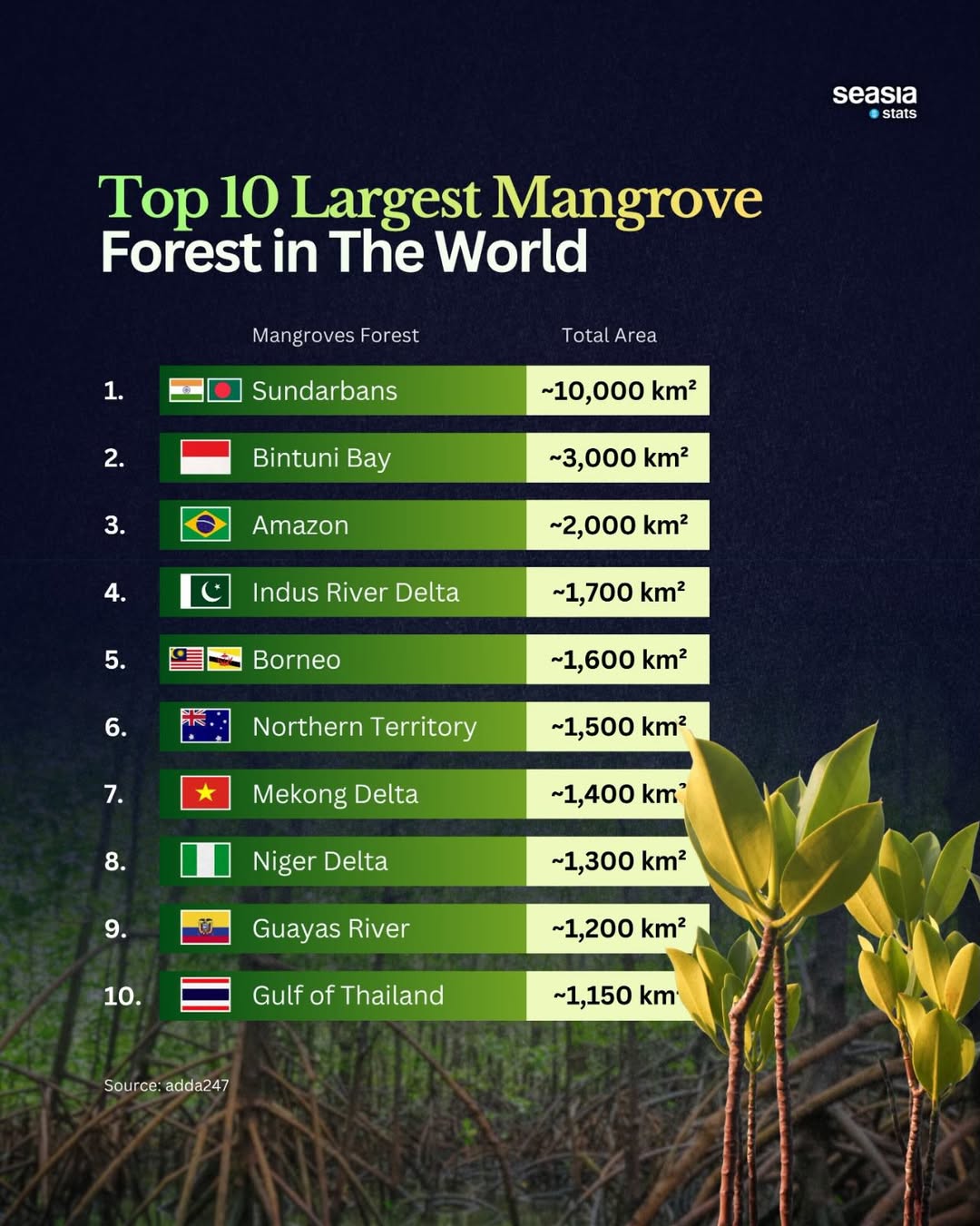
The largest mangrove forest in the world is the Sundarbans, covering approximately 10,000 square kilometers across Bangladesh and India. Famous for its unique biodiversity, the Sundarbans is home to the endangered Bengal tiger, saltwater crocodiles, and hundreds of bird species. The forest also acts as a natural barrier against cyclones and rising sea levels.
Indonesia’s Bintuni Bay ranks second with around 3,000 square kilometers of mangroves. Located in West Papua, this area contains some of the most pristine mangrove ecosystems in Southeast Asia. Its dense forests provide essential habitats for fish, crustaceans, and migratory birds.
The Amazon mangrove region in northern Brazil covers roughly 2,000 square kilometers. Influenced by the Amazon River, this ecosystem benefits from nutrient-rich sediments that support extraordinary biological productivity.
Similarly, Pakistan’s Indus River Delta spans around 1,700 square kilometers and serves as an important breeding ground for fish and shrimp in the Arabian Sea.
Borneo, shared by Indonesia, Malaysia, and Brunei, contains approximately 1,600 square kilometers of mangrove forests. These mangroves are crucial for coastal protection and biodiversity preservation. In Australia, the Northern Territory hosts around 1,500 square kilometers of mangroves, making it one of the largest mangrove regions in Oceania.
Viet Nam’s Mekong Delta supports about 1,400 square kilometers of mangrove forests. Despite decades of environmental pressure, restoration efforts have helped revive many damaged coastal areas.
In Africa, Nigeria’s Niger Delta contains around 1,300 square kilometers of mangroves and represents one of the continent’s most significant wetland ecosystems.
Ecuador’s Guayas River estuary features approximately 1,200 square kilometers of mangroves. These forests are vital for fisheries and local coastal communities. Meanwhile, the Gulf of Thailand region contains about 1,150 square kilometers of mangrove ecosystems distributed across Thailand, Cambodia, and Vietnam.
Together, these ten mangrove forests highlight the global importance of coastal ecosystems. Beyond supporting wildlife, mangroves absorb large amounts of carbon dioxide, helping combat climate change.
However, many of these forests face threats from deforestation, pollution, aquaculture expansion, and urban development. Protecting and restoring mangroves will remain essential for ensuring environmental sustainability and safeguarding coastal populations for future generations.