

World's 10 Oldest Cities Still Inhabited to this Day
The world have some of its most ancient cities in history still being inhabited today.

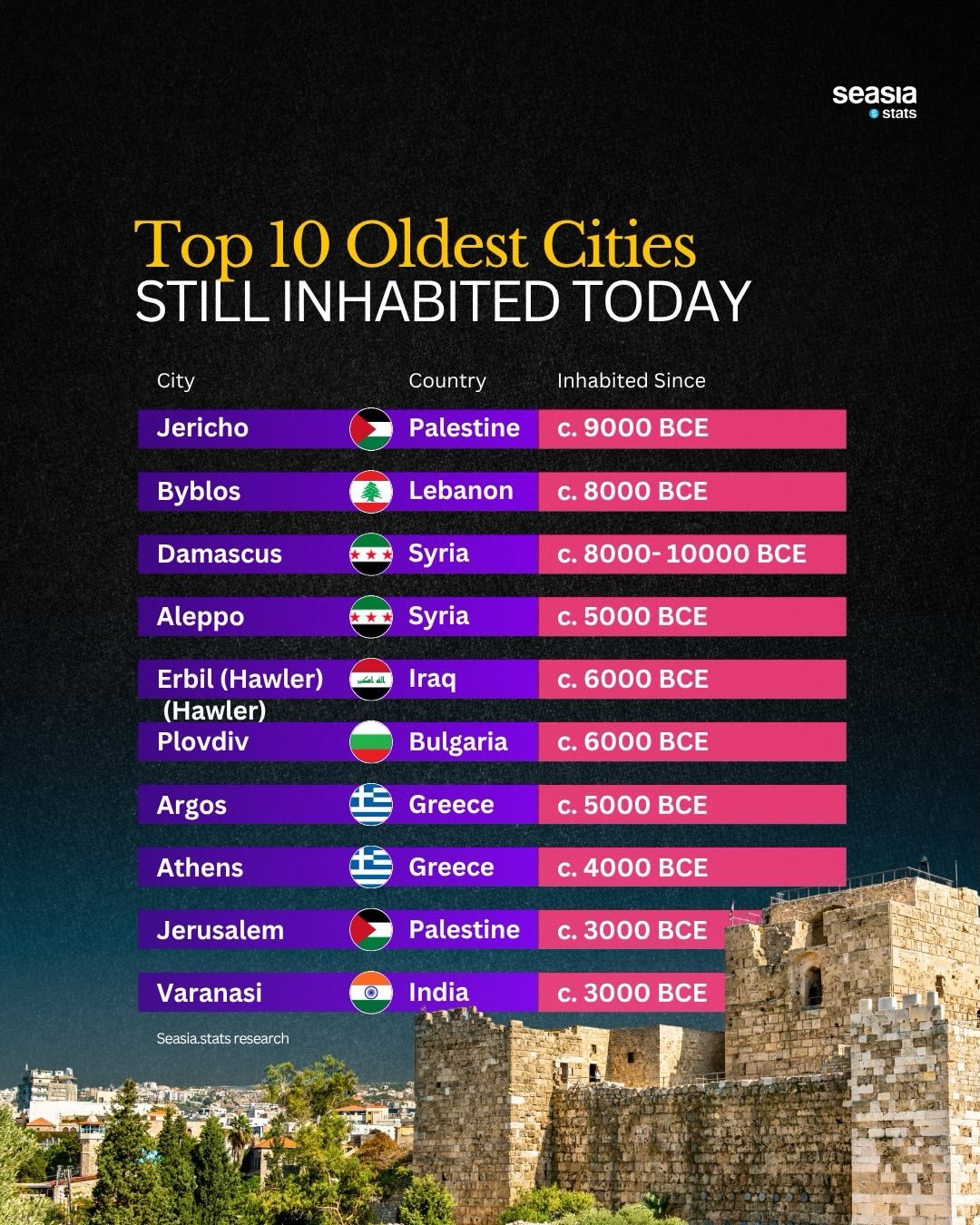
Human civilization has produced countless cities over thousands of years, but only a few have remained continuously inhabited since ancient times. These remarkable urban centers provide a living connection to humanity’s earliest history, preserving traditions, cultures, and architectural heritage across millennia.
Among the oldest is Jericho, located in modern day Palestine and believed to have been inhabited since around 9,000 BC. Often described as the world’s oldest continuously inhabited city, Jericho developed near natural springs that supported agriculture and settlement in the Jordan Valley.
Archaeologists have uncovered ancient walls and towers that reveal the sophistication of early human communities.
Another ancient city is Byblos in Lebanon, inhabited since approximately 8,000 BC. Byblos became a major Phoenician port and played an important role in Mediterranean trade. The city is also linked to the origin of the word “Bible,” reflecting its historical importance in the spread of writing and culture.
In Syria, both Damascus and Aleppo rank among the world’s oldest cities. Damascus may date back between 8,000 and 10,000 BC, making it one of the earliest urban settlements in human history.
Known for its strategic location along trade routes, the city became a center of commerce, religion, and politics for many empires. Aleppo, inhabited since around 5,000 BC, also flourished as a trading hub connecting Asia, Europe, and the Middle East.
In Iraq, Erbil has been continuously inhabited since around 6,000 BC. The city’s ancient citadel, standing on a large mound at its center, reflects thousands of years of civilization in Mesopotamia.
Europe also contains ancient urban centers. Plovdiv in Bulgaria dates back to around 6,000 BC and has been ruled by Thracians, Romans, Byzantines, and Ottomans. In Greece, Argos has existed since about 5,000 BC, while Athens, inhabited since roughly 4,000 BC, later became the birthplace of democracy and classical philosophy.
Two other historically significant cities are Jerusalem and Varanasi, both inhabited since around 3,000 BC. Jerusalem remains sacred to Judaism, Christianity, and Islam, while Varanasi is considered one of Hinduism’s holiest cities.
Together, these ancient cities demonstrate humanity’s enduring ability to build communities that survive across thousands of years of change and history.