

World's Biggest Beef Exporters
Australia often thought as the biggest exporter of beef, when it's actually on second place behind Brazil.

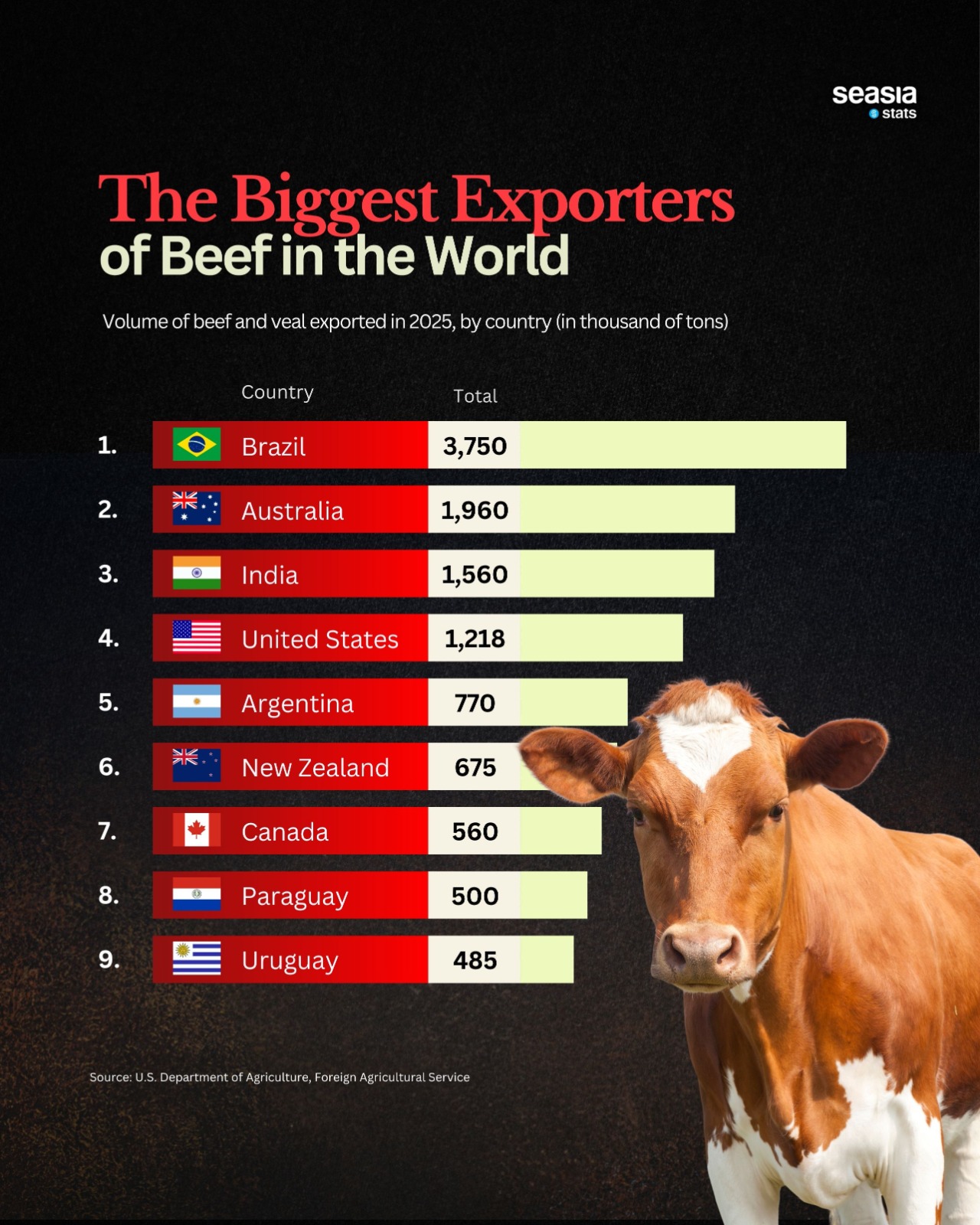
When people think of beef exporters, Australia comes to mind. The Outback, endless grasslands, the natural home of cattle ranching. But the numbers tell a different story entirely. Brazil exported 3,750 thousand tons of beef and veal in 2025 — nearly double Australia's 1,960 tons, and three times India's 1,560 tons.
This is not a recent shift. Brazil has been the world's largest beef exporter for over a decade, but the scale of its dominance has grown quietly, driven by investment in feedlots, technology, and supply chain infrastructure. While Australia and New Zealand compete for second and third place, Brazil sits alone at the top.
Brazil exports more beef than the next three largest exporters combined. It is not a competition.
Volume of beef and veal exported in 2025, by country (in thousand of tons)
- 1🇧🇷 Brazil3,750
- 2🇦🇺 Australia1,960
- 3🇮🇳 India1,560
- 4🇺🇸 United States1,218
- 5🇦🇷 Argentina770
- 6🇳🇿 New Zealand675
- 7🇨🇦 Canada560
- 8🇵🇾 Paraguay500
- 9🇺🇾 Uruguay485
The story is not just about production — it is about strategy. India ranks third despite virtually no domestic beef consumption, a reflection of its skilled processing sector and role as a processor and re-exporter of beef from other countries. Argentina, historically a beef powerhouse, ranks only fifth with 770 thousand tons. Even the United States, with vast ranching capacity, exports only 1,218 thousand tons.
Brazil's edge comes from scale, vertical integration, and the economics of land. The Cerrado and Amazon regions contain vast pasture. Cattle can be raised on marginal land unsuitable for crops. Supply chains are efficient. Meatpacking plants operate at world-class efficiency. The combination is unbeatable.
The environmental question: Brazil's beef dominance comes with a climate cost. Cattle ranching is a leading driver of deforestation in the Amazon, and beef production globally accounts for roughly 15% of global greenhouse gas emissions. As demand for Brazilian beef rises, so too does pressure on forest preservation — a tension the country has struggled to balance.
Latin America as a whole — Brazil, Argentina, Paraguay, and Uruguay combined — accounts for roughly 5,505 thousand tons of the global total, or nearly 60% of the world's beef exports. The region is the world's protein pantry, and Brazil is its undisputed anchor.