

World's Biggest Shopping Malls 2026
The United States might be the pioneer of malls, but when it's about the 12 largest ones, United States only contributes one.

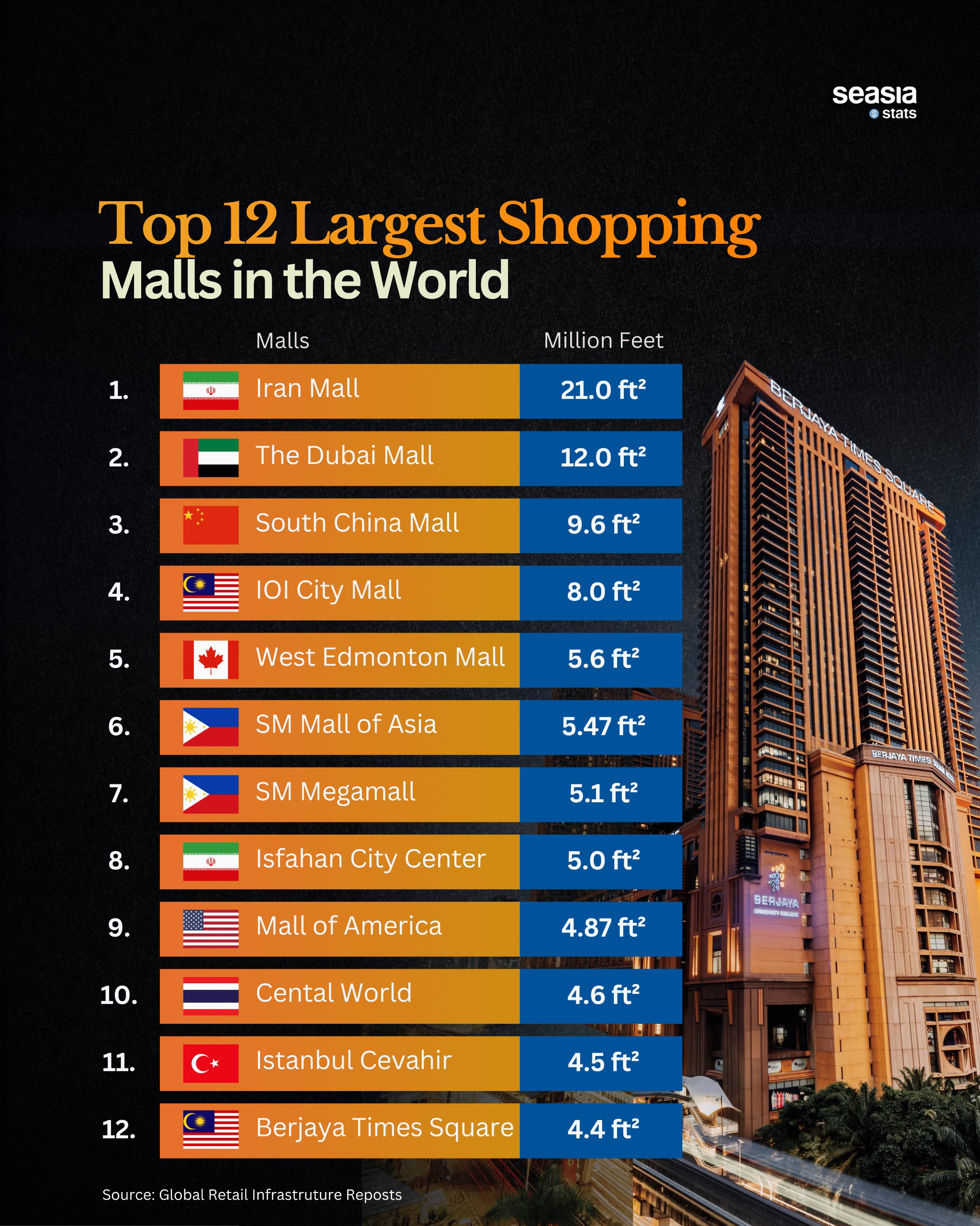
The world's largest shopping malls are not where most people expect them to be. There is no Westchester mall on this list. No sprawling American exurban colossus built in the 1980s. Instead, the map of mega-retail is drawn by Tehran, Dubai, and the East — a stark reminder that shopping centre development over the past two decades has followed capital flows and urban growth toward Asia and the Middle East.
Iran Mall dominates at 21 million square feet — nearly twice the size of Dubai Mall and vastly larger than anything in North America. The facility opened in 2020 in Tehran as a mixed-use complex combining retail, office, and hospitality. It reflects Iran's ability to mobilise capital and construct at scale despite international sanctions, and signals the country's intent to position itself as a regional retail and leisure hub.
Iran, China, and Southeast Asia are reshaping what a shopping mall means in the 21st century — and the West is not driving the conversation.
World's 12 largest shopping malls by area
- 1🇮🇷Iran Mall21.0 ft²
- 2🇦🇪The Dubai Mall12.0 ft²
- 3🇨🇳South China Mall9.6 ft²
- 4🇲🇾IOI City Mall8.0 ft²
- 5🇨🇦West Edmonton Mall5.6 ft²
- 6🇵🇭SM Mall of Asia5.47 ft²
- 7🇵🇭SM Megamall5.1 ft²
- 8🇮🇷Isfahan City Center5.0 ft²
- 9🇺🇸Mall of America4.87 ft²
- 10🇹🇭Cental World4.6 ft²
- 11🇹🇷Istanbul Cevahir4.5 ft²
- 12🇲🇾Berjaya Times Square4.4 ft²
Southeast Asia holds three entries in the top 12 — the Philippines contributes two (SM Mall of Asia at 6th, SM Megamall at 7th), while Malaysia and Thailand each add one. This concentration reflects the region's booming middle class, rapid urbanisation, and the dominance of retail real estate as both a cultural and economic anchor in major cities.
The two Philippine SM properties are not new — SM Mall of Asia opened in 2006, and SM Megamall in 1991. Their persistence at the top reflects their role as regional flagships in a nation where malls serve not just as shopping destinations but as climate-controlled social spaces, entertainment hubs, and community gathering points. In Manila and beyond, the mall is the public square.
The American collapse: Only one U.S. mall appears on this list — Mall of America at ninth place, with 4.87 million square feet. The absence of newer American mega-malls is telling: American retail development peaked in the 1990s and has fragmented since, broken up by e-commerce, changing consumer habits, and capital constraints. The age of the American super-mall is over.
The data reveals a shift in global development priorities. Where capital is flowing, where urban populations are densifying, and where retail still functions as social infrastructure — that is where the world's largest shopping destinations are being built. It is not a story about shopping; it is a story about power, demographics, and where the future of consumption will be centred.